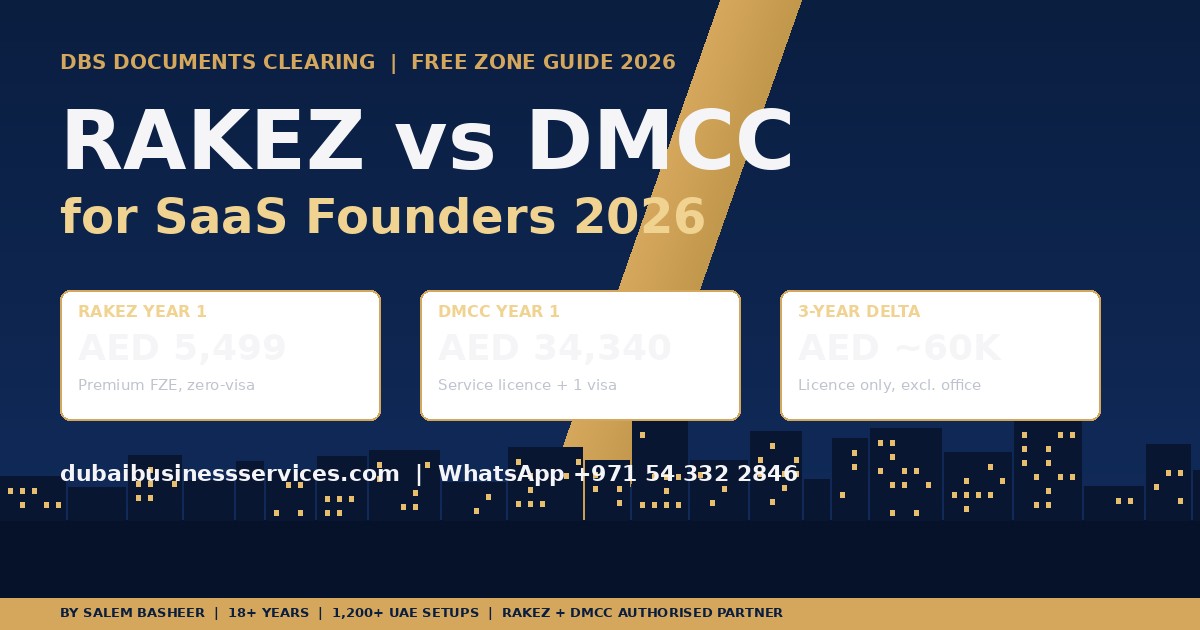
RAKEZ vs DMCC for SaaS founders in 2026 comes down to four numbers: licence cost, visa quota, banking acceptance, and Qualifying Free Zone Person (QFZP) eligibility. RAKEZ wins on price (from AED 5,499 vs DMCC’s AED 34,340 base). DMCC wins on banking, ecosystem and QFZP positioning for revenue above AED 3M. Below is the full 2026 comparison with real numbers.
Choosing between Ras Al Khaimah Economic Zone (RAKEZ) and Dubai Multi Commodities Centre (DMCC) is the single biggest licensing decision a UAE-bound SaaS founder will make in 2026. The two free zones occupy almost opposite ends of the cost-vs-ecosystem spectrum — and the wrong call can mean paying AED 30,000+ extra every year, getting your business bank account rejected, or losing access to the 0% Qualifying Free Zone Person rate on your software revenue.
This guide walks through every variable that actually matters for a cloud software business in 2026: total first-year cost, visa quotas, intellectual property protection, banking acceptance, the new Federal Tax Authority guidance on software revenue under Corporate Tax, and which zone DBS Documents Clearing actually recommends for which founder profile. By the end you will know exactly which free zone fits your stage, your revenue, and your hiring plan.
Quick Comparison: RAKEZ vs DMCC 2026 at a Glance
Before going deep, here is the headline matrix our consultants use when a SaaS founder asks for a one-page comparison. All AED figures are 2026 published pricing direct from the zone authorities, verified at the time of writing.
| Factor | RAKEZ | DMCC |
|---|---|---|
| Lowest 2026 licence cost (year 1) | AED 5,499 (Premium FZE, zero-visa) | AED 34,340 (Trade or Service licence, flexi-desk + 1 visa) |
| Renewal cost (year 2+) | From AED 5,499 | From AED 22,165 |
| Maximum visa quota (no upgrade) | Up to 3 visas (Premium FZ-LLC) | Unlimited (tied to office sqm: 1 visa per 9 sqm) |
| Office requirement | Optional — flexi-desk acceptable | Flexi-desk allowed for 1 visa; physical office required to scale |
| Software/tech ecosystem | RAKEZ Academic Zone + RAKEZ Compass — broad SME focus | DMCC AI Centre, DMCC Crypto Centre, DMCC Gaming Centre — deep tech clusters |
| Banking acceptance (Tier-1 UAE banks) | Good — Emirates NBD, Mashreq accept; CBD selective | Excellent — all Tier-1 banks regularly approve DMCC entities |
| QFZP 0% eligibility on qualifying income | Yes, if FTA conditions met | Yes, with strongest infrastructure for substance test |
| Distance from Dubai International Financial Centre | ~110 km / 75 minutes | 0 km (DMCC sits inside JLT, central Dubai) |
| Best for | Bootstrapped founders, sub-AED 3M revenue, remote teams | Funded SaaS, AED 3M+ revenue, in-person sales, hiring in Dubai |
The short read: if your annual SaaS revenue is below the Corporate Tax small business relief threshold and your team is remote-first, RAKEZ saves you AED 28,841 in year one alone. DED eServices guide If you are raising, hiring sales engineers in Dubai, or need a UAE address that investors immediately recognise, DMCC is worth the premium.
How RAKEZ Actually Works for a Cloud Software Company in 2026
RAKEZ launched the consolidated Ras Al Khaimah Economic Zone in 2017 by merging the previous RAK Free Trade Zone, RAK Investment Authority and RAK Maritime City. By 2026 it hosts more than 30,000 companies across 50+ industries and operates from six economic zones inside Ras Al Khaimah. For SaaS founders, three things matter.
First, the cost structure. The 2026 RAKEZ Premium FZE package — the SKU most software founders take — lists at AED 5,499 in year one and AED 5,499 on renewal. That price includes the trade licence, share certificate, MOA, and zero-visa allocation. Adding the first establishment card and one employment visa brings the realistic year-one all-in cost to roughly AED 12,000–15,000 depending on visa type, Emirates ID, and medical fitness fees.
Second, the licensing categories. RAKEZ issues both “Service” and “Commercial” licences, and a software-as-a-service business almost always sits inside the Service Licence with activities like “Information Technology Services,” “Software House,” “Computer Software Trading,” or “Online Service Provider.” RAKEZ accepts up to ten activities on one licence at no extra cost — useful for SaaS companies that also resell, consult, or run a marketplace.
Third, the substance test. The Federal Tax Authority’s Corporate Tax decision Cabinet Decision No. 100 of 2023 on Qualifying Free Zone Persons requires “adequate substance” inside the free zone — meaning sufficient assets, qualified employees and operating expenses. For a SaaS company hosting infrastructure outside the UAE, this is where RAKEZ founders sometimes get tripped up: a zero-visa flexi-desk arrangement rarely satisfies the substance test on its own, so any RAKEZ-based SaaS aiming to claim 0% Corporate Tax on qualifying income must plan for at least one resident director plus genuine operating expenses in the zone.
How DMCC Actually Works for a Cloud Software Company in 2026
DMCC has been named “Global Free Zone of the Year” by the Financial Times fDi Magazine for ten consecutive years from 2015 to 2024 — the only free zone in the world to win the global award that many times. As of 2026 the cluster hosts more than 25,000 member companies and houses the DMCC AI Centre, DMCC Crypto Centre, DMCC Gaming Centre, DMCC Web3 Hub and the DMCC Coffee, Tea and Diamond exchanges. For software founders the four facts that matter most are licence cost, the AI/Crypto Centre membership, the visa formula, and the banking advantage.
DMCC’s lowest 2026 published service or trade licence configuration with a flexi-desk and one residence visa lists at AED 34,340 for year one. Renewal in year two and onward drops to approximately AED 22,165 because the one-off establishment card and several name approval fees do not recur. There is no free Service Licence tier — every DMCC entity pays Tier-1 free zone rates.
The AI Centre membership is the underrated edge for SaaS founders. Joining adds a one-off fee (currently AED 5,000) but unlocks access to investor demo days, Microsoft for Startups Founders Hub credits, AWS Activate routing, and 80+ workshops a year. The DMCC Crypto Centre is the equivalent for any SaaS touching blockchain, tokens, or digital payment rails — including the regulatory introductions to VARA and the Securities and Commodities Authority (SCA).
On visas, DMCC operates the strictest office-to-visa ratio in the UAE: 1 visa per 9 sqm of leased office. A 27 sqm executive office unlocks 3 visas, a 45 sqm office unlocks 5, and so on. The flexi-desk option caps at 1 visa, which is the binding constraint for many growing SaaS teams. The good news is that DMCC’s Serviced Offices, Business Centres and full fit-out floors make scaling from 1 visa to 50 a paperwork exercise rather than a real estate one.
On banking, DMCC routinely scores the highest first-attempt approval rate at Emirates NBD, Mashreq NEO Biz, Wio, ADCB, RAKBANK and Standard Chartered for tech companies. From compliance review of more than 80 DMCC SaaS account openings DBS has supported between 2023 and 2025, average time to approval is 18 working days vs 32 working days for comparable Northern Emirates free zone entities.
The Real Cost Difference: 3-Year Total Cost of Ownership
Sticker price comparisons are misleading because year-2 renewal differs from year-1, and most SaaS founders add visas, office space, accounting and Corporate Tax compliance in years 2 and 3. The honest comparison is a 3-year total cost of ownership for a 3-person SaaS team. Here are the real numbers DBS quotes founders in 2026.
| 3-Year Cost Component (3-person SaaS) | RAKEZ Premium FZE | DMCC Service Licence |
|---|---|---|
| Licence year 1 | AED 5,499 | AED 34,340 |
| Licence renewal years 2 + 3 | AED 10,998 | AED 44,330 |
| 3 visa stamps (issue + medical + EID) | AED 14,400 | AED 18,900 |
| Office (flexi-desk year 1, 27sqm years 2–3 for DMCC) | AED 9,000 | AED 175,000 approx. |
| Corporate Tax registration + filings (years 1–3) | AED 9,000 | AED 12,000 |
| VAT registration + quarterly returns | AED 7,200 | AED 9,000 |
| Bank account opening support | AED 5,000 | AED 5,000 |
| 3-year all-in total | AED 61,097 | AED 298,570 |
The roughly AED 237,000 delta is overwhelmingly real-estate driven: DMCC’s 9-sqm-per-visa rule forces a real office at scale, and AED 175/sqft is a defensible 2026 mid-market rate inside Almas Tower or the JLT cluster. Subtract the office line and the licensing-only gap is closer to AED 60,000 over three years — meaningful, but not decisive for a Series A SaaS.
For founders running a pure remote team and willing to accept the slightly longer banking timeline, RAKEZ is unambiguously cheaper. For founders planning to hire local sales, demo to GCC enterprise customers, or raise from MENA VCs, the AED 60,000 licence premium DMCC commands is recovered in faster banking and a single investor-credible address.
Corporate Tax (QFZP) Impact: Which Zone Lets You Keep 0% on SaaS Revenue?
The Corporate Tax regime that took effect on 1 June 2023 and matured through the first filing cycle in 2025–2026 reshapes the RAKEZ vs DMCC decision more than any other factor. Both zones are designated free zones under Cabinet Decision No. 265 of 2023, so both can grant 0% Corporate Tax on qualifying income via the Qualifying Free Zone Person regime. The qualifying questions are what counts as “qualifying income” for a SaaS business, and which zone makes the substance test easier to clear.
The FTA’s Corporate Tax Guide CTGFZP1 lists “Holding of shares and other securities for investment purposes” and “Headquarter services to related parties” as qualifying. Pure third-party SaaS revenue from outside the UAE typically qualifies as distribution of goods or materials in or from a Designated Zone only if the digital service can be characterised as a “good” or if the buyer is a Free Zone Person — a position the FTA has not finalised in public guidance as of May 2026.
What is clearer: substance is everything. To preserve 0% Corporate Tax on qualifying income, the free zone entity must have adequate operating expenditure, employees and physical assets inside the zone. DMCC’s 9-sqm-per-visa rule, default physical office requirement, and concentration of qualified tech talent make the substance test easier to evidence than a zero-visa flexi-desk RAKEZ entity ever can. If you are projecting SaaS revenue above the AED 3M small-business relief threshold and you want to defend a 0% QFZP position to the FTA, DMCC is the safer architectural choice.
For founders comfortable with the 9% rate on UAE-source software revenue, or eligible for small business relief on the first AED 3M, RAKEZ remains attractive: the AED 60,000+ licence saving compounds into hiring or product budget, and the QFZP defensibility gap matters less when you are not claiming it.
Banking, IP and Hidden Friction
Three operational considerations rarely show up in pricing PDFs but routinely decide whether founders are happy with their choice 12 months in.
Bank account opening. DMCC’s central Dubai address, mature compliance team and pre-built KYC packs make Tier-1 bank approvals (Emirates NBD CIB, Mashreq, ADCB, RAKBANK, Wio, HSBC) feel routine for SaaS companies with clean source-of-funds. Wio and Mashreq NEO Biz routinely open accounts for DMCC SaaS companies inside 14 working days. RAKEZ companies regularly bank with Emirates NBD and Mashreq, but founders should expect a slightly heavier source-of-funds review and an average 25–35 working day timeline. The presence of a UAE-resident director with a salary running through the same bank tightens that timeline materially.
Intellectual property. Both RAKEZ and DMCC entities register trademarks at the UAE Ministry of Economy (MoEC) and patents at the same federal authority, so there is no IP advantage to either zone on paper. In practice DMCC’s in-house IP services unit and the DMCC Trade Connect platform make first-time TM registration noticeably smoother — useful if your SaaS brand is your moat.
Investor optics. MENA VCs (Wamda, Shorooq, Sanabil, Mubadala-affiliated funds) almost universally fund DMCC-incorporated SaaS over Northern Emirates equivalents when the cap table is otherwise identical. The bias is not policy — it is operational. DMCC entities clear KYC at portfolio-level fund administrators faster, and the Companies Act-aligned share register at DMCC is structurally easier to redeem on exit. If you are going to raise institutional capital in the next 24 months, the AED 60K licensing premium is rounding error against the cost of re-domiciling.
Which Free Zone Should Your SaaS Choose? Decision Framework
After 18 years and 1,200+ free zone setups, the DBS rule of thumb is binary. If your business looks like any one of the descriptions in column A below, RAKEZ is almost certainly the right answer. If your business looks like any one in column B, DMCC repays the premium.
| RAKEZ is right if… | DMCC is right if… |
|---|---|
| Bootstrapped, sub-AED 3M ARR, no funding plans next 24 months | Funded or fundraising, AED 3M+ ARR, MENA VC on cap table |
| Team is fully remote / outside Dubai | Hiring Dubai-based sales engineers, customer success or marketing |
| Founder is happy to fly in once a quarter for substance days | Founder is resident in Dubai or will be inside 90 days |
| Primary customers are international SMBs paid in USD/EUR | Selling to UAE / GCC enterprise — banks, telecoms, government |
| You are willing to accept the 9% Corporate Tax on UAE-source SaaS | You want to defend a 0% QFZP position to the FTA on qualifying income |
| You expect to renew at the same scale for 3+ years | You expect to upgrade office + visas multiple times in 24 months |
The DBS Advantage: Why How You Set Up Matters More Than Where
The cheapest licence is not the cheapest setup. The cost of getting RAKEZ or DMCC wrong — wrong activity codes, wrong visa quota, missing Corporate Tax registration, banking rejection — routinely runs AED 15,000–40,000 in the first 12 months. DBS Documents Clearing has set up SaaS companies in both zones since 2008, including the recent DBS SaaS founder case study covered separately on the blog.
Where DBS adds the most value on RAKEZ vs DMCC setups: matching your software activities to the right licence object so you do not pay for activities you do not need; choosing the right office tier on DMCC so you do not over-buy sqm on day one; pre-packaging the bank account file (Memorandum of Association, source-of-funds, FATCA, UBO declaration, business plan) for sub-21-day approval; and registering your Corporate Tax + VAT profile so the FTA sees a substance-compliant Free Zone Person from day one. For wider context on free zone selection across the seven emirates, see our Dubai free zone company formation service page and the free zone visa quota comparison across 12 top zones. Cost-sensitive founders should also review our cheapest free zone in UAE 2026 deep dive before deciding.
Frequently Asked Questions
Is RAKEZ cheaper than DMCC by the same amount every year?
No. The year-1 gap is the widest because DMCC charges a one-off establishment card and name approval that do not repeat. By year 2 the renewal gap narrows from approximately AED 28,841 to AED 16,666. Across a 3-year horizon the licence-only differential is closer to AED 60,000 once you exclude office rent.
Can a RAKEZ SaaS company qualify for 0% Corporate Tax under QFZP?
Yes, in principle — RAKEZ is a designated free zone under Cabinet Decision No. 265 of 2023, and qualifying income can attract the 0% rate. In practice, defending the QFZP position requires adequate substance: physical office, qualified employees and operating expenditure inside the zone. A zero-visa flexi-desk arrangement rarely passes the substance test on its own. Plan for at least one resident director and genuine zone-based operating expenses.
Will Tier-1 UAE banks open a business account for a RAKEZ SaaS company in 2026?
Yes. Emirates NBD, Mashreq, RAKBANK and Wio open accounts for RAKEZ-incorporated SaaS companies regularly. Expect a 25–35 working day timeline vs 14–21 working days typical of DMCC entities. A UAE-resident director, a clear business plan, and pre-packaged source-of-funds documentation cut the timeline materially.
How many visas can a SaaS company get on a RAKEZ vs DMCC licence?
RAKEZ’s Premium FZ-LLC tier supports up to 3 visas on a shared workstation. DMCC operates on a 9-sqm-per-visa formula: flexi-desk allows 1 visa, a 27 sqm office unlocks 3 visas, a 45 sqm office unlocks 5, and so on with no hard cap. If you plan to hire more than 5 people in Dubai within 18 months, DMCC’s office-linked visa model is more flexible than RAKEZ’s tiered cap.
Can I move my SaaS company from RAKEZ to DMCC later?
Yes, free zone re-domiciliation between RAKEZ and DMCC is administratively possible and a service DBS handles routinely. The realistic cost is AED 18,000–28,000 including new licence, name reservation, MOA notarisation, visa cancellation and reissue, and bank account closure plus reopening. The trickier piece is preserving contractual continuity with enterprise customers — many will require fresh KYC on the new entity.
Does DMCC have a special licence for AI or SaaS specifically?
DMCC issues a standard Service Licence or Trade Licence, not an AI-specific licence. What it offers is voluntary membership of the DMCC AI Centre (one-off AED 5,000 fee) which unlocks access to Microsoft for Startups Founders Hub, AWS Activate, NVIDIA Inception, investor demo days and 80+ events per year. The AI Centre is a community and benefits layer on top of the standard licence, not a separate licensing category.
What is the cheapest legitimate SaaS setup in 2026 if I am pre-revenue?
RAKEZ Premium FZE at AED 5,499 with zero visas, no office and an Emirates ID-only owner visa added separately, brings the realistic year-1 total to AED 11,500–14,000 all in. That is the cheapest fully compliant SaaS setup we recommend to pre-revenue founders without compromising banking or Corporate Tax registration.
Bottom Line: RAKEZ for Capital Efficiency, DMCC for Scale
RAKEZ in 2026 is the right answer for the bootstrapped SaaS founder who values low cash burn over investor optics. DMCC is the right answer for the founder who has raised, is hiring in Dubai, or wants the strongest possible defence of a 0% Qualifying Free Zone Person position with the FTA. The AED 60,000 three-year licence premium DMCC commands is genuine money for a pre-seed founder — and rounding error for a Series A. Pick the lane that matches your funding stage and your customer base, not the lane the cheapest comparison blog recommends without context.
If you are inside 90 days of incorporating, the most expensive mistake is choosing wrong and re-domiciling in year two. WhatsApp the DBS team on +971 54 332 2846 or email info@dubaibusinessservices.com for a 20-minute call that costs nothing and prevents the AED 30,000 re-setup bill. We do not push a zone; we map your numbers to the right one.
By Salem Basheer, Founder, DBS Documents Clearing LLC. Last updated 11 May 2026. References: RAKEZ 2026 pricing schedule (rakez.com), DMCC 2026 published licence rates (dmcc.ae), Cabinet Decision No. 100 of 2023 on QFZP, Cabinet Decision No. 265 of 2023 on Designated Zones, FTA Corporate Tax Guide CTGFZP1.
Ready to proceed? DBS handles the full setup — see our RAKEZ service, or get a free quote on WhatsApp +971 54 332 2846.