Last updated: 2026-05-20
The small business relief uae regime lets UAE-resident companies and natural persons with revenue at or below AED 3,000,000 per tax period elect to have their taxable income treated as zero under Ministerial Decision No. 73 of 2023. The relief is available for every tax period beginning on or after 1 June 2023 and ending on or before 31 December 2026, after which it expires unless the Federal Tax Authority extends it. DBS Group, serving 80,000+ UAE entrepreneurs since 2009, has helped Mainland LLCs and freelance permit holders elect this relief on their first corporate tax return and save up to AED 248,750 in tax across the four-year window.
What Is the UAE Small Business Relief? (Quick Definition)
Small Business Relief (SBR) is an elective tax simplification introduced by the UAE Ministry of Finance under Ministerial Decision No. 73 of 2023, issued on 3 April 2023 in line with Article 21 of Federal Decree-Law No. 47 of 2022 (“the UAE Corporate Tax Law”). Under SBR, a “Taxable Person” who is a UAE Resident — whether a natural person carrying on a business or a juridical person such as a Mainland LLC, a non-qualifying Free Zone Person, or a branch — may elect to have their Taxable Income for the relevant Tax Period treated as nil. In plain English: their corporate tax bill on profits from that tax period becomes AED 0.
The relief is not automatic. It is an annual election made by ticking a box on the Corporate Tax return submitted to the Federal Tax Authority via the EmaraTax portal. If the election is not made for a given tax period, the Taxable Person is taxed normally under Article 3 of the Corporate Tax Law: 0% on the first AED 375,000 of Taxable Income and 9% on the balance.
Want a quote? WhatsApp +971 54 332 2846 →
The 7 Rules That Govern Small Business Relief in 2026
Every UAE-resident business owner considering SBR for the 2025 or 2026 tax periods must satisfy seven cumulative conditions. Miss even one and the election is void — and the Federal Tax Authority will reassess your corporate tax based on full Taxable Income, plus administrative penalties under Cabinet Decision No. 75 of 2023.
- Revenue ceiling — AED 3,000,000 per Tax Period. The Taxable Person’s Revenue (gross income, not profit) in the current Tax Period and in every previous Tax Period since 1 June 2023 must be at or below AED 3 million. Article 2 of Ministerial Decision No. 73 of 2023 is explicit on this cumulative lookback.
- UAE-resident status only. Non-residents — including foreign companies operating in the UAE via a Permanent Establishment — cannot elect SBR. UAE residency is defined in Article 11 of the Corporate Tax Law.
- Not a Qualifying Free Zone Person. Companies registered in any of the 45+ UAE Free Zones (DMCC, IFZA, Meydan, RAKEZ, JAFZA, SHAMS, DSO, etc.) that hold QFZP status and pay 0% on Qualifying Income are excluded. They already pay 0% — SBR would be a downgrade.
- Not a Constituent Company of a Multinational Enterprise Group. If your UAE entity is part of an MNE Group with consolidated global revenue ≥ EUR 750 million (the OECD Pillar Two threshold), SBR is unavailable.
- Tax Period ends on or before 31 December 2026. Article 5 of Ministerial Decision No. 73 sunsets the relief. A tax period starting 1 January 2027 cannot use SBR unless the Cabinet extends the regime.
- Election made on the Corporate Tax return. The SBR box on the EmaraTax Corporate Tax return must be ticked within 9 months of the Tax Period end. A late return is treated as no election made.
- Honest revenue accounting. Artificial revenue fragmentation across multiple entities to stay below AED 3M is a General Anti-Abuse Rule (GAAR) violation under Article 50 of the Corporate Tax Law and triggers reassessment plus penalties up to 300% of evaded tax.
Confused about this? Ask DBS — WhatsApp +971 54 332 2846 →
The AED 3M Revenue Threshold — How the FTA Actually Calculates It
The most misunderstood rule among Dubai SMEs is the AED 3 million revenue test. Three points DBS sees clients trip over every quarter:
It is revenue, not profit. Revenue = total gross income from your trade licence activities before deducting any expenses. A consultancy that invoices AED 2.9M and incurs AED 2.5M of costs (so AED 400k profit) is eligible. A consultancy that invoices AED 3.1M but earns only AED 200k profit is not eligible — even though the higher-profit example would owe more tax under the normal regime.
It is per Tax Period, but with a cumulative lookback. Per Article 2 of Ministerial Decision No. 73 of 2023, you must satisfy the AED 3M test for the current Tax Period and have satisfied it for every preceding Tax Period since 1 June 2023. If your 2024 financial year revenue was AED 3.2M, you are permanently ineligible — even if your 2025 revenue falls back to AED 2.5M.
Revenue is recognised under IFRS or the FTA cash-basis option. Cabinet Decision No. 114 of 2023 lets businesses below AED 3M revenue use the cash basis rather than full IFRS accrual accounting. If you use cash basis, “revenue” means cash actually received during the Tax Period. If you use accrual, it is invoiced amounts. Pick one and apply it consistently — switching mid-stream is a red flag in any FTA audit.
Worked Example: A Dubai Mainland Consultancy in 2025
Faisal runs a UAE Mainland LLC under a DED management consultancy licence. His financial year matches the calendar year. Compare two scenarios for FY2025 (Tax Period 1 January 2025 – 31 December 2025):
| Item | Without SBR election | With SBR election |
|---|---|---|
| Revenue (FY2025) | AED 2,800,000 | AED 2,800,000 |
| Allowable expenses | AED 1,950,000 | AED 1,950,000 |
| Net Taxable Income | AED 850,000 | AED 0 (deemed) |
| 0% bracket (first AED 375k) | AED 0 | — |
| 9% on AED 475,000 | AED 42,750 | — |
| Corporate Tax due | AED 42,750 | AED 0 |
| DBS filing fee | AED 2,500 | AED 1,500 |
| Total cost of compliance | AED 45,250 | AED 1,500 |
Faisal saves AED 43,750 in cash for FY2025 by electing SBR. Across the three remaining Tax Periods (FY2025, FY2026 — SBR sunsets after that), a steady AED 2.8M consultancy could realistically save AED 80,000–AED 130,000 depending on cost structure.
Ready to start? WhatsApp +971 54 332 2846 →
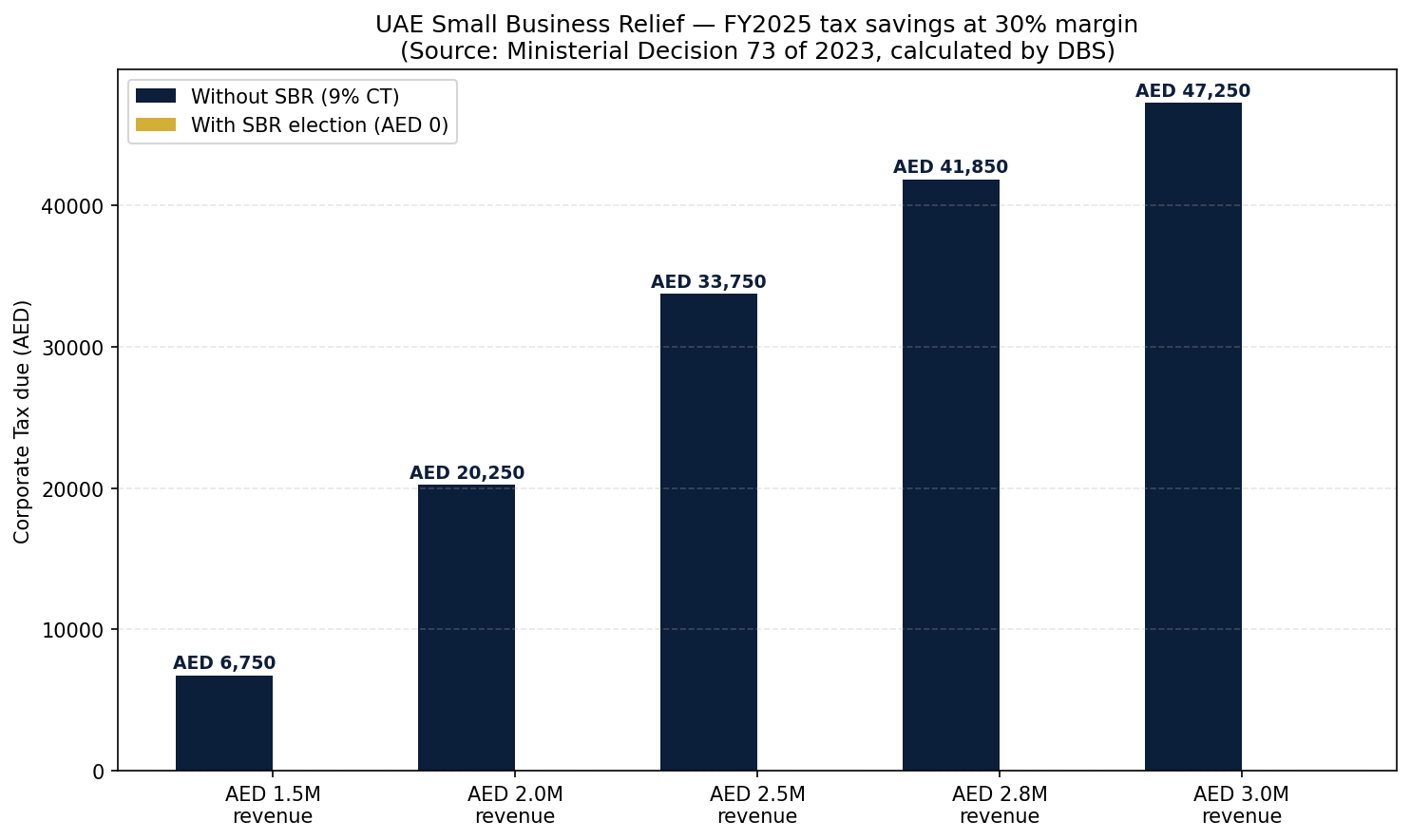
Embed this infographic — copy the code below to share on your site with attribution back to DBS:
<a href="https://www.dubaibusinessservices.com/small-business-relief-uae-2026/">
  <img src="https://www.dubaibusinessservices.com/wp-content/uploads/2026/05/sbr-savings-comparison-uae-2026.png" alt="UAE Small Business Relief 2026 savings comparison | Dubai Business Services" />
</a>
Who CANNOT Use Small Business Relief — The 4 Excluded Categories
Article 4 of Ministerial Decision No. 73 of 2023 is unambiguous: certain Taxable Persons are blocked from electing SBR even if their revenue is under AED 3 million. For more details, see our DED online services.
- Qualifying Free Zone Persons (QFZPs). If your IFZA, DMCC, JAFZA, RAKEZ, Meydan or other Free Zone company has elected QFZP status, you already enjoy 0% on Qualifying Income. SBR would force you to surrender QFZP for the year — a net negative.
- Members of Multinational Enterprise (MNE) Groups. If you are part of a corporate group whose ultimate parent files consolidated financial statements showing global revenue ≥ EUR 750 million, you are an MNE Group member under the OECD/G20 BEPS Pillar Two framework, and SBR is unavailable. This catches UAE subsidiaries of Fortune 500 firms.
- Non-resident persons. Foreign companies with a UAE Permanent Establishment, and non-resident natural persons earning UAE-sourced State-sourced income, fall outside Article 11 residency and so outside SBR.
- Exempt persons. Government entities, UAE pension funds, qualifying investment funds and certain Public Benefit Entities under Article 4 of the Corporate Tax Law are already exempt and have no need for SBR.
Save 40 hours — let DBS handle it. WhatsApp +971 54 332 2846 →
The 2026 Sunset — What Happens After 31 December 2026
The single most important date for any SBR planner: 31 December 2026. Article 5 of Ministerial Decision No. 73 of 2023 caps the regime at “Tax Periods ending on or before 31 December 2026”. A Tax Period beginning 1 January 2027 (or any calendar quarter onward) cannot benefit from SBR unless the UAE Cabinet issues a new decision extending the window.
As of May 2026, the Ministry of Finance has not issued any consultation paper indicating an SBR extension. UAE entrepreneurs should therefore plan as if FY2026 is the last possible SBR election. For most Dubai SMEs on a calendar-year Tax Period, this means:
- FY2025 (1 Jan – 31 Dec 2025): SBR available if revenue ≤ AED 3M.
- FY2026 (1 Jan – 31 Dec 2026): SBR available if revenue ≤ AED 3M.
- FY2027 (1 Jan – 31 Dec 2027): No SBR. Full 9% regime applies on Taxable Income above AED 375,000.
Plan for the cliff. A consultancy on AED 2.9M revenue and 30% margin (AED 870k Taxable Income) goes from AED 0 corporate tax in FY2026 to AED 44,550 in FY2027 — a budget shock if not modelled. DBS recommends every SBR client run a 13-month post-sunset cash-flow forecast by Q3 2026.
How to Elect Small Business Relief on Your Corporate Tax Return
The mechanical steps to claim SBR for the 2025 Tax Period (deadline: 30 September 2026 for calendar-year filers, i.e. 9 months after Tax Period end per Article 53 of the Corporate Tax Law):
- Confirm Corporate Tax registration. Your Tax Registration Number (TRN) for corporate tax must be active in EmaraTax. If not yet registered, complete registration first — registration is mandatory regardless of SBR eligibility.
- Close your books on Tax Period end date. Reconcile bank statements, accruals, and any related-party balances. If using cash basis, ensure all received revenue is captured.
- Verify the AED 3M revenue test. Pull a full revenue report for the current Tax Period and every prior Tax Period since 1 June 2023. Document evidence — invoices, bank credits, EmaraTax VAT returns — in a single audit folder.
- Confirm no exclusion applies. Run the 4-check exclusion test: QFZP status, MNE Group membership, non-resident status, exempt person status. Document the result in writing.
- Prepare the Corporate Tax return on EmaraTax. Use Form CT-101. The SBR election appears as a tickbox in the “Elections” section — confirm the supporting attestation that all conditions are met.
- File within 9 months of Tax Period end. For a Tax Period ending 31 December 2025, the deadline is 30 September 2026. Late filing voids the SBR election and triggers a fixed penalty of AED 500 per month (max AED 10,000) under Cabinet Decision No. 75 of 2023, plus the original tax becomes due.
- Retain records for 7 years. Article 56 of the Corporate Tax Law requires accounting and tax records to be retained for 7 years from Tax Period end. The FTA may audit any SBR election within that window.
Need help with this step? WhatsApp DBS at +971 54 332 2846 →
Hidden Cost of SBR — Loss and Interest Carry-Forward Lockout
The 10x DBS insight that the alaan.com and abbasaccounting.com blogs miss: SBR is not a free lunch. When you elect SBR for a Tax Period, Article 6 of Ministerial Decision No. 73 of 2023 imposes two material restrictions on your tax position:
- Tax losses cannot be carried forward. If your business made an accounting loss in the SBR Tax Period, you may not carry that loss forward to offset future Taxable Income. Under the normal regime, Article 37 of the Corporate Tax Law lets you carry losses indefinitely (subject to a 75% utilisation cap per future year).
- Net Interest Expenditure cannot be carried forward. Article 30 of the Corporate Tax Law allows businesses to carry forward Net Interest Expenditure that exceeds 30% of EBITDA. SBR election disables this — any unrelieved interest expense in an SBR year is permanently lost.
For most cash-positive, low-leverage SMEs at AED 2.8M revenue with healthy margins, this lockout is irrelevant. But for capital-intensive businesses — a Mainland trading LLC with heavy inventory finance, or a construction subcontractor with project losses — electing SBR in a loss year can be a strategic mistake. DBS runs a “should you elect” model on every client engagement.
DBS Advantage — How We Handle SBR for Dubai SMEs
Of the 80,000+ Dubai business setups DBS has supported since 2009, approximately 41% currently sit below the AED 3M revenue threshold — Mainland consultancies, IFZA solo founders, Meydan ecommerce starters, and DED-licensed freelancers. Our standard Corporate Tax filing engagement for these clients includes:
- SBR eligibility review (AED 750). 90-minute review of revenue history, residency status, group structure, and Free Zone election. Output: a written eligibility memo you can attach to your Corporate Tax return as audit-defence evidence.
- Election strategy decision (AED 1,250). Cash-flow model comparing SBR election vs. normal regime over the remaining 2025–2026 Tax Periods, with sensitivity scenarios on revenue growth and the 2027 cliff.
- Corporate Tax return preparation (AED 1,500 – AED 3,500). Full Form CT-101 preparation on EmaraTax, including supporting schedules, documentation pack and electronic submission.
- Post-filing audit support (included). If the FTA opens a query within the 7-year retention window, DBS responds on your behalf using the original eligibility memo.
Skip the paperwork — WhatsApp DBS at +971 54 332 2846 →
Frequently Asked Questions about Small Business Relief UAE 2026
How much can a Dubai SME save under Small Business Relief in 2026?
A UAE-resident business at the AED 3 million revenue cap with a 30% net margin (AED 900,000 Taxable Income) saves approximately AED 47,250 in Corporate Tax for that Tax Period — calculated as 9% on the AED 525,000 above the AED 375,000 zero-rate bracket. Across the FY2025 and FY2026 Tax Periods combined, total SBR savings for a steady-state AED 2.9M consultancy can exceed AED 90,000 in cash.
Is Small Business Relief automatic, or do I need to apply?
SBR is never automatic. Article 2 of Ministerial Decision No. 73 of 2023 makes it an annual election that must be ticked on each Corporate Tax return submitted to the Federal Tax Authority via EmaraTax. The election must be made within 9 months of the Tax Period end — so by 30 September 2026 for the FY2025 Tax Period.
Does Small Business Relief apply to Free Zone companies?
SBR applies to Free Zone companies that are not Qualifying Free Zone Persons (QFZPs). If your DMCC, IFZA, JAFZA, RAKEZ, Meydan or other Free Zone entity has not elected QFZP status — and many small Free Zone operators have not — you can still claim SBR provided revenue stays at or below AED 3 million per Tax Period and no other exclusion applies. The QFZP rules and audit requirements are covered in our Dubai Free Zone audit requirements 2026 guide.
What is the deadline to elect Small Business Relief for 2025?
For calendar-year filers, the Tax Period ends 31 December 2025 and the Corporate Tax return is due by 30 September 2026 — 9 months after Tax Period end per Article 53 of Federal Decree-Law No. 47 of 2022. The SBR election must be made on that return. Late filing voids the election and triggers Cabinet Decision No. 75 of 2023 penalties.
Can I elect Small Business Relief one year and skip it the next?
Yes. SBR is an annual election. You can elect for FY2025, skip for FY2026 if business circumstances change, then elect again if still eligible — provided every preceding Tax Period since 1 June 2023 also satisfied the AED 3M revenue cap. Once any prior Tax Period exceeds AED 3M revenue, you are permanently ineligible.
What happens to Small Business Relief after 31 December 2026?
Article 5 of Ministerial Decision No. 73 of 2023 sunsets SBR for Tax Periods ending after 31 December 2026. Unless the UAE Cabinet issues a new decision extending the regime, businesses must plan for full 9% Corporate Tax on Taxable Income above AED 375,000 starting from their first Tax Period in 2027. As of May 2026, no extension has been announced by the Ministry of Finance.
Do I still need to register for Corporate Tax if I plan to elect SBR?
Yes — Corporate Tax registration is mandatory for every UAE Resident Taxable Person under Article 51 of the Corporate Tax Law, regardless of whether SBR will be elected. Registration must be completed before the first Tax Period ends. Failure to register on time triggers an AED 10,000 administrative penalty under Cabinet Decision No. 75 of 2023.
Does Small Business Relief cover Value Added Tax (VAT)?
No. SBR applies only to UAE Corporate Tax under Federal Decree-Law No. 47 of 2022. VAT under Federal Decree-Law No. 8 of 2017 is a separate regime — the AED 375,000 VAT mandatory registration threshold and the standard 5% VAT rate continue to apply independently, and the new UAE e-invoicing mandate phasing in 2026 sits on top of both regimes. A business under SBR for corporate tax can still be VAT-registered and must file quarterly VAT returns.
The Bottom Line — Should You Elect SBR for 2025 and 2026?
For most Dubai Mainland LLCs, IFZA solo founders and DED-licensed freelancers operating below AED 3 million revenue, SBR is a high-leverage compliance win for the FY2025 and FY2026 Tax Periods. The election cuts the corporate tax bill to zero, simplifies record-keeping, and costs nothing beyond the standard return filing fee. The two real costs — loss carry-forward lockout and the 31 December 2026 sunset — matter only for capital-intensive businesses with high leverage or for founders who do not plan for the 2027 cliff.
DBS’s recommendation for the average Dubai SME: elect SBR for FY2025, model the 2027 normal-regime impact during FY2026 budgeting, and use the savings to strengthen the cash buffer ahead of the sunset.
Talk to DBS about your 2025 Corporate Tax return today. WhatsApp +971 54 332 2846 or email inquiry@dubaibusinessservices.com. Our team handles Corporate Tax registration, SBR eligibility memos, and full Form CT-101 filing for Mainland LLCs, Free Zone companies and DED freelancers across all seven Emirates.
Authored by Salem Basheer, Managing Director, DBS Documents Clearing LLC — serving 80,000+ UAE entrepreneurs since 2009. Last updated 20 May 2026.