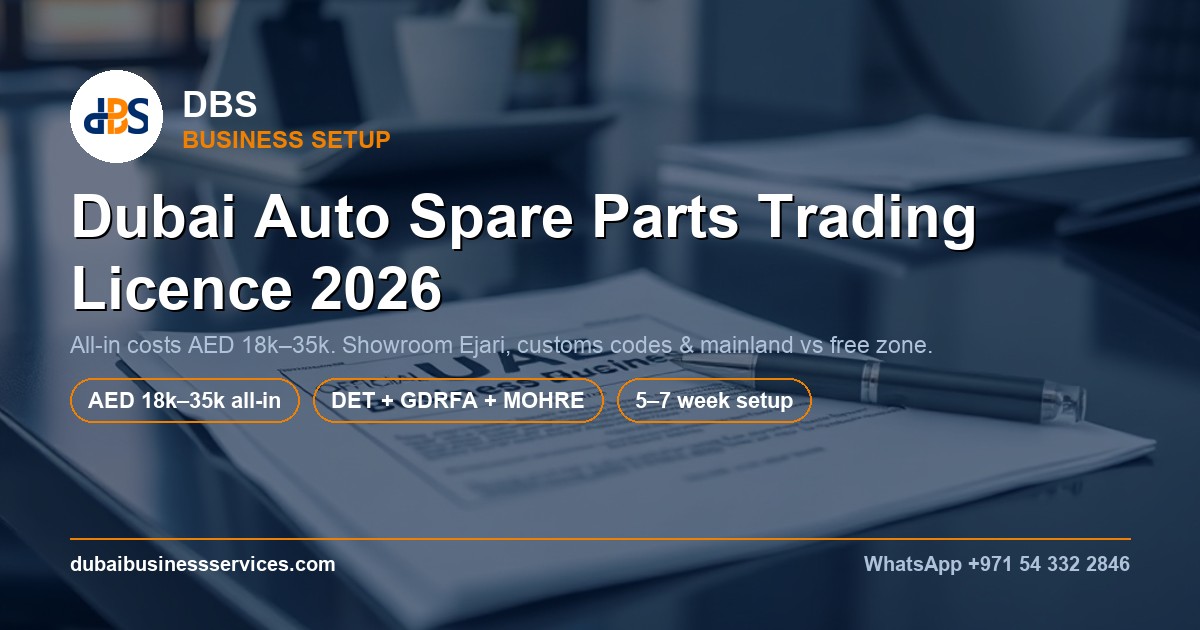
A Dubai auto spare parts trading licence costs AED 18,000–35,000 all-in (2026). You must register a showroom or warehouse via Ejari, obtain a customs code from the General Department of Residency and Foreign Affairs (GDRFA), and comply with DET and MOHRE regulations. Mainland and free-zone structures suit different import volumes and margins.
What Is a Dubai Auto Spare Parts Trading Licence?
An auto spare parts trading licence permits you to buy, stock, and distribute genuine and aftermarket automotive components across the UAE. This falls under activity code 4530 (wholesale of motor vehicle parts and accessories). Whether you’re sourcing from international suppliers or reselling locally, your Dubai business setup must be licensed by the Department of Economy and Tourism (DET) and comply with Ministry of Human Resources and Emiratisation (MOHRE) labour standards if you hire staff.
Ready to verify your exact activity code and DET registration path? WhatsApp +971 54 332 2846.
Licence Cost Breakdown: AED 18,000–35,000 All-In (2026)
Your total investment spans registration, trade name approval, visa processing, and Ejari. Here’s the typical range:
| Component | AED Range | Notes |
|---|---|---|
| Trade name approval (DET) | AED 800–1,200 | Processing 2–5 days |
| Licence fee (DET, annual) | AED 3,500–6,000 | Based on capital & activity scope |
| Ejari (showroom/warehouse) | AED 4,000–8,000 | 12-month commercial lease |
| Visa & sponsorship setup | AED 2,500–5,000 | Manager + 1–2 additional staff |
| Customs code registration | AED 500–800 | GDRFA processing |
| Municipality approvals | AED 1,500–3,000 | Health, safety, signage |
| Document clearing & consultation | AED 5,000–10,000 | Dubai Business Services fee |
The AED 18,000–35,000 bracket reflects mainland Dubai. Free-zone setups (JAFZA, Jebel Ali Free Zone) may vary by zone and will be discussed below.
Showroom or Warehouse: Ejari & Location Requirements
Every auto spare parts trader must secure a physical location registered under an Ejari tenancy contract. The DET will not issue your licence without proof of a commercial premises. Your options include a retail showroom, warehouse, or combined unit.
- Showroom: Customers visit to browse parts; typically 500–1,500 sq.m. in malls or standalone units. Ejari cost roughly AED 5,000–8,000 annually.
- Warehouse: Bulk storage in industrial zones (Al Quoz, Jebel Ali); 2,000–10,000 sq.m. Industrial Ejari ranges AED 4,000–7,000 yearly.
- Combined: Showroom + warehouse under one or two adjacent Ejari contracts; AED 8,000–12,000 combined.
Your landlord must provide a no-objection letter (NOC) for DET registration. The lease must clearly state “wholesale or retail trading of motor vehicle parts.”
Stuck finding a compliant warehouse in Dubai? Our Dubai business setup consultants have direct contacts in Al Quoz and Jebel Ali.
Customs Code & Import Duties on Auto Parts
If you import spare parts from overseas suppliers, the General Department of Residency and Foreign Affairs (GDRFA) must issue you a customs code (also called an importer/exporter code). This is a prerequisite for clearing shipments through Dubai Customs.
Key points:
- Customs code: Applied for via GDRFA; AED 500–800 fee; valid for 5 years.
- HS code classification: Auto parts fall under HS codes 8708.xx (automotive parts & accessories). Your customs broker will classify each line item.
- Import duty: UAE standard tariff is 5% on most auto spare parts, unless your supplier is a Free Trade Agreement (FTA) country (e.g., India, Singapore, Egypt). FTA goods attract 0–2.5% duty.
- VAT on import: 5% VAT applies on the CIF value (cost + insurance + freight) plus duty.
Plan to engage a licensed customs broker to file import declarations (Form 1) and manage quarantine/inspection. Broker fees typically range AED 300–800 per shipment.
Mainland Dubai vs. Free-Zone Setup: Which Is Better?
Your choice between mainland and free-zone structures hinges on import volume, customer base, and profit margins.
| Factor | Mainland (DET Licensed) | Free Zone (JAFZA, etc.) |
|---|---|---|
| Licence cost (annual) | AED 3,500–6,000 | AED 5,000–10,000 |
| Ejari requirement | Mandatory (showroom/warehouse in Dubai proper) | Mandatory (inside free zone; often included in zone fee) |
| Import duty | 5% standard; FTA rates apply | 0% on re-export; 5% if sold locally |
| Local sales tax (VAT) | 5% on retail/wholesale prices | 5% applies; exemptions for re-export |
| Staff visas | MOHRE approval required; unlimited | Zone cap; typically 5–10 employees |
| Target market | UAE-wide distribution to retailers, workshops | Re-export to GCC/MENA; limited UAE domestic |
| Customs clearance | Faster; Dubai Customs integrated | Zone-controlled; slight delay for local sales |
Mainland is ideal if you’re supplying local workshops, retailers, and independent mechanics across the emirates—higher volumes, lower duty overhead.
Free zone is ideal if you’re re-exporting to regional buyers (Saudi Arabia, Qatar, Oman) or managing large import volumes where tariff deferral justifies the extra compliance.
Step-by-Step Setup Timeline (Mainland, 2026)
- Days 1–3: Secure an Ejari-registered showroom/warehouse. Obtain landlord NOC.
- Days 4–7: File trade name application with DET; receive approval.
- Days 8–14: Submit licence application (DET) with Ejari, capital proof, and activity details.
- Days 15–21: DET issues licence. Apply for customs code (GDRFA).
- Days 22–28: MOHRE visa sponsorship if hiring employees. Health card & safety approvals.
- Days 29–35: Customs broker setup; first import clearance test run.
Total timeline: 5–7 weeks from Ejari signature to first shipment clearance, assuming no document delays.
FAQs: Your Auto Spare Parts Licence Questions Answered
Frequently asked questions
How much does an auto spare parts trading licence cost in Dubai in 2026?
Total all-in cost ranges AED 18,000–35,000, covering DET licence (AED 3,500–6,000), Ejari (AED 4,000–8,000), customs code registration (AED 500–800), visas (AED 2,500–5,000), and professional consultation (AED 5,000–10,000). Free-zone setups may differ. Contact Dubai Business Services for a tailored quote.
Do I need a showroom or warehouse for spare parts trading?
Yes, mandatory. DET requires an Ejari-registered commercial premises—either a retail showroom, warehouse, or both. Showroom Ejari costs AED 5,000–8,000 annually; industrial warehouse, AED 4,000–7,000. Your landlord must provide a no-objection letter (NOC) for DET registration.
Can I import car parts under a Dubai trading licence?
Yes. You must obtain a customs code from GDRFA (AED 500–800) and register with Dubai Customs via a licensed broker. Standard import duty is 5% on auto spare parts; FTA-sourced goods attract 0–2.5%. VAT 5% applies on the CIF value plus duty. Budget AED 300–800 per shipment for customs clearance.
Is mainland or free zone better for auto parts trading?
Mainland Dubai suits UAE-wide distribution to workshops and retailers; lower tariff overhead for frequent local sales. Free zones (JAFZA) suit re-export to GCC/MENA regions and large import volumes with tariff deferral. Mainland licence is AED 3,500–6,000 annually; free zone, AED 5,000–10,000. Choose based on your target market.
Do I need a customs code for importing spare parts?
Yes, mandatory. GDRFA issues the customs code (importer/exporter code) for AED 500–800; valid 5 years. You’ll also need an HS code classification (auto parts use HS 8708.xx). A customs broker handles import declarations and clearance; expect AED 300–800 per shipment.
What are the main costs in my first year of operation?
Initial setup: AED 18,000–35,000 (licence, Ejari, customs, visas, consultation). Operating costs: Ejari renewal (AED 4,000–8,000), customs broker fees (AED 300–800 per shipment, assume 12 shipments = AED 3,600–9,600), import duty/VAT (5–10% on goods cost), staff wages (MOHRE-compliant), and utilities. Plan a working capital buffer of AED 50,000–100,000 for initial inventory.
How long does it take to get a Dubai auto spare parts licence?
5–7 weeks from Ejari signature to operational. Timeline: Days 1–3 secure premises, Days 4–7 trade name approval (DET), Days 8–14 licence issuance, Days 15–21 customs code & visa processing, Days 22–28 customs broker setup and first clearance. Delays occur if Ejari or NOC approval slips. Dubai Business Services accelerates this; contact us for priority processing.
Get expert help in 20 minutes
Need clarity on your Dubai setup? Talk to DBS Documents Clearing LLC — 80,000+ entrepreneurs served since 2009. WhatsApp +971 54 332 2846 or email inquiry@dubaibusinessservices.com for a free 20-minute scoping call.