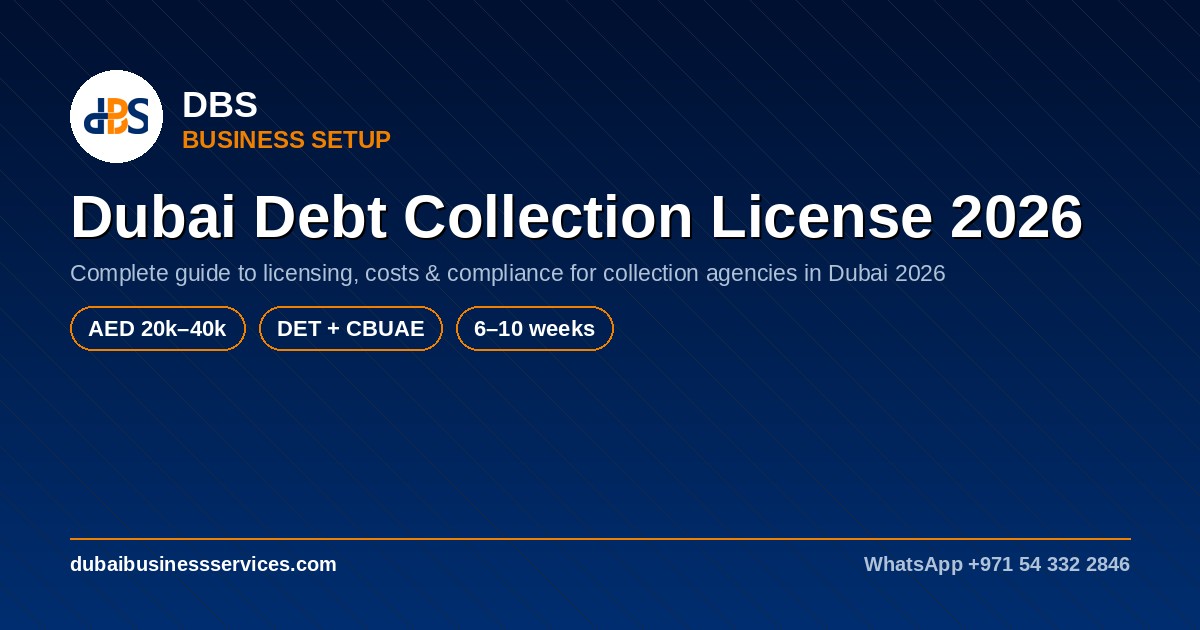
A Dubai debt collection license costs AED 20,000–40,000 all-in and requires approvals from the Department of Economy and Tourism (DET) and Central Bank of UAE (CBUAE). The typical timeline is 6–10 weeks from application to issuance. Licensing ensures your collection agency operates within UAE regulatory frameworks and protects creditor–debtor relationships.
Is a Debt Collection Business Legal in Dubai?
Yes. Debt collection is a regulated activity in the UAE. Any Dubai business setup in this sector must obtain a dedicated licence from the Department of Economy and Tourism (DET) and undergo compliance vetting by the Central Bank of UAE (CBUAE). Operating without a licence is illegal and attracts penalties up to AED 100,000 and potential prosecution under UAE Commercial Transactions Law.
Unsure about your sector’s licensing requirements? WhatsApp our team on +971 54 332 2846 for a free assessment.
Licensing Authority & Regulatory Framework
The DET issues the initial commercial licence for debt collection activities. However, the CBUAE must separately approve your business model, compliance procedures, and debt-handling protocols before you can legally operate. Both approvals are non-negotiable. The CBUAE enforces strict rules on debtor communication, interest caps, and dispute resolution under UAE Consumer Protection Law and Central Bank Board resolutions.
| Authority | Role | Timeline |
|---|---|---|
| DET | Commercial licence issuance | 3–5 weeks |
| CBUAE | Regulatory approval & compliance sign-off | 4–6 weeks |
| MOHRE (if staff hired) | Labour card & visa approval | 1–2 weeks parallel |
Parallel approvals can compress your timeline. Let our Dubai business setup consultants coordinate all touchpoints.
Cost Breakdown: AED 20,000–40,000 All-In (2026)
The all-in cost for a Dubai debt collection licence includes:
- DET licence fee: AED 1,500–3,500 (activity-specific)
- CBUAE compliance review & approval: AED 5,000–12,000
- Legal documentation & compliance manual: AED 3,000–8,000
- Security deposit (if mainland): AED 5,000–10,000
- Professional setup support & liaison: AED 5,000–10,000
Free-zone options (DMCC, RAK FZ) may cost AED 18,000–35,000 all-in due to lower overheads but may carry restricted client access outside the zone.
Mainland vs. Free Zone: Which Route?
Mainland (DET) licences allow you to operate across all of Dubai and access the broader UAE market. Free-zone licences (DMCC, RAK FZ, Jebel Ali Free Zone) offer faster setup and lower ongoing fees but typically restrict client acquisition to zone tenants or exported services. For a debt collection agency, mainland is recommended unless your client base is entirely free-zone–based. Timeline: Mainland 6–10 weeks; free zone 4–7 weeks.
Not sure which route fits your business model? Chat with us on WhatsApp +971 54 332 2846 to explore options.
Required Documents & CBUAE Compliance Dossier
Prepare the following:
- Passport, visa, and residency copies (all owners)
- CBUAE–approved collection procedures manual (templates provided by DET)
- Financial statements or bank reference letter (proof of solvency)
- Conflict-of-interest declaration
- CV & professional references (managing director)
- Proposed debtor communication policy (email, SMS, call log templates)
- Data protection & privacy compliance plan (GDPR/local equivalents)
- Audit & governance framework (internal controls)
The CBUAE will scrutinise your manual for compliance with interest-rate caps, dispute-resolution protocols, and debtor confidentiality. Incomplete dossiers trigger a 2–3 week review cycle.
Visa Eligibility, Ownership & Quotas
UAE nationals and GCC citizens can own a debt collection business with no quota limits. Expats must hold a valid UAE residency visa (3 years or renewable) and can own 100% if partnered with a local sponsor or via a Free Zone vehicle. Visa quota: typically 1 employee visa per AED 100,000 paid-up capital (DET guidance). Sponsor requirements vary—consult MOHRE for current staffing allocations in your chosen emirate.
Post-Licence: Compliance & Renewal
Once licensed, you must submit annual compliance reports to the CBUAE (due by March 31), file audited accounts with DET by June 30, and renew your commercial licence every three years. CBUAE conducts spot audits on debtor complaint handling and interest calculations. Any breach (e.g., harassment, unlawful interest charges) can result in suspension or revocation.
Your compliance roadmap matters as much as launch day. Let DBS guide you through year-one reporting and renewal.
Frequently asked questions
Is a debt collection business legal in Dubai and what license is needed?
Yes, debt collection is legal in Dubai under strict regulation. You must obtain a commercial licence from the Department of Economy and Tourism (DET) and separate regulatory approval from the Central Bank of UAE (CBUAE). Operating without both licences violates UAE Commercial Transactions Law and attracts fines up to AED 100,000 and prosecution risk.
Does a Dubai debt collection agency need Central Bank approval?
Yes, mandatory. The CBUAE must approve your business model, compliance procedures, debtor-communication protocols, and interest-rate practices before launch. This approval is separate from your DET commercial licence and typically takes 4–6 weeks. The CBUAE enforces rules on consumer protection, dispute resolution, and data confidentiality.
How much does a debt collection license cost in Dubai in 2026?
All-in costs range from AED 20,000 to AED 40,000. This covers the DET licence (AED 1,500–3,500), CBUAE approval (AED 5,000–12,000), compliance manual & legal work (AED 3,000–8,000), security deposits (AED 5,000–10,000), and setup support. Free-zone options may cost AED 18,000–35,000 but carry geographic restrictions.
What compliance rules govern collection agencies in the UAE?
Collection agencies must comply with UAE Consumer Protection Law, CBUAE Board resolutions, and interest-rate caps (max 6% per annum on consumer debts). Rules mandate fair debtor communication (no harassment), confidentiality, documented dispute resolution, annual CBUAE reporting by 31 March, and audited financial statements to DET by 30 June. Breaches trigger suspension or licence revocation.
Can a foreigner own a debt collection company in Dubai?
Yes. Expats can own 100% via a Free Zone (DMCC, RAK FZ, Jebel Ali) or partner with a local UAE sponsor on mainland. You must hold valid UAE residency (3+ years). Visa quota is typically 1 employee per AED 100,000 paid-up capital. GCC citizens face no quota limits. Consult MOHRE for current emirate-specific staffing rules.
How long does it take to set up a debt recovery firm in Dubai?
Typical timeline is 6–10 weeks for mainland licences (DET + CBUAE approvals running in parallel) and 4–7 weeks for free-zone routes. Critical milestones: DET licence 3–5 weeks, CBUAE approval 4–6 weeks, labour/visa processing 1–2 weeks. Incomplete compliance dossiers can add 2–3 weeks. Professional setup coordination compresses timelines.
What happens if I operate a debt collection business without a licence in Dubai?
Operating unlicensed is illegal and subject to fines up to AED 100,000, criminal prosecution under UAE Commercial Transactions Law, business suspension, and potential deportation for expats. Your clients’ debts may become unenforceable if collection methods are deemed unlawful. Always obtain DET and CBUAE approvals before launch.
Get expert help in 20 minutes
Need clarity on your Dubai setup? Talk to DBS Documents Clearing LLC — 80,000+ entrepreneurs served since 2009. WhatsApp +971 54 332 2846 or email inquiry@dubaibusinessservices.com for a free 20-minute scoping call.