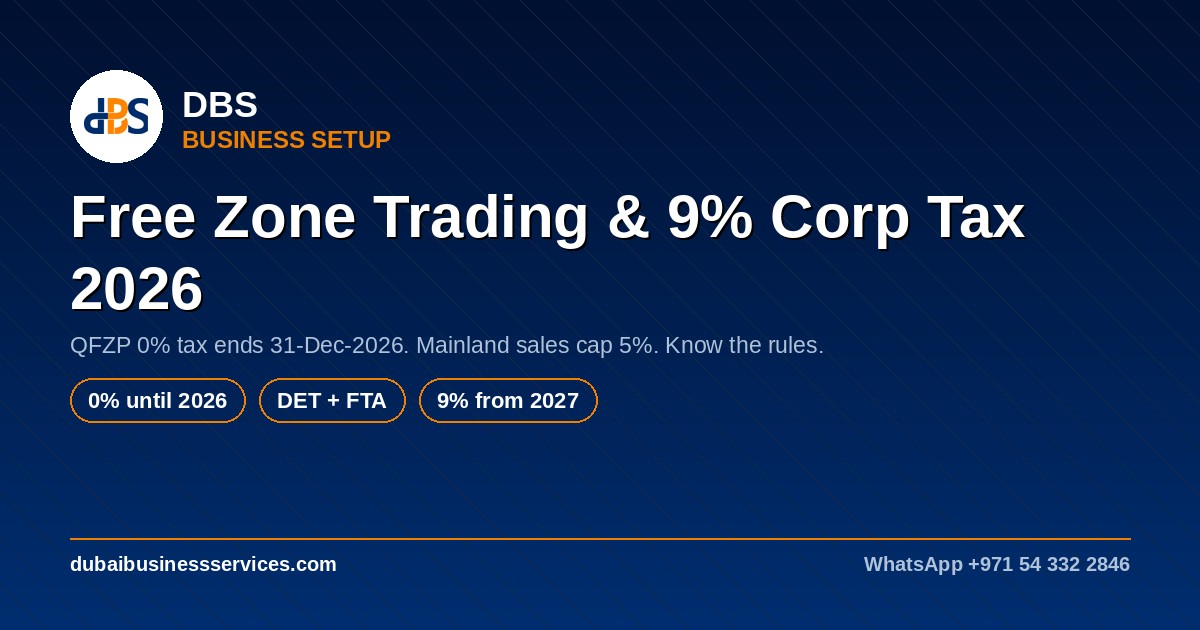
Free zone trading companies in the UAE enjoy 0% corporate tax until end-2026 under the Qualified Free Zone Person (QFZP) regime, then transition to 9% from 2027. However, Cabinet Decision 100/2023 restricts this benefit to designated trading activities listed by the Department of Economy & Tourism (DET). Revenue from non-qualifying activities or mainland customers above the de-minimis threshold (5%) triggers full UAE corporate tax at the standard rate.
Understanding Free Zone Trading & the 9% Corporate Tax Transition
The UAE introduced radical corporate tax transparency through Cabinet Decision 100/2023 and Ministerial Decision 265/2023, establishing that UAE corporate tax services for free zone traders fall into two distinct regimes: Qualified Free Zone Person (QFZP) status—offering 0% corporate tax through 31 December 2026—and the standard 9% rate that applies from 2027 onwards for all businesses. This framework fundamentally changed how trading companies, particularly in Dubai free zone setup, must structure their activities and track revenue by source and type.
Need to audit your current free zone tax classification? Contact DBS: WhatsApp +971 54 332 2846.
Designated Zone Goods & Qualifying Trading Activities
Not all free zone trading qualifies for 0% tax. The Department of Economy & Tourism (DET) publishes a Designated Zone list specifying which goods and trading activities remain QFZP-eligible. Common qualifying trading categories include importing and re-exporting commodities (minerals, metals, textiles, machinery), petroleum products distribution, and agency services for overseas principals—provided you conduct no value-added manufacturing or substantial services locally. Ministerial Decision 265/2023 explicitly excludes retail, hospitality, professional services, and mixed-model businesses unless activities are wholly contained within the designated list.
| Activity Type | QFZP Eligible (0% to 2026) | Notes |
|---|---|---|
| Import/re-export commodities | Yes | Minerals, metals, chemicals on DET list |
| Petroleum distribution | Yes | Trading only; no refining |
| Agency/brokerage services | Yes | For overseas principals |
| Retail operations | No | Always subject to 9% from 2024 |
| Professional services | No | Consulting, law, accounting taxed at 9% |
| Manufacturing/value-add | No | Triggers 9% corporate tax |
Unclear which Designated Zone category applies to you? Email inquiry@dubaibusinessservices.com for a compliance audit.
The Mainland-Customer Trap: De-Minimis Revenue & Election-Out Implications
A critical compliance risk for free zone traders is the de-minimis revenue threshold. Cabinet Decision 100/2023 permits up to 5% of annual revenue to derive from UAE mainland customers without triggering loss of QFZP status—provided that revenue is incidental to your primary qualifying activity. Once mainland revenue exceeds 5%, your entire company becomes subject to UAE corporate tax at 9%, not just the excess portion. The Federal Tax Authority (FTA) interprets this broadly: even one substantial mainland customer contract can disqualify QFZP status if it pushes you over the threshold. Traders must maintain detailed revenue segmentation (free zone customers vs. mainland UAE customers vs. international customers) and report this split quarterly to the FTA.
An election-out election means voluntarily surrendering QFZP status to accept the standard 9% rate permanently. This is irreversible and typically done when mainland revenue has grown beyond 5% and you wish to access local supply-chain relationships without ambiguity. Under Ministerial Decision 265/2023, once elected out, you cannot revert to QFZP in future fiscal years.
Calculating your de-minimis exposure? Our VAT & corporate tax compliance specialists save traders thousands in penalties. WhatsApp +971 54 332 2846.
Designated Zone vs. General Free Zone Status: VAT & CT Differences
The UAE tax authority distinguishes between free zone registration (a location/operational status) and Designated Zone eligibility (a commodity/activity classification for tax benefit purposes). A company registered in any free zone—Jebel Ali Free Zone, DMCC, JAFZA, or RAKFTZ—does not automatically qualify for QFZP treatment. Instead, DET maintains a Designated Zone list of goods categories that, when traded in any free zone, retain 0% corporate tax eligibility. If your company trades goods outside the Designated Zone list, it is taxed at 9% regardless of free zone location. Similarly, VAT is applied at import/domestic supply stage based on commodity classification, not free zone status; Designated Zone goods may have different VAT treatment than standard imports.
Revenue Tracking & Compliance for 2026 Transition
As the 0% regime expires 31 December 2026, all QFZP-status traders must prepare for automatic transition to 9% corporate tax from 1 January 2027. The FTA requires monthly or quarterly segmented revenue reporting by activity type and customer location starting immediately. Recommended compliance framework includes: (1) separate cost codes in your ERP/accounting system for qualifying vs. non-qualifying revenue; (2) monthly de-minimis revenue tracking (target: ≤5% mainland); (3) annual tax position paper filed with the FTA by 31 May, confirming QFZP eligibility and mainland revenue percentage; (4) retention of all customer location documentation and shipping records for seven years. Non-compliance attracts penalties up to AED 500,000 for false tax filing and potential loss of free zone licence.
Automate your revenue tracking now: DBS offers MOHRE-compliant accounting setups from AED 3,500/year. Email inquiry@dubaibusinessservices.com to connect with our tax ops team.
Key Dates & FTA Filing Deadlines for Trading Companies
31 December 2026: Final day of QFZP 0% corporate tax regime. 1 January 2027: All non-QFZP and elected-out companies enter 9% standard rate; no grandfathering. 31 May 2027: FTA deadline to file 2026 corporate tax return, declaring final QFZP status and mainland revenue split. April 2024 onwards: Monthly FTA VAT filing now mandatory for all importers/free zone traders (no exemption for low turnover). Annual audit of free zone trading licence by DET: performed at licence renewal, typically every three years. Non-residents trading through free zone entities face withholding tax at 10% on dividends unless treaty relief is claimed; treaty certificate must be filed with FTA before year-end. Failure to declare mainland revenue exceeding 5% attracts penalties of 5–10% of unpaid tax per FTA Ministerial Decisions 265/2023 and subsequent guidance.
Frequently asked questions
Is a free zone trading company taxed at 0% or 9% in 2026?
Free zone companies with Qualified Free Zone Person (QFZP) status qualify for 0% corporate tax through 31 December 2026 under Cabinet Decision 100/2023. From 1 January 2027, all QFZP companies automatically transition to 9% corporate tax unless they have elected out or fail the de-minimis mainland revenue test (5% limit). Non-designated trading activities are taxed at 9% immediately, regardless of free zone location.
What counts as a qualifying trading activity under QFZP?
Qualifying trading activities are strictly limited to those listed on the Department of Economy & Tourism (DET) Designated Zone list. Common examples include import/re-export of commodities (minerals, metals, chemicals), petroleum products distribution, and agency services for overseas principals. Manufacturing, retail, professional services, and value-added processing are explicitly excluded and taxed at 9% regardless of free zone registration. You must confirm your exact activity code matches DET’s published Designated Zone register.
Does selling to UAE mainland customers break QFZP status permanently?
Not immediately—the de-minimis rule allows up to 5% of annual revenue from mainland UAE customers without loss of QFZP status, provided it is incidental. However, once mainland revenue exceeds 5%, your entire company loses QFZP eligibility and becomes subject to 9% corporate tax (not just the excess). This is all-or-nothing; there is no partial taxation. The FTA monitors this closely and penalties for under-reporting mainland sales reach AED 500,000 plus back-tax interest.
What is a Designated Zone for VAT vs corporate tax purposes?
A Designated Zone is a commodity and activity classification list published by DET that determines corporate tax eligibility for free zone traders. It is not a physical location; instead, it defines which goods—when traded in any free zone—retain QFZP 0% corporate tax status. VAT treatment depends on import classification and supply point, not Designated Zone status. A single company may have some revenue in Designated Zone commodities (0% CT) and some outside (9% CT), requiring careful revenue segmentation for compliance.
How do I track qualifying vs non-qualifying revenue for FTA reporting?
Implement separate cost/revenue codes in your accounting system for each activity type and customer segment (free zone, mainland UAE, international). File a tax position paper with the FTA by 31 May each year, disclosing mainland revenue as a percentage of total turnover. Maintain itemised invoices, shipping documents, and customer location proof for seven years. Monthly FTA VAT filing (mandatory since April 2024) includes these splits. Failure to reconcile segments triggers audit risk and penalties up to 10% of unpaid tax under Ministerial Decision 265/2023.
When should a trading company elect out of QFZP?
Election-out is appropriate when mainland UAE revenue has exceeded or is forecast to exceed 5% of annual turnover and you wish to operate transparently under the 9% standard rate without risk of losing QFZP retroactively. Once elected out, you cannot revert to QFZP in future fiscal years, so this is irreversible. Some traders elect out to unlock local supply-chain sales and access without compliance complexity. Election must be declared to the FTA in writing before the start of the fiscal year in which 9% is to apply.
What happens to my free zone licence when I transition from 0% to 9% tax in 2027?
Your free zone licence itself does not expire; rather, your corporate tax regime changes automatically on 1 January 2027. QFZP companies continue to operate in the free zone under their existing licence but now report and pay 9% corporate tax to the FTA, just like mainland companies. You must update your tax registration with the FTA and file your 2026 return by 31 May 2027 declaring the final QFZP status and triggering the 2027 9% rate. Licence renewals (typically every three years through DET) are unaffected, though DET may audit trading activity against the Designated Zone list at renewal.
Get expert help in 20 minutes
Need clarity on your Dubai setup? Talk to DBS Documents Clearing LLC — 80,000+ entrepreneurs served since 2009. WhatsApp +971 54 332 2846 or email inquiry@dubaibusinessservices.com for a free 20-minute scoping call.
Ready to proceed? DBS handles the full setup — see our Corporate Tax Registration service, or get a free quote on WhatsApp +971 54 332 2846.