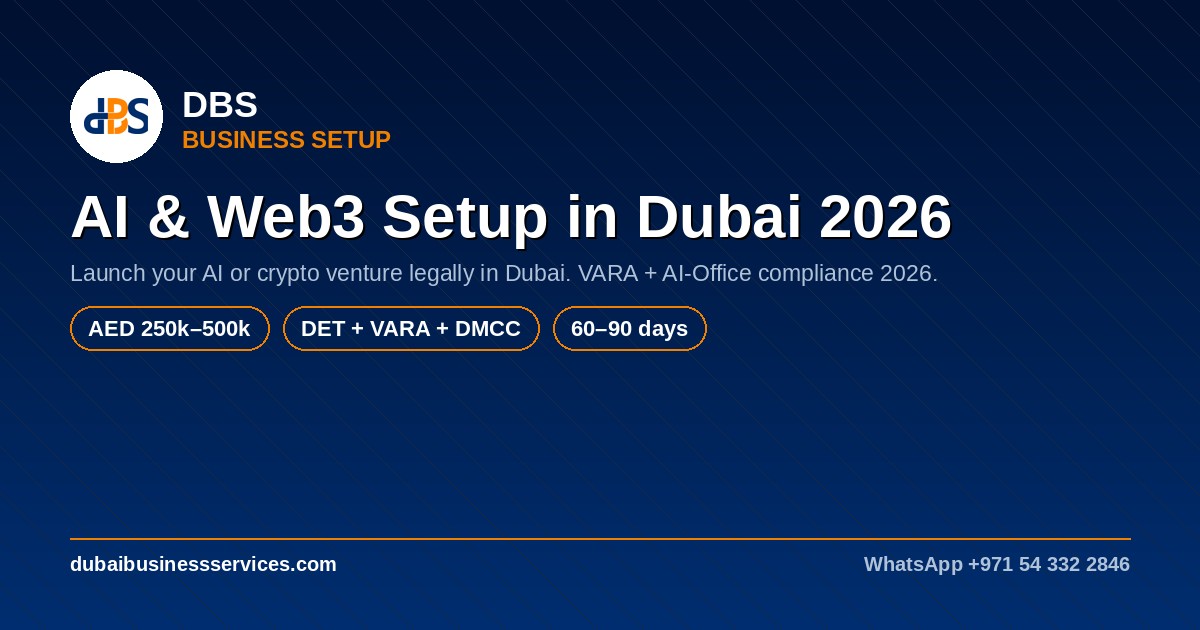
Dubai AI and Web3 businesses in 2026 operate under VARA (Virtual Asset Regulatory Authority) for crypto and the AI-Office of UAE for artificial intelligence. Capital ranges from AED 250,000 for basic Web3 activities to AED 500,000+ for exchanges. Full VARA licence approval typically takes 60–90 days via the DET (Dubai Economy and Tourism).
VARA Licence Categories for Web3 Founders in Dubai 2026
The Virtual Asset Regulatory Authority (VARA) oversees all virtual-asset businesses in Dubai. Under VARA, six core activity codes define your Web3 company type. A Dubai free zone setup in DMCC, IFZA, or Meydan allows you to register under these codes: Broker-Dealer, Exchange, Custodian, Investment Advisor, Stablecoin Issuer, and Service Provider. Each category carries distinct capital minimums and compliance burdens. Broker-dealers (trading platforms) require AED 250,000–350,000; exchanges (peer-to-peer or spot) demand AED 350,000–500,000; custodians (wallet/vault operators) typically need AED 300,000–400,000. Stablecoin issuers—still within VARA’s purview in 2026—face higher scrutiny and often AED 400,000+ in required capital.
DMCC, IFZA, and Meydan: Free-Zone Crypto Activity Codes Compared
DMCC (Precious Metals & Commodities Centre) has historically supported crypto activities under its Trader and Technology Service Provider codes. In 2026, DMCC remains the primary choice for crypto trading desks and exchanges, with licence timelines of 30–45 days post-VARA pre-approval. IFZA (International Financial Zone Authority) offers a parallel fintech pathway: its Virtual Asset Service Provider code and Fintech Operator code suit custody and payment-protocol companies. Meydan Free Zone provides a lower-cost alternative for basic Web3 service providers and tech consultants, though it has tighter restrictions on direct trading activities. All three require VARA pre-clearance before free-zone commercial registration. Licensing costs across zones range from AED 8,000–15,000 annually; setup fees from AED 5,000–12,000.
AI-Office of UAE and AI Activity Codes in 2026
Parallel to VARA, the AI-Office of UAE (housed under the Office of the Prime Minister) now regulates artificial-intelligence SaaS, model providers, and data-processing firms. If your Dubai business builds AI models, operates LLM services, or processes data at scale, you must also comply with AI-Office activity codes: AI Model Developer, AI Service Operator, and Data Processor. The AI pathway does not require a dedicated “AI licence” per se; instead, your Dubai business setup company licence and DMCC/IFZA commercial registration incorporate AI activities into your approved scope. Capital thresholds for AI firms are typically AED 100,000–200,000, lower than crypto-native categories. Combined AI + Web3 setups (e.g., a platform offering both AI analytics and crypto trading) incur both VARA and AI-Office alignment, extending timelines to 90–120 days.
Capital Requirements and Timeline: VARA Full Licence in 2026
VARA distinguishes between Temporary Licence and Full Licence. A Temporary Licence (issued in 15–20 days for cash-constrained founders) requires minimal capital—typically AED 100,000—and permits limited operations for 6 months. Full Licence applications demand the category-specific capital (AED 250,000–500,000) and take 60–90 days for DET approval. The DET (Dubai Economy and Tourism) remains the issuing authority. Book a free consultation with DBS to map your capital and timeline.
Stablecoin Issuers: Still Regulated by VARA in 2026
Yes, stablecoin issuers remain squarely within VARA’s remit in 2026. Issuers of asset-backed or fiat-backed stablecoins must secure Stablecoin Issuer category approval, distinct from the Broker-Dealer or Exchange codes. Capital requirements are stringent: AED 400,000–600,000, with additional reserves held in trust to back the stablecoin supply. Reserve audits are mandatory quarterly. The approval timeline stretches 90–120 days due to enhanced due diligence by VARA’s compliance team. Launch of algorithmic (non-backed) stablecoins remains prohibited under 2026 regulations.
Fast-Track vs. Standard VARA Approval and Compliance Costs
Most Web3 founders pursue the Standard pathway: submit to VARA, await pre-clearance (30–45 days), then apply for free-zone commercial registration (15–20 days). Total: 60–90 days, costs AED 15,000–25,000 (VARA fees, legal, and free-zone setup). Some operators attempt a Fast-Track via direct IFZA or DMCC engagement, claiming 45-day turnaround, but DET still imposes its 60-day baseline review. Ongoing annual compliance costs (audit, reporting, supervision) add AED 25,000–50,000 per year depending on category. Contact DBS: WhatsApp +971 54 332 2846 for a transparent cost breakdown.
MOHRE and Employment Compliance for Your Web3 Team
Once your VARA licence is active, you’ll hire staff. The Ministry of Human Resources & Emiratisation (MOHRE) governs employment contracts, visa sponsorship, and emiratisation ratios. Your Web3 company must issue Arabic-translated employment contracts, remit all social-security contributions, and if headcount exceeds 50, meet an 2% emiratisation threshold (by 2026, this may rise). Visa processing for foreign tech talent adds 2–4 weeks. Budget AED 3,000–5,000 per expatriate hire for visa and GOSI (General Organisation for Social Insurance) setup.
Frequently asked questions
Do I need a VARA licence for a Web3 startup in Dubai in 2026?
Yes. Any virtual-asset business—trading, custody, stablecoin issuance, or advisory—operating in Dubai must obtain a VARA licence. The only exception is if you operate purely outside UAE borders and serve no UAE customers. Even pre-revenue startups seeking to pilot products must secure at least a Temporary Licence (AED 100,000 capital, 15–20 days) to remain compliant with DET regulations.
Can I run an AI SaaS company on a DMCC licence?
Partially. A DMCC Technology Service Provider or AI activity code covers basic SaaS delivery. However, if your AI SaaS processes or stores large-scale customer data, or if you’re developing proprietary LLMs, you must also align with the AI-Office of UAE codes. This dual compliance adds 30 days to your timeline but keeps both regulators satisfied. DMCC commercial registration alone costs AED 8,000–10,000 annually.
Which Dubai free zones support crypto activities in 2026?
Three zones dominate: DMCC (Broker-Dealer, Trading, Tech Provider codes), IFZA (Virtual Asset Service Provider, Fintech Operator), and Meydan (basic Service Provider). DMCC remains the gold standard for trading platforms. IFZA suits custody and payment solutions. Meydan is cost-effective for consultants but has limited trading scope. All require VARA pre-approval before zone registration.
How long does a VARA full licence take?
Expect 60–90 days end-to-end. VARA pre-clearance: 30–45 days. Free-zone commercial registration: 15–20 days. This assumes clean compliance records and complete documentation. Stablecoin issuers may face 90–120 days due to deeper reserves and audits. Temporary Licences (limited scope) can be issued in 15–20 days.
Are stablecoin issuers still regulated by VARA in 2026?
Yes, stablecoin issuers remain under VARA’s Stablecoin Issuer category. Capital is AED 400,000–600,000. You must hold reserves in trust, undergo quarterly audits, and maintain compliance with asset-backing standards. Algorithmic stablecoins (unbacked) are prohibited. The approval timeline is 90–120 days, longer than other VARA categories, due to enhanced due diligence.
What’s the AED capital requirement for VARA categories?
Broker-Dealer: AED 250,000–350,000. Exchange: AED 350,000–500,000. Custodian: AED 300,000–400,000. Stablecoin Issuer: AED 400,000–600,000. Investment Advisor: AED 150,000–250,000. Service Provider: AED 100,000–200,000. Temporary Licences require only AED 100,000 but permit limited operations. All capital must be held in a local UAE bank; proof is mandatory for VARA approval.
Can I operate my Web3 business outside a free zone in mainland Dubai?
Not easily. VARA regulations effectively require free-zone residency (DMCC, IFZA, Meydan) or a dedicated limited licence from DET for mainland operations—the latter is rarely granted. Free zones offer liability isolation and tax efficiency. Setup via a free zone is the standard, cost-effective path. Mainland setup adds 6–12 weeks and AED 20,000–40,000 in government fees without clear regulatory clarity.
Get expert help in 20 minutes
Need clarity on your Dubai setup? Talk to DBS Documents Clearing LLC — 80,000+ entrepreneurs served since 2009. WhatsApp +971 54 332 2846 or email inquiry@dubaibusinessservices.com for a free 20-minute scoping call.