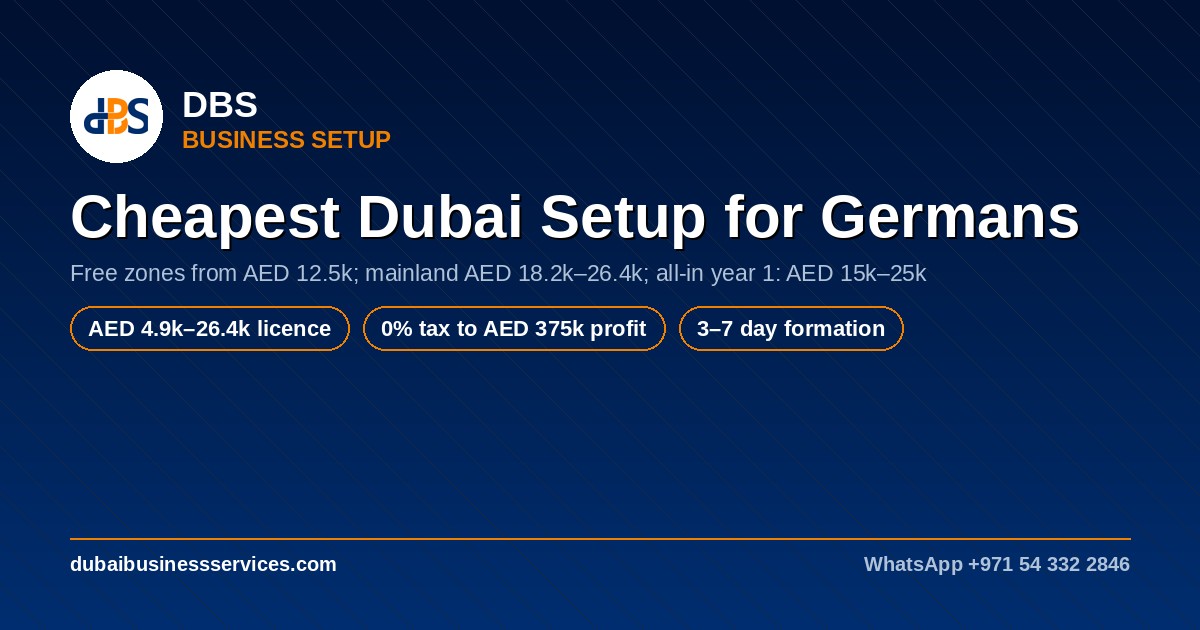
The cheapest Dubai setup for French founders is a free-zone licence at ~AED 12,500–12,900 (Meydan or IFZA), plus investor visa and banking setup—totalling AED 15–25k in year one. Formation takes 3–7 working days and is fully remote; the real bottleneck is banking approval, which depends on clean compliance documents. All-in costs include licence renewal, medical, Emirates ID and flexi-desk.
Key takeaways
- Cheapest Dubai company for French founders: free-zone licence ~AED 12.5–12.9k + investor visa ~AED 6–9k + banking + insurance = AED 15–25k year one
- Ajman SHAMS mainland licence: AED 4.9–5.8k (licence-only; no visa included)
- Formation is 3–7 days, fully remote; banking is the real friction, not company setup
- DET + MOHRE + Dubai Municipality regulate Dubai licences; FTA rules 0% corporate tax on profits ≤ AED 375k
- French tax residency: consult a licensed French tax advisor on exit rules; DBS handles UAE setup only
What is the cheapest Dubai company setup for French founders?
The cheapest path to a business setup in Dubai for French founders is a free-zone licence, starting at ~AED 12,500 (Meydan, one visa included) or ~AED 12,900 (IFZA, zero-visa option). If you want the absolute lowest licence fee nationwide, Ajman or SHAMS (Sharjah Multi-Services) offer ~AED 4,888–5,750 for a licence-only trade name, though these exclude residency visas and are mainland entities. All free zones and mainland licences are issued by the Department of Economy and Tourism (DET) and registered with MOHRE (Ministry of Human Resources and Emiratisation). Setup takes 3–7 working days, and the entire process is remote—no visa is needed to own a Dubai company while you are abroad, though banking approval may require a UAE resident signatory or proof of compliance.
DBS cost calculator: use the free DBS cost calculator for an instant breakdown in your currency.
Why is the real first-year cost higher than the licence headline price?
The licence fee is only one component. A realistic lean first-year cost is AED 15–25k all-in and includes: trade licence renewal (AED 1–3k), investor visa (AED 6–9k per person), medical exam and Emirates ID (AED 350–1k), administrative registration, insurance (AED 1–2k), and a flexi-desk address (AED 2–4k). Banking setup—which is NOT part of company formation but essential to operate—may require 1–8 weeks and depends on your personal and business KYC profile. Non-resident founders typically need a UAE-resident signatory or power of attorney, and banks now scrutinise source-of-funds documentation closely. Never confuse the DET licence cost with your true cost of business.
Transparent pricing: DBS lists every cost range; no hidden charges. Book a free consultation for your exact scenario.
Does the cheapest licence include a visa?
No. The cheapest free-zone licences (Meydan ~AED 12,500 or IFZA ~AED 12,900) include only the company formation and trade name. Meydan includes one residency visa at ~AED 12,500 all-in; IFZA is zero-visa. If you need a visa, add an investor/partner visa (2-year) at ~AED 6–9k realistic all-in, plus medical (AED 300–500) and Emirates ID (AED 100–200). Mainland licences in Ajman or SHAMS are even cheaper (AED 4,888–5,750 licence-only), but similarly exclude visas. You cannot legally reside in the UAE on a company licence alone; a residency visa is mandatory. For comparison, a Golden Visa (10-year investor visa) costs ~AED 4,695–10,140 in government fees alone and requires proof of investment (AED 2M property, deposit or company share)—significantly more complex than a 2-year partner visa.
Meydan or IFZA—which free zone is cheaper for French founders?
| Factor | Meydan Free Zone | IFZA (DP World) | Ajman SHAMS (Mainland) |
|---|---|---|---|
| Licence + All-In Setup | ~AED 12,500 (1 visa included) | ~AED 12,900 (zero visa) | ~AED 4,888–5,750 (licence-only) |
| Second Year Renewal | ~AED 7–9k | ~AED 7–9k | ~AED 3–5k |
| Visa (if separate) | Included in year 1 | Add ~AED 6–9k | Add ~AED 6–9k |
| Corporate Tax Rate | 0% on Qualifying Income (QFZP rules) | 0% on Qualifying Income (QFZP rules) | 0% if profit ≤ AED 375k (Small Business Relief until 31 Dec 2026) |
| Approx. in EUR (at ~1 AED = 0.25 EUR) | ~€3,100–3,200 | ~€3,200–3,225 | ~€1,200–1,440 |
Indicative at current rates—convert at today’s rate. Meydan is best if you want a visa bundled; IFZA is marginally cheaper on licence alone but adds visa cost later. Ajman SHAMS is the absolute cheapest licence, but you must secure a separate investor visa. Free zones benefit from Qualifying Free Zone Perimeter (QFZP) rules under the Federal Tax Authority: qualifying income is taxed 0%, but non-qualifying (e.g., domestic services) is taxed 9% from dirham one. Consult the Federal Tax Authority rules for your activity.
Confused about which is right for you? DBS will model your exact activity and visa needs for free.
What does the headline price NOT include—and what are the hidden costs?
The DET licence fee covers only the trade name and company registration certificate. It does NOT cover:
- Residency visa (AED 6–9k per person; mandatory to live in UAE).
- Medical exam and Emirates ID (AED 350–1k combined; required for visa issuance).
- Office address (virtual office ~AED 2–4k/year; some free zones include; mainland requires real premises).
- Business interruption and liability insurance (AED 1–2k/year; often required by banks or free zones).
- Banking setup and minimum balance (account opening takes 1 week to several months; minimum balances AED 25–50k at traditional banks, AED 0 at Wio).
- Home-country tax and accounting (French tax residency rules; hire a licensed French tax advisor—DBS does not handle home-country tax).
- Renewal and ongoing compliance (AED 7–20k/year depending on structure; includes licence renewal, visa sponsorship, municipal fees).
Many French founders underestimate the banking friction. Corporate accounts in the UAE now require strict KYC: proof of beneficial ownership, source of funds, business plan, and—for non-residents—often a UAE resident signatory or power of attorney. Even with a perfect licence, approval can take 2–8 weeks or be declined if documentation is weak. DBS introduces you to banks with proven non-resident track records and advises you on the precise documents they need.
Timeline: how long does a Dubai company setup really take?
Formation phase (3–7 working days, fully remote):
- Day 1–2: You provide passport scan, POA (power of attorney), home-country business registration (if any), and visa details to DBS. We submit to DET.
- Day 3–4: DET issues trade name approval and company registration number. You e-sign licence document via portal.
- Day 5–7: Licence is printed, Dubai Municipality fees settled, and your trade licence is issued. You receive PDF and hard copy.
Visa sponsorship (3–5 additional weeks, if opting for investor/partner visa):
- Week 1–2: Medical exam booked (1 day) and medical report sent to MOHRE.
- Week 2–3: MOHRE processes visa application and approves.
- Week 3–4: You collect Emirates ID or receive it by post (1–2 weeks).
Banking (1 week to several months—the real bottleneck):
- Week 1: DBS submits corporate KYC package (licence, UBO passport, source-of-funds memo, business plan) to your bank of choice.
- Week 2–4: Bank conducts compliance review; may request video KYC or a UAE resident signatory.
- Week 4–8: Account approval (or decline) and account activation.
Expect company formation in under 2 weeks; a visa adds 3–5 more weeks; banking is the variable (1–8 weeks). Do not assume you can trade the day your licence arrives—you cannot legally invoice clients until a corporate bank account is active.
Banking: documents checklist for a Dubai corporate account as a French founder
Banks are now the real gatekeeper, not formation. When applying for a corporate account, have ready:
- Signed trade licence (original or notarised copy).
- Company registration certificate (original).
- Passport (colour scan, notarised if requested).
- UBO (beneficial owner) declaration, signed and notarised.
- Source-of-funds memo (1-page letter explaining where your capital comes from—savings, founder investment, loan, etc.; notarised).
- Business plan (1–2 pages: what you sell, to whom, revenue forecast).
- Proof of UK/EU business address (utility bill or lease, in your name or POA).
- Shareholder agreement (if more than one owner).
- Power of attorney (if you are a non-resident founder delegating signing authority to a UAE resident signatory).
- MOHRE visa stamp or visa permit (if visa granted).
Bring originals to the bank or use a notarised copies. Many French founders find non-resident KYC stricter: banks want assurance you are not layering or sanctions-dodging. A clean UBO, steady source of funds, and a credible business plan are the best insurance. DBS provides a pre-bank KYC audit for free to flag weak spots before submission.
French tax and UAE setup: what you need to know
DBS is not a tax advisor. However, here is the landscape:
- UAE Corporate Tax (2023 onwards): 0% on taxable profit up to AED 375,000 per annum; 9% on profit above. Free zones pay 0% only on Qualifying Income under QFZP rules (contact Federal Tax Authority for your activity); non-qualifying income is 9% from dirham one. Small Business Relief (0% if revenue ≤ AED 3M) applies until 31 December 2026, then expires.
- Personal income tax in UAE: 0% (genuine 0%, not a tax holiday).
- VAT in UAE: 5% once you register (threshold: AED 375,000 turnover).
- French tax residency and exit: If you are currently a French tax resident, you must formally notify French tax authorities (DGFIP) that you have ceased tax residency. Generally, residency is lost after 183 days abroad or if you no longer have a home in France and your centre of economic interest is in the UAE. Hire a licensed French tax advisor (Conseil en gestion de patrimoine or accountant) in France to handle your exit and ongoing French/UAE tax treaty compliance. DBS does not provide French tax advice.
- UAE–France tax treaty: There is no bilateral treaty, so you may face French tax on worldwide income if you retain residency. Terminating French residency is essential.
- Golden Visa and tax residency: A 10-year Golden Visa does not establish UAE tax residency alone; you must spend ≥183 days in the UAE in a 12-month period or meet the 90-day + UAE tie test. Use an investor or partner visa if you do not plan to spend 183 days in the UAE immediately.
Tax residency is personal and legal—not commercial. Book a free DBS setup consultation here, then engage a French tax professional in parallel.
Frequently asked questions
What is the cheapest Dubai setup for French founders?
A free-zone licence (Meydan ~AED 12,500 or IFZA ~AED 12,900) is the cheapest path. All-in first-year cost is AED 15–25k when you add investor visa (~AED 6–9k), medical and Emirates ID, insurance, and admin. Ajman SHAMS mainland licence is cheaper on licence alone (~AED 4.9–5.8k) but excludes visa and renewal fees. Formation takes 3–7 days, fully remote.
Why is the real first-year cost higher than the licence price?
The DET licence fee covers only company registration. Real first-year costs include renewal (AED 1–3k), investor visa (AED 6–9k), medical and Emirates ID (AED 350–1k), insurance (AED 1–2k), office address (AED 2–4k), and 1–2 weeks of banking setup (depends on your KYC profile). Banking is the biggest variable; approval can take 1–8 weeks and may need a UAE resident signatory.
Does the cheapest licence include a visa?
Meydan includes one residency visa at ~AED 12,500 all-in; IFZA is zero-visa. If you need a visa with IFZA or Ajman, add ~AED 6–9k for a 2-year investor/partner visa, plus medical (AED 300–500) and Emirates ID (AED 100–200). You cannot legally live in the UAE on a licence alone; residency visa is mandatory.
Meydan or IFZA—which is cheaper?
Meydan (~AED 12,500) includes one visa; IFZA (~AED 12,900) is licence-only and needs a separate visa (~AED 6–9k extra). First-year cost is similar (~AED 18–21k total). Both enjoy 0% corporate tax on Qualifying Income under QFZP rules. Ajman SHAMS mainland is cheaper on licence alone (~AED 4.9–5.8k) but adds visa cost and no free-zone tax benefits.
What does the headline price NOT include—and what are the hidden costs?
The licence fee excludes visa (AED 6–9k), medical and Emirates ID (AED 350–1k), office address (AED 2–4k/year), insurance (AED 1–2k/year), and banking setup (1–8 weeks, non-resident KYC often needs a resident signatory). Renewal is AED 7–20k/year. Home-country French tax and ongoing French tax residency rules are not covered by DBS; hire a French tax advisor for that.
How long does a Dubai company setup actually take?
Company formation is 3–7 working days, fully remote. Visa sponsorship adds 3–5 weeks (medical + MOHRE + Emirates ID). Banking is the bottleneck (1 week to 2 months), depending on KYC and whether a resident signatory is needed. Do not assume you can invoice clients until your corporate bank account is live.
Is a Dubai company truly 100% tax-free?
No. UAE has had corporate tax since 2023: 0% on profit up to AED 375,000, then 9% above. Free zones pay 0% only on Qualifying Income (QFZP rules); non-qualifying is 9%. Small Business Relief (0% if revenue ≤ AED 3M) ends 31 Dec 2026. Personal income is genuinely 0%. French exit tax and residency rules apply; consult a French tax advisor before moving to the UAE.
Get expert help in 20 minutes
Try the free DBS cost calculator at https://www.dubaibusinessservices.com/business-setup-cost-calculator/ for an instant estimate, then talk to DBS on WhatsApp +971 54 332 2846 or email inquiry@dubaibusinessservices.com for a free, fully itemised cost breakdown in your own currency — and a straight answer on banking and tax.