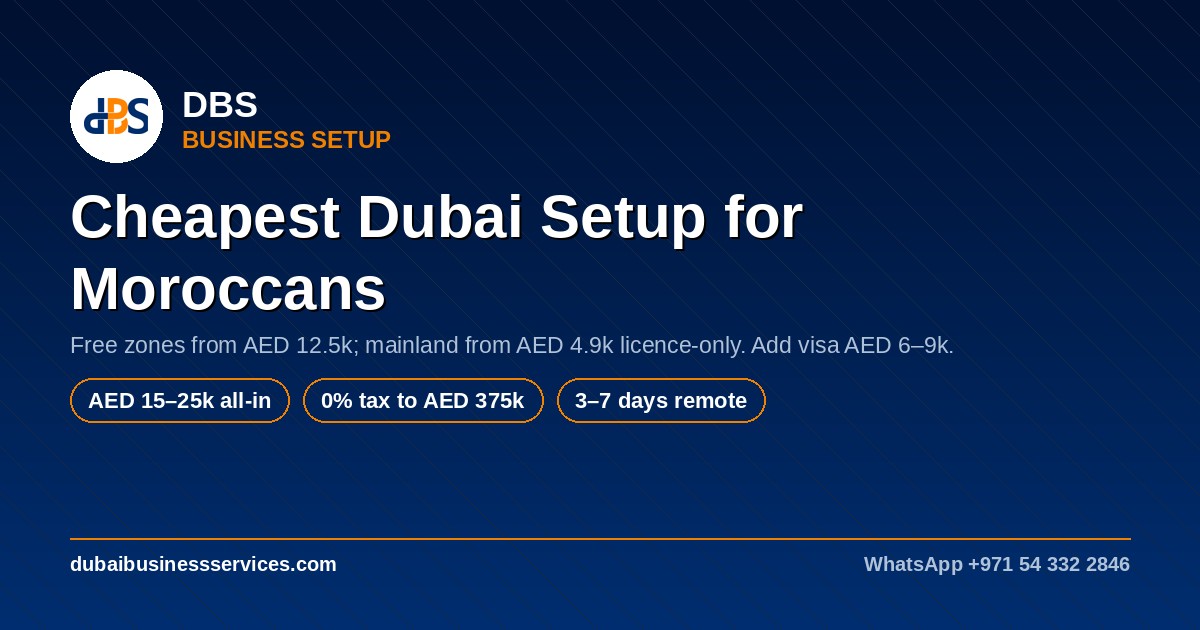
The cheapest Dubai company for Moroccans costs AED 15,000–25,000 all-in in year one, including licence, one investor visa, and banking-ready documentation. The Federal Tax Authority confirms 0% corporate tax on profits up to AED 375,000. Most Moroccan nationals qualify for 100% foreign ownership and can operate fully remotely; real friction is banking, not formation.
Key takeaways
- Cheapest Dubai company for Moroccans: AED 15k–25k first year all-in (licence + visa + desk + banking prep)
- Free zones (Meydan ~AED 12.5k with visa; IFZA ~AED 12.9k zero-visa) beat mainland (AED 18.2k–26.4k) for most traders
- 0% corporate tax on profits ≤AED 375k (Federal Tax Authority rule); 9% above; personal income 0% always
- Banking approval, not licence, is the real bottleneck — requires clean UBO docs, source of funds, often 1–3 months
- Setup is 3–7 working days remote (e-signed docs, POA); you need no UAE residence visa to own a zero-visa company
- Moroccan residents stay subject to MAD taxation and Office des Changes rules — consult a licensed Moroccan tax advisor
What is the cheapest Dubai company setup for Moroccans in 2026?
The business setup in Dubai for Moroccan nationals starts at AED 15,000–25,000 all-in in the first year. This all-in figure includes your trade licence, one investor/partner visa (2-year), a business address, and the documentation you need to open a bank account. The cheapest option is a Dubai free zone company formation—specifically Meydan Free Zone or IFZA—which bundles the licence cost with visa or zero-visa setup. Formation itself takes 3–7 working days and is entirely remote: you sign documents electronically, provide a UAE Power of Attorney, and submit home-country certificate attestations (notarised business registration or passport extract from your home authority). No physical presence in Dubai is required to form the company or hold its ownership, though banking may require a resident signatory or in-person KYC later.
Free zone vs. mainland: which is truly cheaper for Moroccan traders?
Free zones and mainland each suit different trade profiles. Here is an indicative cost breakdown:
| Setup Option | AED Range (Licence + 1-Yr Fees) | Approx USD Range | Visa Included? | Notes |
|---|---|---|---|---|
| Meydan Free Zone | AED 12,500–14,500 | USD 3,400–4,000 | Yes (1 visa) | Goods trade, logistics; visa included; full first-year |
| IFZA (Jebel Ali) | AED 12,900–15,200 | USD 3,500–4,150 | No (zero-visa) | Import–export, e-commerce; lowest headcount; no visa cost if remote |
| Ajman/SHAMS (Mainland Cheapest) | AED 4,888–5,750 (licence only) | USD 1,330–1,570 | No | Licence only; add investor visa AED 3.5k–7.5k if needed; popular for cost-focused traders |
| Dubai Mainland (DET) | AED 18,200–20,500 (no visa) | USD 4,960–5,590 | No | Retail, consulting, services; higher prestige; more expensive; visa separate |
| Dubai Mainland + Investor Visa | AED 26,355–30,000 | USD 7,180–8,170 | Yes (2-yr investor visa) | All-in; most visible for local clients |
| Investor/Partner Visa (standalone) | AED 6,000–9,000 | USD 1,635–2,450 | Yes (2-year) | Add to any licence; standard for Moroccan business partners/managers |
| Banking Setup (all types) | AED 0–3,000 | USD 0–820 | N/A | DBS handles account introduction; some banks (Wio) charge no fee; Mashreq NeoBiz ~AED 500–2k opening |
Indicative at current exchange rates—convert at today’s rate. No exact fees are guaranteed; all ranges reflect DBS clients’ typical first-year all-in costs across Dubai Business Services checked in 2026.
For Moroccan traders focused solely on cost, Ajman Free Zone or SHAMS Ajman Free Zone offers the absolute cheapest licence (AED 4,888–5,750) with zero visa requirement if you operate remotely. If you need a UAE residence or investor visa (for banking or credibility), add AED 6,000–9,000. For e-commerce and import–export, IFZA (zero-visa) undercuts Meydan by avoiding visa cost and is favoured by remote Moroccan founders. For goods distribution, Meydan bundles visa into licence cost and suits physical warehouse operations.
Why does the real first-year cost exceed the licence price?
The licence price alone (AED 4,888–20,500) is only the starting point. Here are the hidden costs—none invented, all documented by DBS clients in 2026:
- Investor visa (if chosen): AED 6,000–9,000. Many Moroccan founders add this for banking credibility or future residency, even if not legally required.
- Business address (flexi-desk): AED 2,000–4,000/year. Free-zone licence alone does not include a desk; mainland licences sometimes do. Most banks require a physical address for KYC.
- Banking introduction & KYC prep: AED 0–2,500. DBS provides introduction at no charge; account opening takes 1–3 months and may need in-person KYC or a UAE resident signatory if you remain in Morocco.
- Company insurance (optional): AED 1,500–3,500/year. Professional indemnity or public liability; not mandatory but often needed for B2B contracts or regulated sectors.
- Home-country attestation & notarisation: AED 500–1,500. Moroccan nationals typically need a notarised business-registration extract or certificate of good standing from their home authority; most post this to DBS or the UAE authority.
- First-year renewal buffer: Ajman licence renews at AED 1,500–2,500; free zones at AED 2,000–4,000. Budget for Year 2 from Month 1.
Thus, a realistic lean first-year all-in cost (licence + 1 visa + desk + banking ready) is AED 15,000–25,000. Without a visa, it falls to AED 10,000–15,000; with visa, insurance, and professional address, it rises to AED 25,000–32,000.
Use the free Dubai business setup cost calculator for an instant estimate tailored to your trade and visa choice.
Tax: 0% corporate, 0% personal income—but Moroccan residents have obligations too
Once your Dubai company is formed, the UAE tax framework is straightforward:
- Corporate tax (UAE): 0% on profits up to AED 375,000 per financial year (confirmed by the Federal Tax Authority). Above AED 375,000, the rate is 9%. This applies to all entities—free zone and mainland—from 1 January 2023 onwards. Free zones enjoy an additional 0% on “Qualifying Income” under QFZP rules (a de-minimis of 5% of revenue or AED 5 million, whichever is lower); a breach of this rule can forfeit the 0% rate for approximately 5 years, so seek professional advice if your revenue exceeds the threshold.
- Personal income tax (UAE): 0%. Moroccans working in Dubai or drawing dividends pay no personal income tax on UAE-sourced income.
- Small Business Relief (UAE): 0% corporate tax applies if your revenue does not exceed AED 3 million for financial periods ending on or before 31 December 2026. After that date, the threshold and relief structure may change; monitor the Federal Tax Authority’s announcements.
- VAT (UAE): 5% on goods and services. You must register once your revenue reaches AED 375,000 (mandatory). Below that threshold, registration is optional but often beneficial for B2B credibility.
- Moroccan tax (critical for Moroccan residents): Moroccan nationals resident in Morocco remain subject to Moroccan tax on worldwide income, including Dubai company profits. This is not a UAE matter. You must consult a licensed Moroccan tax advisor about how to declare and pay Moroccan personal income tax (Impôt sur le Revenu) and any company-level obligations (Impôt sur les Sociétés). Additionally, check Morocco’s Office des Changes (foreign-exchange control authority) rules on repatriating dividends or transferring funds from Dubai to Morocco; they may require prior authorisation or documentation.
DBS does not provide tax or legal advice in Morocco or any home country. We facilitate UAE company formation and banking introduction only. For Moroccan tax compliance, consult a Moroccan Chartered Accountant (Expert-Comptable) or tax firm licensed by Morocco’s tax authority (Direction Générale des Impôts).
Banking is the real friction: how to open a Dubai account as a Moroccan
Formation is fast (3–7 days, fully remote), but opening a bank account is where most Moroccan founders encounter delays:
- Minimum balance & fees: UAE banks typically ask for AED 25,000–50,000 minimum balance for corporate accounts. Wio Bank and Mashreq NeoBiz are more flexible (Wio from AED 0; Mashreq NeoBiz ~AED 10,000). Opening fees range AED 500–2,500.
- Non-resident KYC friction: If you remain in Morocco, most banks will require either (a) in-person KYC in a Dubai branch, (b) a UAE-resident signatory (a local director or colleague), or (c) a Power of Attorney granting signing authority to someone based in UAE. DBS can facilitate this; we provide banking introductions and can help arrange POA documentation.
- Source of funds & UBO clarity: Banks demand clear documentation of where your capital comes from—bank statements from Morocco, proof of employment, or proof of a previous business. The Beneficial Ownership (UBO) must be transparent. Moroccan nationals with clean records typically approve within 4–8 weeks; those with complex international structures or previous banking issues face longer review (2–6 months).
- Timeline: Formation to account live is typically 6–12 weeks; best case 4 weeks, worst case 3+ months if banking documentation is incomplete or if the bank requests further KYC rounds.
Contact DBS on WhatsApp +971 54 332 2846 to discuss your banking profile and arrange an introduction to a bank suited to your residency and trade profile.
Step-by-step setup timeline: days 1–7 and beyond
Here is what to expect from application to company live:
| Phase | Timeline | Key Action / Deliverable |
|---|---|---|
| Day 1–2: Consultation & Quote | Same day | DBS sends you an itemised quote (licence, visa option, address, banking) with AED range and local MAD estimate. |
| Day 2–3: Document Collection | 24–48 hrs | You provide: notarised business-registration extract (or certificate of good standing from Morocco), passport copy, bank statement (last 3 months), proof of address, and articles of association (if forming a partnership). |
| Day 3–4: Home Country Attestation | 24–48 hrs | DBS prepares UAE Power of Attorney and articles; you e-sign them. Home-country documents are uploaded for attestation (usually via UAE embassy in Morocco or notarisation service). |
| Day 4–5: DET/Authority Application | 1–2 days | DBS submits your licence application to Dubai Economy & Tourism (DET) or the relevant free-zone authority (Meydan, IFZA, Ajman). Pre-clearance from MOHRE (Ministry of Human Resources & Emiratisation) if you are requesting an investor visa. |
| Day 5–7: Licence & Visa Issuance | 2–3 days | DET or free-zone authority issues your trade licence. MOHRE approves investor visa (if chosen). You receive soft copy; DBS collects originals or uses e-portal. |
| Week 2–4: Banking Introduction | 2–3 weeks | DBS introduces you to a bank aligned with your profile. You submit KYC pack (licence, visa, bank statements, source-of-funds letter). Bank conducts compliance review. |
| Week 4–12: Account Opening & Live | 2–8 weeks | Bank arranges in-person KYC (via video or in-branch), you sign account papers, funds transferred, account live. Moroccan residents may need POA or in-person visit. |
What documents does the bank need? The complete KYC checklist for Moroccans
Once your licence and visa (if applicable) are issued, the bank will request a KYC pack. Here is the standard list:
- Trade licence (original or certified copy)
- Investor/partner visa (if obtained)
- Articles of Association (or MOA)
- UAE Power of Attorney (DBS-prepared; if you are not in-person)
- Passport copy (notarised, usually by your home country’s embassy in UAE or Morocco)
- Bank statement from Morocco (last 3–6 months) showing source of initial capital
- Proof of address in Morocco (utility bill or tenancy agreement) or UAE (if visa granted)
- Source-of-funds letter (from you, explaining where capital originates—salary, savings, previous business, loan, investor)
- CV or business-background summary (especially if you are a solo founder or new to UAE)
- Beneficial Ownership declaration (even if you are the sole owner, state so explicitly)
- Certificate of good standing or no-objection from Morocco (if applicable; some banks request this for traders moving from Morocco)
Missing or unclear documentation is the most common reason for banking delays. DBS prepares a pre-KYC checklist at formation and can flag gaps before the bank reviews your file.
Moroccan residents: visa, residency and home-country tax rules
Many Moroccan business owners ask: do I need to live in Dubai to own my company? The answer is no—but choices differ by visa status:
- Investor/Partner Visa (2-year): Realistic cost AED 6,000–9,000. Grants you a UAE residence visa and residence permit (Tawjeeh) for 2 years, renewable. You can live in Dubai and operate day-to-day. This is the most popular choice for Moroccan founders who plan to base themselves in UAE. Issued by MOHRE for a minimum company equity share (usually 51% or more).
- No visa (zero-visa company): Some companies (e.g., IFZA free-zone software houses) operate with zero visa requirement. You remain in Morocco, managing the company remotely, holding 100% ownership. Banking and credibility may suffer; most UAE banks prefer at least one resident signatory.
- Golden Visa (10-year): Available if you invest AED 2 million (deposit, property, or company ownership). Government fees are AED 4,695–10,140. Since February 2026, mortgaged property and off-plan units qualify (the previous 50%-upfront-only rule has been removed). This suits high-net-worth Moroccan nationals planning long-term UAE residence.
- Green Visa (5-year, freelance or skilled employment): If self-employed, your freelance income must be ≥AED 360,000/year (or as an investor, ≥AED 1 million company equity). Otherwise, you need a skilled-employment contract ≥AED 15,000/month salary. Issued for 5 years; ideal for independent consultants.
- Family Sponsorship: If you are on an investor or employment visa, you can sponsor dependents. Minimum monthly income required: AED 4,000 (spouse/children) or AED 20,000 (parents). Processing time 2–4 weeks.
- Moroccan tax residency: As a Moroccan citizen, if you reside in Morocco for 183+ days per calendar year (or accumulate 90 days plus a material tie—e.g., accommodation, family, business centre—to Morocco), you are a Moroccan tax resident. Moroccan tax residents are taxed on worldwide income, including Dubai company profits. Work with a Moroccan tax advisor (Expert-Comptable) to file annual tax returns and comply with the Direction Générale des Impôts. Additionally, the Office des Changes may require you to register foreign-currency earnings and obtain approval before repatriating dividends to Morocco.
FAQs: cheap Dubai setup for Moroccan nationals
Frequently asked questions
What is the cheapest Dubai setup for Moroccans?
The absolute cheapest is Ajman/SHAMS mainland licence at AED 4,888–5,750 (licence only, no visa required). If you add a 2-year investor visa for banking or credibility, the total is AED 10,000–15,000. All-in first year (licence + visa + flexi-desk + banking-ready docs) typically runs AED 15,000–25,000. Free zones (Meydan, IFZA) bundle visa or zero-visa options and cost AED 12,500–15,200 all-in, often better value than mainland if you need a visa.
Why is the real first-year cost higher than the licence price?
The licence price (AED 4,888–20,500) covers only the trade permit. Hidden costs include investor visa (AED 6,000–9,000 if you choose it), business address/flexi-desk (AED 2,000–4,000/year), banking introduction & KYC (AED 0–2,500), home-country attestation (AED 500–1,500), and optional insurance (AED 1,500–3,500/year). Real first-year all-in is thus AED 15,000–25,000; second-year onwards renewal is AED 7,000–20,000.
Does the cheapest licence include a visa?
No. Ajman/SHAMS licence (AED 4,888–5,750) includes no visa. Meydan Free Zone (AED 12,500–14,500) includes one visa cost bundled. IFZA (AED 12,900–15,200) is zero-visa, so no visa cost but you gain no residency. If you want a residency visa on a cheap licence, add investor visa AED 6,000–9,000 separately.
Meydan or IFZA—which is cheaper?
IFZA is cheaper by roughly AED 1,000–2,000 if you do not need a visa (zero-visa licence). Meydan is cheaper if you do need a visa because it bundles visa cost into licence. IFZA suits e-commerce, import–export, and digital services; Meydan suits goods logistics and warehousing. For Moroccan traders, IFZA + standalone investor visa (AED 6k–9k) is often competitive with Meydan’s bundled package.
What does the headline price NOT include?
The licence price does not include: visa (if zero-visa or separate purchase), business address (flexi-desk), bank-account opening, insurance, visa renewal, or Moroccan home-country attestation. It is a permit only. A true all-in first-year cost adds visa (AED 6k–9k), address (AED 2k–4k), banking intro (AED 0–2.5k), and attestation (AED 0.5k–1.5k), bringing the realistic total to AED 15,000–25,000.
How long does formation take, and can I do it from Morocco?
Formation is 3–7 working days, fully remote. You e-sign documents, provide a UAE Power of Attorney, and send home-country attestation (notarised business registration or certificate of good standing from Morocco). No physical presence in Dubai is required to form or own the company. Banking KYC, however, may require in-person KYC or a UAE resident signatory if you remain in Morocco; this takes 4–12 weeks.
As a Moroccan resident, do I owe tax in both Morocco and UAE?
Yes, potentially. UAE has 0% corporate tax to AED 375,000 profit and 0% personal income tax. Morocco taxes residents worldwide income, including Dubai profits; you must file annual returns with the Direction Générale des Impôts and pay Moroccan personal income tax (Impôt sur le Revenu). Consult a Moroccan tax advisor. Also check the Office des Changes for foreign-exchange rules on repatriating dividends to Morocco—approval may be required.
Get expert help in 20 minutes
Try the free DBS cost calculator at https://www.dubaibusinessservices.com/business-setup-cost-calculator/ for an instant estimate, then talk to DBS on WhatsApp +971 54 332 2846 or email inquiry@dubaibusinessservices.com for a free, fully itemised cost breakdown in your own currency — and a straight answer on banking and tax.