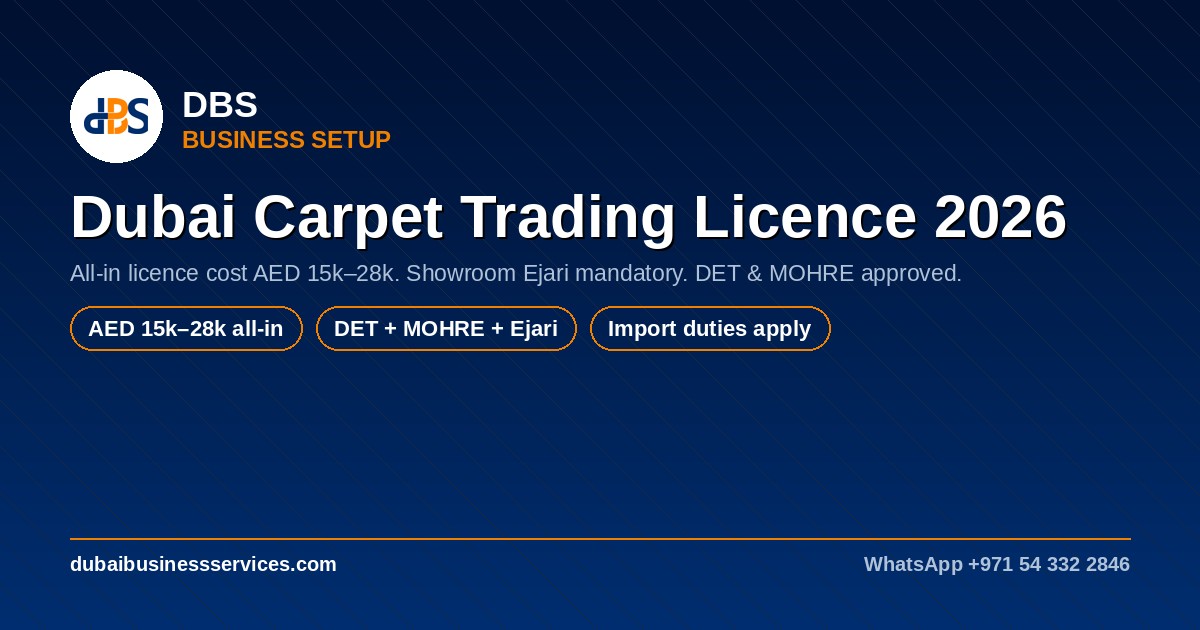
A Dubai carpet trading licence costs AED 15,000–28,000 all-in (2026), regulated by the Department of Economy and Tourism (DET) and monitored by the Ministry of Human Resources & Emiratisation (MOHRE). You must secure a showroom or warehouse with a valid Ejari rental contract, register your commercial activity code with customs, and declare import duties on stock. Mainland and free-zone structures differ significantly in setup cost, ongoing fees, and import protocols.
Carpet Trading Licence Cost in Dubai 2026
A Dubai carpet trading licence operates under DET oversight and requires an all-in investment of AED 15,000–28,000. This bracket covers licence issuance, municipality approvals, and initial compliance. Costs scale with business structure (sole trader, limited liability company, or free-zone entity) and physical footprint. See our Dubai business setup guide for structural options. The exact figure depends on whether you trade mainland or within a free zone, your premises size, and whether you import or stock locally.
Exact cost depends on your entity type and import volume—request a free scoping call via WhatsApp +971 54 332 2846.
Showroom and Warehouse Ejari Requirements
The Department of Economy and Tourism mandates a physical showroom or warehouse for any carpet and flooring trading licence. You must register an Ejari rental contract in your business name—this is non-negotiable for DET licence issuance. The premises must be classified as commercial (Activity Code 4719 or similar) and pass a site inspection. Minimum size is typically 200–500 sq.m. depending on your retail vs. wholesale model. Ejari costs approximately AED 500–1,500 annually (renewal), plus your landlord’s initial registration fee (AED 200–400).
Ejari verified directly by DET; your licence application halts without it.
Customs Codes and Import Duty Framework
Carpet and flooring products fall under HS Code 5701–5705 (Carpets and Other Textile Floor Coverings) in the UAE Customs tariff. Imported stock attracts a 5% customs duty on CIF (Cost, Insurance, Freight) value, plus a 5% UAE VAT on the total. You must obtain a Customs Registration Code (CRC) from the Federal Tax Authority (FTA) and declare all inbound shipments via the Automated Cargo Clearance System (ACCS). A carpet trader typically budgets AED 2,000–5,000 in annual customs clearance costs for modest stock rotation. High-volume importers should engage a licensed customs broker (AED 1,500–3,000 per shipment).
FTA approval required before your first import; budget 1–2 weeks for CRC issuance.
Mainland vs. Free Zone: A Comparison for Flooring Traders
Two primary structures exist for carpet and flooring trading in Dubai:
| Factor | Mainland (DET) | Free Zone (e.g. Jebel Ali, DAFZ) |
|---|---|---|
| Licence Cost (AED) | 15,000–22,000 | 18,000–28,000 |
| Annual Renewal | 3,000–5,000 | 4,000–6,500 |
| Local Partner | 51% UAE national (or waived in certain sectors) | Not required |
| Showroom Ejari | Mandatory (AED 500–1,500/yr) | Optional (office/warehouse inside zone) |
| Import Duties | 5% customs + 5% VAT on CIF | 0% within zone; 5%+5% on re-export to UAE market |
| UAE Market Sales | Direct (no re-export fees) | Requires re-export licence; extra AED 500–1,000 per transaction |
Recommendation: Mainland suits B2C (retail) flooring traders; free zones suit import-heavy, bulk B2B operations with regional distribution. Our Dubai business setup consultants help you model both scenarios.
Step-by-Step Licence Application Timeline
Expect a 7–14 working day timeline from application to final approval:
- Days 1–2: Ejari registration and MOI (Ministry of Interior) site clearance approval.
- Days 3–5: DET licence application submission with memorandum of association, passport copies, and trade name reservation.
- Days 6–9: MOHRE and Municipality of Dubai (MoD) secondary approvals.
- Days 10–12: FTA Customs Registration Code (CRC) issuance and trade name final certificate.
- Days 13–14: Licence issuance and collection from DET Al Wasl office (or e-service delivery).
Delays occur if Ejari or site inspection fails; factor in 2–3 extra days for remediation.
Hidden Costs and Annual Compliance Budget
Beyond the initial AED 15,000–28,000, carpet traders must budget for:
- Annual Licence Renewal: AED 3,000–5,000 (mainland) or AED 4,000–6,500 (free zone).
- Ejari Renewal: AED 500–1,500 per year.
- Customs Clearance & Brokerage: AED 2,000–5,000 (varies by import frequency and volume).
- Municipality and Safety Inspections: AED 800–1,500 annually (waived if no violations).
- Professional Services (accountancy, compliance): AED 2,500–4,000 per annum.
- VAT Registration (if turnover > AED 375,000): Mandatory; no fee, but adds compliance overhead.
A typical Year 1 total-cost-of-ownership for a small carpet showroom: AED 26,000–42,000.
Frequently asked questions
How much does a carpet trading licence cost in Dubai in 2026?
A carpet trading licence in Dubai costs AED 15,000–28,000 all-in (2026), covering DET issuance, municipality sign-off, and initial compliance. Exact price depends on whether you operate mainland or free zone, your legal structure (sole trader vs. LLC), and premises size. Mainland typically ranges AED 15,000–22,000; free zones AED 18,000–28,000. Annual renewal costs AED 3,000–6,500 thereafter.
Do I need a showroom for a carpet and flooring business?
Yes. The Department of Economy and Tourism (DET) requires a physical showroom or warehouse with a valid Ejari rental contract for any carpet trading licence. The premises must be commercially zoned (Activity Code 4719+) and pass a site inspection. Minimum floor space is typically 200–500 sq.m., depending on your retail vs. wholesale model. Ejari registration costs AED 500–1,500 annually.
Can I import carpets under a Dubai trading licence?
Yes. Once you hold a DET licence and obtain a Customs Registration Code (CRC) from the Federal Tax Authority (FTA), you can import carpets and flooring. Imported goods fall under HS Code 5701–5705 and attract 5% customs duty plus 5% UAE VAT on CIF value. Budget AED 2,000–5,000 annually for customs clearance; high-volume importers should hire a licensed customs broker (AED 1,500–3,000 per shipment).
Is mainland or free zone better for flooring trading?
Mainland (DET) suits B2C retail traders; lower licence costs (AED 15,000–22,000) and direct UAE market access. Free zones suit bulk B2B importers with regional distribution; zero import duties within the zone, but re-export to UAE attracts 5%+5% plus re-export transaction fees (AED 500–1,000 each). Compare your sales model: if >70% local retail, choose mainland; if >60% re-export, choose free zone.
What customs duties apply to imported carpets?
Imported carpets and flooring products (HS Code 5701–5705) incur a 5% customs duty on CIF (Cost, Insurance, Freight) value, plus 5% UAE VAT on the total landed cost. A free-zone trader pays 0% duty within the zone but must pay 5%+5% if re-exporting stock to the UAE market. Register with the FTA for a Customs Registration Code (CRC) before your first import shipment.
What is the timeline for getting a carpet trading licence in Dubai?
Expect 7–14 working days from application to final DET licence issuance (2026). Ejari registration (1–2 days), DET application (3–5 days), MOHRE and Municipality approvals (3–4 days), and FTA CRC issuance (2–3 days) run in parallel. Delays occur if site inspection fails or Ejari documentation is incomplete. Engage a professional licence partner to compress timelines.
What annual costs do I need to budget beyond the initial licence fee?
Budget AED 26,000–42,000 in Year 1 total-cost-of-ownership: licence renewal (AED 3,000–6,500), Ejari renewal (AED 500–1,500), customs clearance (AED 2,000–5,000), safety/municipality inspections (AED 800–1,500), and professional services/accountancy (AED 2,500–4,000). VAT registration is mandatory if turnover exceeds AED 375,000 (no fee, but adds compliance overhead).
Get expert help in 20 minutes
Need clarity on your Dubai setup? Talk to DBS Documents Clearing LLC — 80,000+ entrepreneurs served since 2009. WhatsApp +971 54 332 2846 or email inquiry@dubaibusinessservices.com for a free 20-minute scoping call.