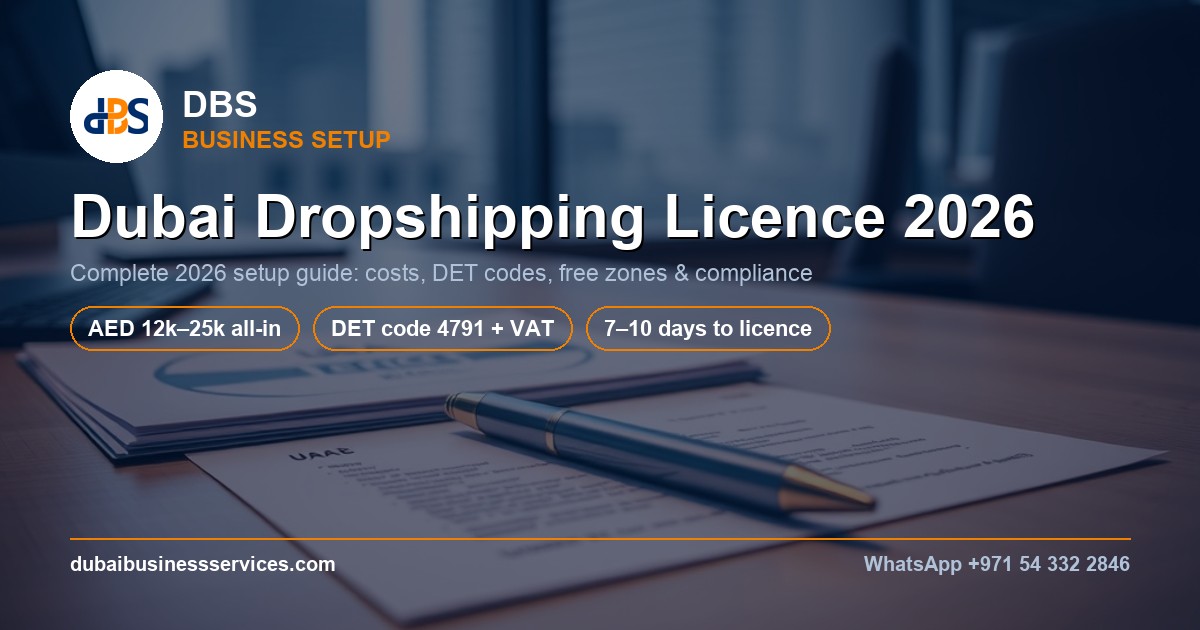
A Dubai dropshipping licence costs AED 12,000–25,000 all-in, including trade licence, VAT registration, and compliance setup. The Department of Economy and Tourism (DET) recognises e-commerce and no-inventory models under specific activity codes. You need supplier agreements, payment gateway integration, and marketplace seller accounts (Amazon, Noon) but no physical warehouse.
What Is a Dropshipping Licence in Dubai?
A dropshipping licence allows you to operate an e-commerce business without holding inventory. You source products from suppliers, display them on your storefront, and fulfil orders only when customers purchase. The Dubai business setup process for dropshipping requires DET approval of your activity code, a trade licence, and compliance with UAE e-commerce and VAT regulations. This model suits entrepreneurs seeking low capital entry into retail.
Ready to validate your dropshipping idea? Message DBS on WhatsApp +971 54 332 2846 for a 10-minute feasibility check.
Dropshipping Licence Cost Breakdown: AED 12,000–25,000
| Item | Cost Range (AED) | Notes |
|---|---|---|
| Trade Licence (DET) | 1,500–3,500 | Annual; e-commerce activity code required |
| Free-Zone Registration | 4,000–8,000 | If applicable (e.g., DTEC, Jafza, DAX) |
| VAT Registration & Setup | 0–1,500 | Mandatory if turnover exceeds AED 375,000 |
| Payment Gateway Integration | 1,000–3,000 | Initial setup + merchant account fees |
| Legal & Compliance Docs | 2,000–5,000 | Supplier agreements, T&C, privacy policy |
| MOHRE Compliance (if applicable) | 500–2,000 | Employee setup or freelancer registration |
| Consultancy & Admin | 2,500–5,000 | Pro-rata service fees |
Total all-in cost ranges AED 12,000–25,000. Sole traders and limited-liability companies both qualify. Use free zones to reduce taxation and enjoy simplified setup—popular options include DTEC, Dubai Airport Free Zone (DAFZ), and Jafza.
Get a bespoke cost quote from DBS’s Dubai business setup consultants in 24 hours.
DET Activity Codes for E-Commerce & Dropshipping
The Department of Economy and Tourism (DET) classifies dropshipping under e-commerce and retail trading. The primary activity codes recognised in 2026 include:
- 5610: Restoran & mobile food service (if selling food/beverage)
- 4711: Retail sale in non-specialised stores (general e-commerce)
- 4789: Other retail sale not in stores (online retail)
- 4791: Retail sale via mail order or internet (direct e-commerce)
Select code 4791 for pure dropshipping. DET approves your business plan within 2–5 working days if documents are complete. Free-zone authorities (DTEC, Jafza, DAX) provide additional code flexibility and faster turnaround (1–3 days). Ensure your activity code aligns with your supplier agreements and marketplace policies.
No-Inventory Model: Supplier Agreements & Payment Gateways
Dropshipping relies on three pillars: supplier agreements, payment processing, and order logistics. Your supplier agreement must clarify product pricing, delivery timescales, returns policy, and quality standards. Most suppliers operate on 15–30-day net payment terms; plan cash flow accordingly. Payment gateways (2Checkout, Stripe, PayPal) charge 2·5–3·5% per transaction plus fixed fees. VAT registration is mandatory if your annual turnover exceeds AED 375,000; include this in your financial projections. MOHRE (Ministry of Human Resources & Emiratisation) may require freelancer or employee registration if you hire staff to manage operations or customer service.
Need a compliant supplier agreement template? Email inquiry@dubaibusinessservices.com for a sample.
Free-Zone vs. Mainland: Which Is Best for Dropshipping?
Both paths work for dropshipping in Dubai. Mainland setup (DET) costs AED 12,000–18,000 and allows 100% local ownership; you must have a local partner or hire a freelancer if you’re non-Emirati. Free zones (DTEC, DAFZ, Jafza, DAX) cost AED 15,000–25,000 but offer 100% foreign ownership, no local partner required, and zero corporate tax on profits. Free zones streamline compliance, provide commercial addresses, and offer faster licence processing. Mainland is cheaper if you have local sponsorship; free zones are ideal for rapid global expansion and investor confidence.
Marketplace Seller Accounts: Amazon, Noon & Local Platforms
You can operate dropshipping across Amazon UAE, Noon, and local marketplaces once your trade licence is active. Amazon requires valid tax ID (UAE VAT number or DET licence), bank account verification, and trademark clearance per category. Noon UAE has similar requirements and fast-tracks sellers with DET-registered accounts. Local platforms (Dubizzle, Careem Now) have lighter requirements. Ensure your product sourcing complies with intellectual property law; counterfeit or grey-market goods breach licence conditions and incur DET fines (AED 5,000–50,000). Use licensed wholesalers and authorised distributors only.
Unsure if your supplier is legitimate? DBS can run an IP and import clearance audit for AED 1,500–2,500.
VAT, Compliance & Hidden Costs to Avoid
VAT at 5% applies to your sales if turnover exceeds AED 375,000 annually. You must register with FTA (Federal Tax Authority) and file monthly or quarterly returns. Common pitfalls: underreporting supplier margins, ignoring Customs duties on imports, and misrepresenting inventory as dropshipping (which triggers warehouse-licence reclassification and higher fees). Annual licence renewal is AED 1,500–2,000. Late renewal incurs fines of AED 500–2,000. Professional audit and compliance reviews cost AED 2,000–4,000 yearly. Factor these ongoing costs into your unit economics and pricing model.
Frequently asked questions
How much does a dropshipping licence cost in Dubai in 2026?
A Dubai dropshipping licence costs AED 12,000–25,000 all-in. This includes DET trade licence (AED 1,500–3,500), free-zone registration if applicable (AED 4,000–8,000), VAT setup, payment gateway integration (AED 1,000–3,000), legal documents (AED 2,000–5,000), and consultancy fees (AED 2,500–5,000). Mainland setup is typically cheaper; free zones offer tax benefits and faster processing.
Do I need a warehouse for a dropshipping licence in Dubai?
No. Dropshipping requires no warehouse because you do not hold inventory. Your supplier ships directly to customers. However, if you later stock items, you must upgrade to a retail trading licence (DET 4711 code) and secure a bonded warehouse or commercial space. Always declare your operating model to DET upfront; misrepresentation risks licence cancellation and fines.
Which free zone is best for dropshipping in Dubai?
DTEC (Dubai Technology Entrepreneur Campus) is ideal for tech-forward e-commerce; costs AED 15,000–20,000, includes office services, and has fast DET liaison. Jafza suits larger operations; AED 18,000–25,000. DAX is budget-friendly (AED 12,000–16,000) for startups. DAFZ (Dubai Airport Free Zone) is best if you import goods for re-export. All offer 0% corporate tax and simplified compliance.
Can I sell on Amazon and Noon with a dropshipping licence?
Yes. Both Amazon UAE and Noon accept DET-registered dropshippers. You must provide your UAE tax ID, valid bank account, and brand authorisation (if selling branded goods). Ensure your suppliers are not counterfeit sources; FTA and DET audit seller accounts regularly. Misrepresenting product origin or selling grey-market goods incurs fines up to AED 50,000 and licence suspension.
What activity code does DET assign for dropshipping?
DET assigns code 4791 (retail sale via mail order or internet) for pure dropshipping, or 4789 (other retail not in stores) if combined with other e-commerce services. Free zones may use alternative codes (e.g., 5099 for business & management consultancy if you’re reselling platform services). Submit your business plan to DET; they confirm the code within 3–5 working days.
Do I need to register for VAT if I start dropshipping in Dubai?
VAT registration is optional until your annual turnover exceeds AED 375,000. If you expect to cross this threshold, register proactively with FTA (Federal Tax Authority) before launch. You’ll charge 5% VAT on sales, file monthly or quarterly returns, and reclaim input VAT on business expenses. Non-compliance incurs penalties of 5–25% of unpaid tax.
How long does it take to get a dropshipping licence in Dubai?
Mainland setup takes 7–10 working days from document submission to DET approval and trade licence issuance. Free-zone registration is faster: 3–5 days (DTEC, Jafza, DAX). Payment gateway approval adds 2–5 days. End-to-end timeline: 12–20 days if you have all documents ready. DBS fast-tracks applications to 5–7 days for a AED 500 expedite fee.
Get expert help in 20 minutes
Need clarity on your Dubai setup? Talk to DBS Documents Clearing LLC — 80,000+ entrepreneurs served since 2009. WhatsApp +971 54 332 2846 or email inquiry@dubaibusinessservices.com for a free 20-minute scoping call.