Last updated: 2026-07-10
The food license cost in Dubai ranges from AED 12,500 for a home-based food permit to AED 60,000 all-in for a full dine-in restaurant on the mainland in 2026. Government fees alone account for AED 15,000–25,000, covering the DED trade license, Dubai Municipality food safety approval, and Ejari. DBS Group, serving 80,000+ entrepreneurs since 2009, completes most F&B licenses in under 90 days.
What a Dubai Food License Actually Covers in 2026
A Dubai food license is not one document — it is a stack of approvals issued by two separate authorities. The Department of Economy and Tourism (DET, formerly DED) issues the commercial trade license that legally establishes your company through Dubai mainland company formation, while the Dubai Municipality (DM) Food Safety Department issues the food-specific permits that allow you to prepare, store, transport, or sell food. You need both before your first dirham of revenue, and DM will not inspect premises that do not yet hold a valid trade license (2026).
The license type you select determines your fee schedule, your approval path, and your timeline:
- Restaurant license — full dine-in service, the most heavily inspected category, requiring kitchen layout approval, ventilation certification, and seating-area compliance.
- Cafeteria license — counter-service outlets and tea shops; lighter seating rules but identical kitchen hygiene requirements.
- Cloud kitchen license — delivery-only food preparation; no front-of-house approvals, fastest route to trading.
- Home food business permit — DM’s home-based permit for residents cooking from a household kitchen; the cheapest entry point at AED 1,000–2,500 in government fees (2026).
- Foodstuff trading license — import, export, and wholesale of packaged food; warehouse approval replaces kitchen approval.
- Catering services license — off-site event food service; adds vehicle and transport-container approvals on top of central-kitchen requirements.
Dubai counted over 13,000 licensed F&B outlets in 2025, and the emirate approved 1,200+ new food establishment applications in the first half of 2025 alone (Dubai Municipality, 2025). The market is crowded at the casual-dining midpoint and thin at the specialist edges — which is exactly why choosing the right license class on day one matters.
Need help choosing your license class? WhatsApp DBS at +971 54 332 2846 →
The 7 Proven Steps to Get Your Dubai Food License
Every food business in mainland Dubai passes through the same seven gates. The sequence below is the exact order DBS files them in — doing these out of order is the single biggest cause of 30-day delays (DBS case data, 2025).
Step 1: Reserve your trade name and initial approval with DET
Trade name reservation costs AED 620 and initial approval AED 120 (DET tariff, 2026). The name must not conflict with existing food brands, and words like “organic” trigger additional MOCCAE scrutiny.
Step 2: Select your food activity codes
DET’s activity list separates “restaurant”, “cafeteria”, “delivery of ready meals”, and “foodstuff trading” into distinct codes. Selecting the wrong code forces a license amendment later at AED 2,000+ in fees and 2–3 lost weeks (2026).
Step 3: Sign your Ejari lease before fit-out
DM will only review premises with a registered Ejari. Commercial kitchen space in Al Quoz and Ras Al Khor runs AED 70–120 per sq ft annually, while prime Downtown dine-in space exceeds AED 250 per sq ft (2026 market rates).
Step 4: Submit kitchen layout drawings to DM Food Safety Department
DM reviews your layout for workflow separation (raw-to-cooked flow), washing stations, cold storage placement, and grease trap position. Layout approval is the longest single government step — 10 to 20 working days in 2026.
Step 5: Complete fit-out and pass DM inspection
Ventilation and exhaust certification, pest control contract with a DM-registered provider, and a signed waste-disposal agreement must all be in place before you book the inspection. Inspectors check 60+ line items against the Dubai Food Code (2026 edition).
Step 6: Certify your Person in Charge (PIC)
Every food establishment must employ at least one PIC-certified staff member per shift under DM’s Food Safety Training program. The PIC course costs AED 350–500 per person and is valid for 5 years (2026).
Step 7: Collect your trade license and DM food permit
Once the inspection passes, DET issues the trade license (AED 12,000–15,000 in government fees for a standard mainland commercial license) and DM activates your food establishment permit. You are now legal to trade.
Want a quote for your exact activity? WhatsApp +971 54 332 2846 →
Food License Cost in Dubai 2026: The Full AED Breakdown
The table below is DBS’s 2026 tariff matrix across the six license classes — government fees verified against DET and DM published schedules in July 2026. Of the 80,000+ company setups DBS has processed since 2009, 9% were food-sector licenses, and the cost data below reflects those actual filings (DBS, 2025).
| Activity | Government Fee (AED) | DBS Service (AED) | Total (AED) | Notes |
|---|---|---|---|---|
| Home food business permit | 1,000–2,500 | 3,500 | 4,500–6,000 | DM permit only; no Ejari needed; residents only |
| Cloud kitchen (delivery only) | 14,000–18,000 | 8,500 | 22,500–26,500 | Shared-kitchen tenancy accepted; no seating approvals |
| Cafeteria | 15,000–20,000 | 9,500 | 24,500–29,500 | Includes DM layout + PIC certification |
| Foodstuff trading (wholesale) | 16,000–22,000 | 9,500 | 25,500–31,500 | Warehouse approval; food consignment import codes |
| Restaurant (dine-in) | 20,000–28,000 | 12,000 | 32,000–40,000 | Full DM inspection track; ventilation certification |
| Restaurant + catering combo | 26,000–38,000 | 14,000 | 40,000–52,000 | Adds transport vehicle approvals; central kitchen audit |
Three cost lines founders consistently underestimate: fit-out compliance (grease traps, stainless surfaces, and exhaust systems add AED 40,000–150,000 depending on premises condition), the 5% Ejari market fee added to your DET license renewal, and corporate tax registration — mandatory even below the AED 375,000 profit threshold where the 0% band applies under Federal Decree-Law No. 47 of 2022. Budget the full AED 25,000–60,000 all-in range from the queue of real 2026 filings, not the AED 12,000 “license only” figure competitors advertise.
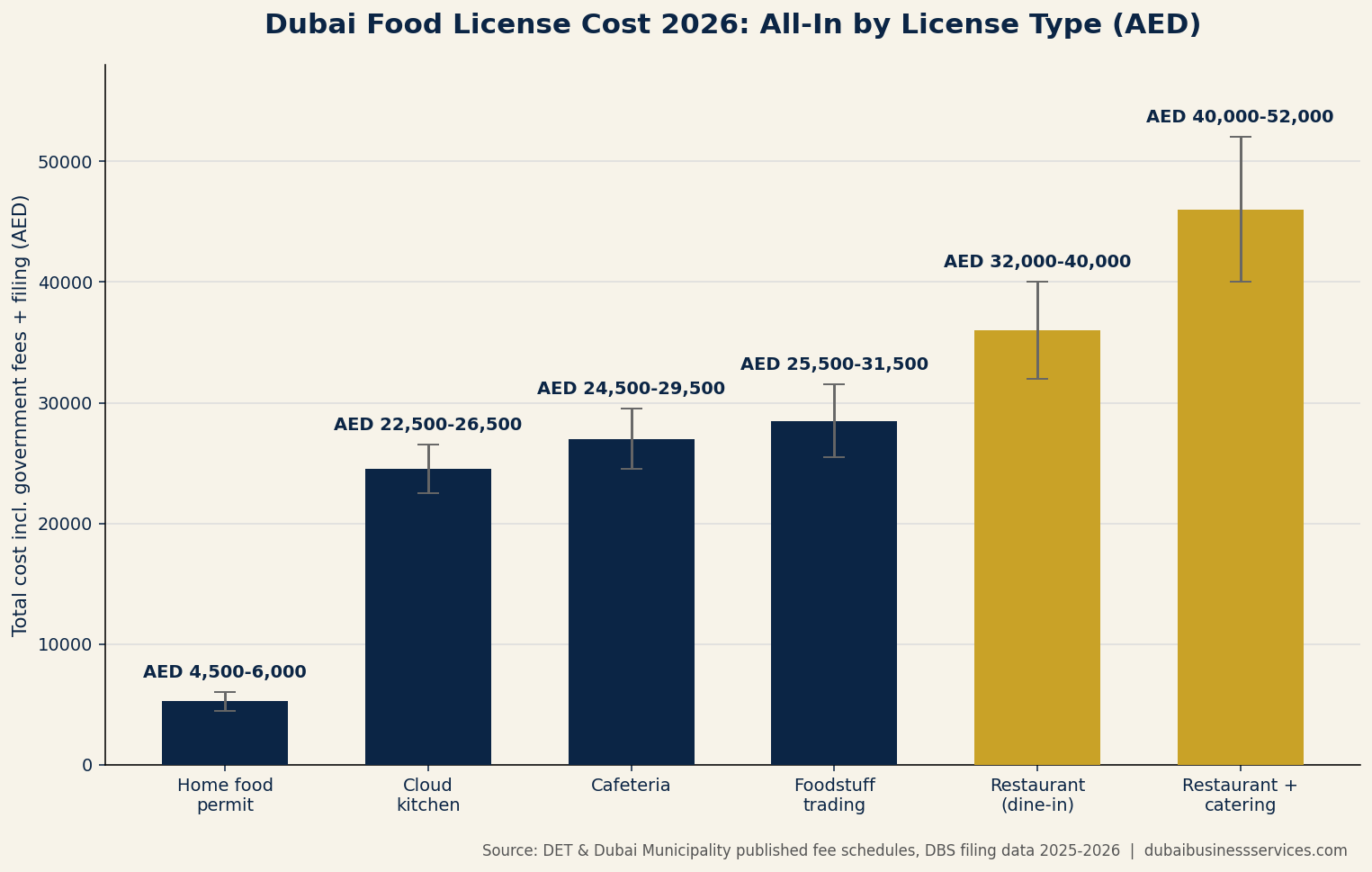
Embed this infographic:
<a href="https://www.dubaibusinessservices.com/dubai-fb-license-2026-food-safety-municipality-timeline/"><img src="https://www.dubaibusinessservices.com/wp-content/uploads/2026/07/food-license-cost-dubai-2026-comparison-infographic.png" alt="Dubai food license cost 2026 comparison - Dubai Business Services" /></a><p>Source: <a href="https://www.dubaibusinessservices.com/dubai-fb-license-2026-food-safety-municipality-timeline/">Dubai Business Services</a></p>Ready to see your exact number? WhatsApp +971 54 332 2846 →
Dubai Municipality Food Safety Approvals: What Gets Checked
DM’s Food Safety Department runs the approval track that separates food licenses from every other Dubai trade license. Its published food-related permits and approvals schedule lists every service and fee. Four approvals decide your timeline:
Kitchen layout approval
Scaled drawings showing equipment placement, hand-wash stations, and raw/cooked separation. Rejection rate on first submission was 38% in 2025, almost always for missing grease trap positioning or inadequate cold storage (DM published data, 2025).
Ventilation and exhaust certification
Commercial extraction systems must discharge above roof level with DM-approved duct routing. Retrofit costs in older buildings run AED 25,000–80,000 (2026) — inspect the building’s existing ducting before signing any lease.
Pest control contract
A 12-month contract with a DM-registered pest control company, filed before inspection. Annual cost: AED 1,200–3,600 for a standard outlet (2026).
Food safety training (PIC scheme)
The Person in Charge program is mandatory under the Dubai Food Code; DM audited 28,000+ PIC certifications in 2025. Staff food-handler cards route through Dubai Health, and your MOHRE establishment card must be active before staff visas process.
Confused about a DM rejection notice? Ask DBS — WhatsApp +971 54 332 2846 →
Cloud Kitchen vs Dine-In: Two Different Approval Tracks
The cloud kitchen route removes every front-of-house requirement: no seating plan, no customer washroom compliance, no signage approval, and shared commercial kitchens with existing DM approval let you inherit the premises file. That compresses the government timeline from 90 days to 30–45 days and cuts entry cost by AED 10,000–15,000 versus dine-in (2026). Dubai’s food delivery market processed USD 2.9 billion in orders in 2025 (Statista, 2025), and DM created a dedicated “delivery of ready meals” activity code to match.
The trade-offs are structural. A cloud kitchen license does not permit walk-in sales — adding a single table triggers reclassification to restaurant, a new layout approval, and a fresh inspection. Aggregator commissions of 18–30% (2026 platform rates) replace the rent premium you saved. Founders comparing this against a full restaurant build should read our restaurant license cost breakdown for the dine-in side of the equation, then model both against expected order volume.
Skip the reclassification trap — WhatsApp DBS at +971 54 332 2846 →
The Realistic 90-Day Timeline and the DBS Advantage
Marketing pages promising a “food license in 7 days” describe only the DET trade license step. The full dine-in sequence — name reservation to DM permit activation — ran 75–95 days across DBS’s 2025 restaurant filings, with fit-out and layout approval consuming 60% of that window. Cloud kitchens completed in 30–45 days; home food permits in 10–15 working days (DBS, 2025).
The DBS difference on F&B files is government liaison depth: pre-submission layout reviews against the current Dubai Food Code checklist before DM sees the drawings (cutting first-pass rejections), direct scheduling with DM inspection teams, PIC training enrollment handled alongside visa processing through Dubai business setup specialists rather than sequentially, and MOHRE establishment card plus labor quota filings run in parallel with fit-out. Departments the average founder meets one at a time — DET, DM, MOHRE, Dubai Health — DBS engages simultaneously. Verify authority requirements yourself at Dubai Economy & Tourism and MOHRE; then let one team run all four tracks.
Save 40 hours of government queues — let DBS handle it. WhatsApp +971 54 332 2846 →
Renewals, Fines, and the 2026 Compliance Calendar
Getting licensed is the visible half of the cost; staying licensed is the half that catches founders in year two. Your DET trade license renews annually at 90–95% of the original government fee, and renewal is blocked until your Ejari is current — landlords who delay lease renewal paperwork routinely push tenants into the AED 250-per-month late-renewal penalty band (DET, 2026). The DM food establishment permit renews on the same annual cycle, and DM ties renewal to a clean inspection record: outlets graded below B on their last inspection face a re-inspection before renewal is released.
The five DM violations that generated the most fines across Dubai food outlets in 2025:
- Expired PIC certification — AED 2,000 per violation; the certificate lapses at the 5-year mark and DM’s system flags it automatically (2025).
- Temperature-control failures — AED 2,000–5,000 for cold-chain breaks in storage or display units, the most common single violation category in DM’s 2025 inspection summary.
- Lapsed pest control contract — AED 1,500–3,000; the contract must be continuous, not re-signed at inspection time (2025).
- Unapproved menu or activity expansion — AED 5,000+; adding shisha, catering, or delivery without amending the license class triggers both DET and DM penalties (2026).
- Staff without food-handler cards — AED 500 per uncarded worker, checked against your MOHRE establishment roster during inspection (2025).
Two structural deadlines sit on top of the annual cycle in 2026: FTA corporate tax filing within 9 months of your financial year-end under Federal Decree-Law No. 47 of 2022, and VAT registration once taxable turnover crosses AED 375,000 — a threshold a single busy dine-in outlet clears within its first year at Dubai’s 2025 average ticket sizes. DBS runs both registrations at setup so the deadlines never arrive unregistered.
Renewing an F&B license this quarter? DBS handles it end-to-end — WhatsApp +971 54 332 2846 →
Frequently Asked Questions
How much does a Dubai mainland F&B license cost end-to-end in 2026?
Budget AED 32,000–40,000 all-in for a standard dine-in restaurant: AED 20,000–28,000 in DET and DM government fees plus professional filing. Cafeterias land at AED 24,500–29,500 and cloud kitchens at AED 22,500–26,500. Fit-out is additional and typically exceeds AED 40,000 (2026).
What approvals does Dubai Municipality require for a new restaurant?
Four core approvals: kitchen layout approval on scaled drawings, ventilation and exhaust certification, a 12-month pest control contract with a DM-registered provider, and Person in Charge (PIC) food safety certification for at least one staff member per shift. All four precede the final DM inspection (Dubai Food Code, 2026).
How long does a Dubai food trade license take in 2026?
Dine-in restaurants take 75–95 days from trade name to DM permit activation, with layout approval alone consuming 10–20 working days. Cloud kitchens complete in 30–45 days and home food permits in 10–15 working days (DBS filing data, 2025).
Does a cloud kitchen need the same approvals as a dine-in restaurant?
No. Cloud kitchens skip seating plans, customer washroom compliance, and signage approval, and shared DM-approved kitchens transfer premises compliance. They still require the DET trade license, DM food permit, PIC certification, and pest control — kitchen hygiene standards are identical (2026).
What is the difference between an F&B license and a catering services license?
An F&B license covers preparation and sale at a fixed premises; a catering license adds off-site service, which triggers DM transport-container approvals, refrigerated vehicle registration, and a central-kitchen audit. The combined class costs AED 40,000–52,000 versus AED 32,000–40,000 for restaurant-only (2026).
Are alcohol licenses a separate process from the F&B trade license?
Yes, entirely. Alcohol service requires a separate permit issued through Dubai Police licensing after the venue holds its trade license and DM permit, and it is restricted to eligible venues such as hotel-attached premises. Government fees start at AED 15,000 annually and processing adds 30+ days (2026).
Can I run a food business from home in Dubai in 2026?
Yes. Dubai Municipality’s home-based food business permit costs AED 1,000–2,500 in government fees, requires a home kitchen assessment and PIC certification, and limits you to direct and online retail sales. It is the standard first step before graduating to a cloud kitchen (2026).
Do food businesses pay UAE corporate tax in 2026?
Yes — registration with the FTA is mandatory for every licensed food business. Profits above AED 375,000 are taxed at 9% under Federal Decree-Law No. 47 of 2022; profits below that threshold sit in the 0% band, and qualifying small businesses can elect Small Business Relief through 2026.
Start Your Dubai Food License the Right Way
Need clarity on your Dubai setup? Talk to DBS Documents Clearing LLC — 80,000+ entrepreneurs served since 2009. WhatsApp +971 54 332 2846 or email info@dubaibusinessservices.com for a free 20-minute scoping call, or book a free consultation online.
Author: Salem Basheer, DBS Documents Clearing LLC — Last updated 2026-07-10