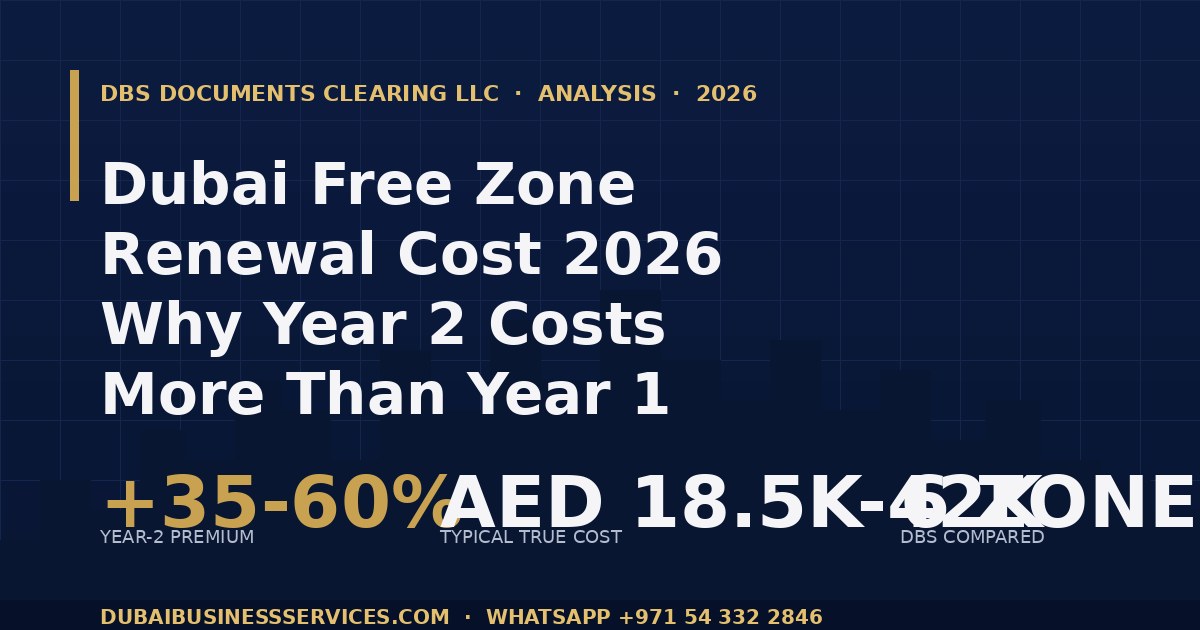
Dubai free zone renewal cost in 2026 typically lands 35–60% higher than the “introductory” year-1 sticker price most founders pay at setup. Across the six largest zones (IFZA, DMCC, Meydan, SHAMS, RAKEZ, JAFZA) DBS sees real Year-2 spends of AED 18,500 to AED 42,000 once trade licence renewal, immigration card refresh, establishment card, audit, Corporate Tax filing and (if applicable) office escalation hit at once. The “AED 5,750 free zone” figure was always Year-1 only — and even that excluded most government cards.
If you’re holding a 2025-issued licence renewing this calendar year, the gap is widest. Below is the AED-by-AED breakdown DBS has built from clearing 100+ free zone renewals across the last 12 months, plus the eight cost components most founders never see in the sales quote.
Why Year-1 Free Zone Pricing Is Engineered to Look Cheap
Free zone marketing copy is dominated by three numbers — AED 4,888 (SHAMS / SPC entry packages), AED 5,750 (IFZA-style entry licence) and AED 12,500 (Meydan basic). All three are real. None of them represent what the same company actually pays in its second year of operation.
The reason is structural, not deceptive. A first-year free zone setup package typically bundles: (a) the trade licence itself, (b) a 1- or 2-visa quota allocation, (c) a flexi-desk address, and (d) initial registration with the relevant government registry. Three things are deliberately missing or short-paid in Year 1: the immigration / establishment cards (often invoiced separately on day-30 to day-60), e-Channel deposit (refundable AED 5,000 held against visa misuse — money out, not money spent, but cash blocked), and ongoing compliance items (UBO filing, audit, CT filing, AML registration).
Year 2 is the year all four arrive together. There are no “new client” discounts. The trade licence renewal is invoiced at the published rate, which for several zones runs 15–30% above the new-licence promo price. Add the immigration card, establishment card, and the new mandatory items introduced under the 9% Corporate Tax regime, and the second invoice always lands harder than the first.
The 8-Component Year-2 Cost Stack DBS Sees Across Every Zone
From renewals processed January 2025–April 2026, the pattern is identical regardless of zone. Year 2 is built from these eight line items:
- Trade licence renewal fee — The published renewal rate, typically 15–30% above introductory pricing. AED 9,500 (SHAMS) → AED 28,000+ (DMCC business licence).
- Establishment card renewal — Required to sponsor any visa. AED 1,200–2,000 every 1–3 years depending on zone, plus typing and knowledge fees of ~AED 200–350.
- Immigration / e-Channel card renewal — AED 1,500–3,500 depending on zone, mandatory if you hold or plan any employment visa.
- Office / flexi-desk renewal — Most zones include a flexi-desk in Year 1 at AED 0–5,000. Year 2 standalone is AED 8,000–18,000 (or AED 25,000+ for a real cabin / smart office).
- Visa renewals — AED 4,500–7,500 per investor visa cycle (Emirates ID + medical + visa stamp + delivery). e channel
- Mandatory annual audit — Triggered for QFZP claims, banking compliance, and several free zones outright. AED 5,000–15,000 from a UAE-licensed auditor.
- UAE Corporate Tax filing — The 9% CT regime under Federal Decree-Law No. 47 of 2022 applies to free zone companies too. CT registration is free; missed registration carries an AED 10,000 administrative penalty under Cabinet Decision No. 75 of 2023. The pitfalls of the first CT filing cycle are detailed separately. Tax-agent / accountant fees: AED 4,000–12,000 per filing.
- UBO + AML compliance updates — UBO Register confirmation each year. AML registration (goAML) for designated activities — auditing fee or in-house compliance time costs AED 1,500–4,000.
Every renewal will hit at least 5 of these 8. Most hit 7. Year 1 promotional pricing usually only invoices items 1, 4 (subsidised) and a partial 5.
Year-1 vs Year-2 AED Comparison: Six Free Zones, Real Numbers
The table below reflects real renewal spend (excluding VAT) DBS has invoiced clients for in 2025–Q1 2026. Year-1 figures are typical promotional packages; Year-2 figures assume one investor visa, flexi-desk continuation (or smart-desk in DMCC/Meydan), audit, and CT filing.
| Free Zone | Year-1 Package (AED) | Year-2 True Cost (AED) | Year-2 Premium | Main Driver |
|---|---|---|---|---|
| SHAMS / SPC (Sharjah) | 4,888 – 6,500 | 18,500 – 22,000 | +278% | Audit + visa renewal + CT filing |
| IFZA (Dubai) | 11,900 – 14,500 | 22,500 – 27,000 | +86% | Establishment card + visa + CT |
| RAKEZ | 11,441 – 15,500 | 23,000 – 28,500 | +88% | Office escalation + audit |
| Meydan (Dubai) | 12,500 – 16,500 | 26,000 – 32,000 | +99% | Smart-desk renewal + CT |
| JAFZA (Dubai) | 16,500 – 23,000 | 32,000 – 39,000 | +85% | Lease renewal + audit |
| DMCC | 20,500 – 28,000 | 34,500 – 42,000 | +62% | Premium licence rate + flexi-desk renewal |
The Year-2 premium is widest at SHAMS (+278%) because the introductory package is structurally low — almost every cost item is deferred to renewal. DMCC has the smallest Year-2 jump (+62%) because Year-1 pricing already reflects most of the underlying cost stack. This is the inverse of how most founders rank the zones at setup time.
The Hidden Year-2 Charges Most Founders Don’t See Coming
Beyond the eight published items, six smaller charges show up on almost every renewal invoice DBS reviews. Individually they’re small — AED 200 to AED 3,000 — but stacked, they add another AED 4,000–9,000 to a typical Year 2.
- Late renewal penalty — Most zones charge AED 200–500 per day overdue, capped at 6 months. Founders who travel and miss the renewal window routinely add AED 3,000–6,000 here.
- P.O. Box renewal — Mandatory for several free zones for receiving government correspondence. AED 1,000–1,500 per year if not bundled.
- Bank account maintenance — Several Tier-1 UAE banks (Emirates NBD, Mashreq, ADCB) charge AED 350–500 monthly fall-below fees if the average balance drops under AED 100,000–250,000. AED 4,200–6,000 annualised if the account underfunds.
- VAT Returns — If the company crossed the AED 375,000 mandatory threshold, quarterly returns add AED 1,000–3,000 in tax-agent fees per cycle. Even voluntary VAT-registered companies (turnover above AED 187,500) must file.
- UBO confirmation filing — Cabinet Resolution No. 109 of 2023 requires annual UBO confirmation; while filing itself is free, most clients pay AED 500–1,000 in agent / typing fees.
- Activity amendment fees — Adding or removing any activity, even a sub-activity, runs AED 1,000–3,500 plus typing. Most companies amend once in Year 2 as the business focus narrows.
None of these are captured in any free zone’s Year-1 sales quote. They appear on the renewal invoice with limited explanation.
Why the Corporate Tax Regime Made Year-2 Permanently More Expensive
The 9% UAE Corporate Tax went live for financial years starting on or after 1 June 2023, meaning calendar-year companies started filing through 2024–2025. Federal Tax Authority data shows over 540,000 entities registered for Corporate Tax by Q4 2025. For free zone companies, three things shifted permanently:
- Audited financials are now functionally mandatory. Even if your zone didn’t require an audit before, the QFZP (Qualifying Free Zone Person) regime under Cabinet Decision No. 100 of 2023 requires audited statements to claim the 0% rate on qualifying income. Without an audit, you default to 9% on profits above AED 375,000.
- Transfer pricing documentation is now required if the company has any related-party transactions and exceeds the disclosure thresholds. Master File and Local File preparation costs AED 8,000–25,000 from most firms.
- Late registration carries an AED 10,000 penalty. Cabinet Decision No. 75 of 2023 set the timeline-based registration deadlines and the AED 10,000 administrative fine for missing them. The FTA granted a one-time waiver in 2024 for entities filing within seven months of their first tax period — but that waiver expired for most calendar-year filers on 30 September 2025.
Together these add a hard floor of AED 6,000–18,000 to every free zone Year 2 in 2026, regardless of revenue. Free zone packages priced before the CT regime simply did not include these costs.
How DBS Clients Avoid the Year-2 Spike
The most expensive Year-2 invoice DBS has seen in 2025 was a Meydan dual-activity setup that landed at AED 47,800 — versus the AED 14,500 first-year package the founder originally compared against IFZA. That spread is fixable. The four-step protocol DBS runs at setup is:
- Quote both years before signing. DBS issues a 24-month total cost of ownership before incorporation. Free zones quote Year-1 only because their commission models reward new licences; renewals close at lower margin. Force the comparison upfront.
- Match the activity list to a single zone’s strength. A consultancy + e-commerce dual licence at DMCC is 3x the cost of two separate licences across SHAMS and Meydan. Activity bundling is the single biggest cost lever.
- Pre-fund Corporate Tax filing. Year 2 is the first audited year for most 2024-incorporated companies. Booking an external auditor and tax agent in Q1 of the renewal year (not Q3) cuts 25–40% off the rush-fee premium.
- Calendar the establishment + immigration card windows separately. These cards have 1- and 3-year validities that don’t align with the trade licence cycle. Missing them by a week in 2025 cost two DBS clients AED 4,800 and AED 6,200 in penalties respectively.
For founders already in their second year, the recoverable items are: switching auditor before renewal, dropping unused activity codes (each saves AED 800–2,000), and right-sizing the office downward if the visa quota allows it.
FAQ: Dubai Free Zone Renewal Cost 2026
What is the typical renewal cost for a Dubai free zone company in 2026?
For a single-activity company with one investor visa and a flexi-desk, the realistic Year-2 cost in 2026 is AED 18,500–28,000 across most Dubai free zones (IFZA, Meydan, SHAMS), and AED 32,000–42,000 at premium zones (DMCC, JAFZA). This includes trade licence renewal, establishment + immigration cards, audit, and Corporate Tax filing.
Why is Year 2 more expensive than Year 1?
Year-1 packages bundle and discount the trade licence and a flexi-desk to win the new client. Most government cards (immigration, establishment, e-Channel deposit), audit, and CT filing are deferred or excluded. They all hit Year 2 simultaneously, plus mandatory items added under the 9% Corporate Tax regime since 2024.
Can I avoid the Corporate Tax filing cost?
No. UAE Corporate Tax registration is mandatory for every UAE company including free zone entities, even at 0% taxable income. Penalty for late registration is AED 10,000 under Cabinet Decision No. 75 of 2023. You can avoid the 9% rate via the QFZP regime, but only if you have audited financials and qualifying income — both add cost.
Which Dubai free zone has the cheapest renewal?
SHAMS / SPC and IFZA renewals run lowest in absolute AED terms — AED 18,500–22,500 typical Year-2 spend. RAKEZ is comparable. DMCC and JAFZA are the most expensive at AED 34,500–42,000. The cheapest renewal is also a function of activity match — the wrong activity at a low-cost zone can become the most expensive option overall.
What happens if I miss my free zone renewal date?
The licence enters a grace period (typically 30 days) followed by daily late fees of AED 200–500 capped at 6 months. After 6 months most zones move the licence to expired / blacklisted status, freezing visa renewals and bank operations. Reactivation involves a clearance application and back-payment of all dues plus penalties.
Is the audit really mandatory for free zone companies in 2026?
It is functionally mandatory. DMCC, JAFZA, RAKEZ, ADGM and DIFC require audits explicitly. For other zones (IFZA, Meydan, SHAMS), audited statements are required to claim the QFZP 0% Corporate Tax rate, to maintain banking, and for any visa or licence amendment after 2024. Skipping the audit means defaulting to 9% Corporate Tax above AED 375,000 profit.
Should I cancel and re-register at a cheaper zone instead of renewing?
Almost never. Liquidation costs AED 4,000–8,000 plus visa cancellation; re-registration is full Year-1 pricing again at the new zone, plus migration of bank accounts, contracts, e-commerce platforms and tax registrations. The break-even is 4+ years. The exception: a wrong-zone setup where the activity match is structurally broken (e.g. a fintech licence at a zone that doesn’t qualify for VARA / DFSA passporting). DBS runs a re-domiciliation cost analysis before any cancellation.
The Bottom Line for Founders Renewing in 2026
The “cheap free zone” framing collapses at Year 2. The real comparison metric is total 24-month cost of ownership against your specific activity mix and visa needs. Founders who set up in 2024 are now seeing the full cost surface — and 2026 is the first year that includes a complete CT-filing cycle.
If you’re renewing this year, or you’re evaluating a setup quote that looks suspiciously low, DBS will run the 24-month total-cost projection on your specific activity and zone combination at no charge. WhatsApp +971 54 332 2846 with your existing licence (or your draft activity list) and we’ll send the full breakdown within one working day. Email info@dubaibusinessservices.com if you’d prefer to send the documents securely.
By Salem Basheer, Managing Director, DBS Documents Clearing LLC. Last updated 10 May 2026.