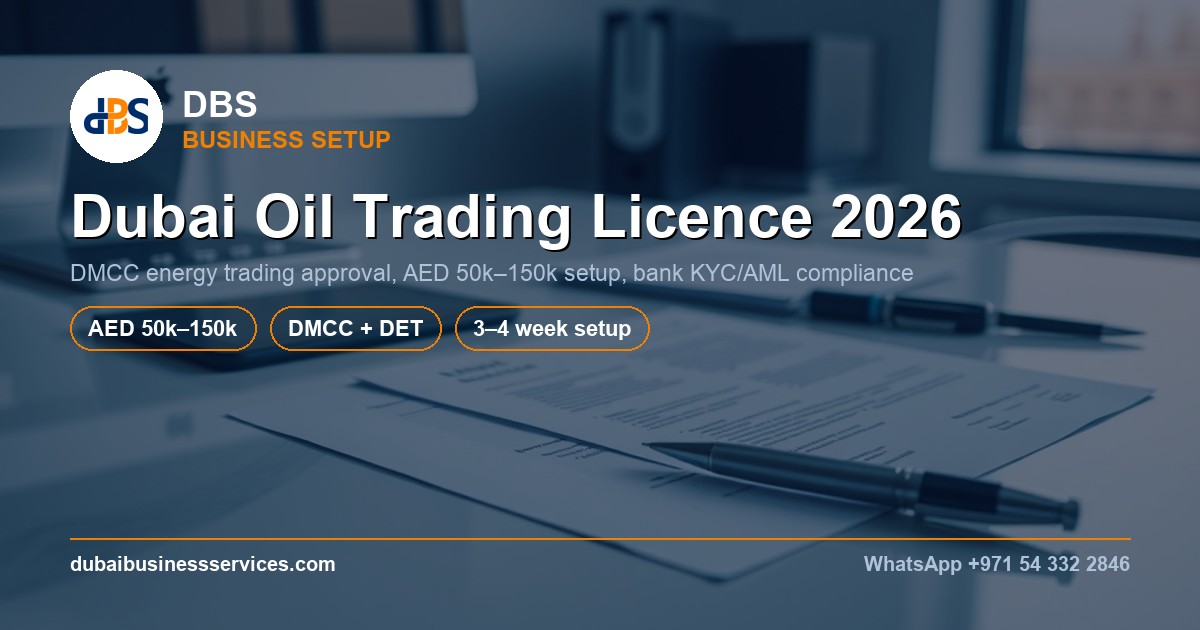
A Dubai oil trading licence in 2026 costs between AED 50,000 and AED 150,000 all-in through DMCC. You must obtain energy trading activity approval from DMCC, pass ADNOC supplier vetting, and comply with MOHRE labour and FTA import–export rules. Physical storage or paper trading arrangements depend on your business model.
What Is a Dubai Oil Trading Licence?
An oil trading licence in Dubai permits you to buy, sell, and distribute petroleum products—crude oil, diesel, fuel oil, and lubricants—domestically and internationally. The primary pathway is via Dubai business setup in the DMCC (Dubai Multi Commodities Centre) free zone, which specialises in energy commodities. DMCC offers pre-approved energy trading activity codes and direct ADNOC (Abu Dhabi National Oil Company) integration for supply chains.
Want to confirm your DMCC energy trading fit? WhatsApp +971 54 332 2846 for a free activity assessment.
Cost Breakdown: AED 50,000–150,000 All-In for 2026
| Cost Category | AED Range | Notes |
|---|---|---|
| DMCC trade licence (1 year) | 8,000–15,000 | Includes activity code registration and DMCC membership |
| Office setup & lease (virtual or physical) | 5,000–40,000 | Virtual office from AED 5k; dedicated office from AED 20k–40k per year |
| Bank account opening & KYC/AML documentation | 2,000–5,000 | UAE bank compliance; may require auditor or legal opinion |
| ADNOC supplier registration & vetting | 3,000–10,000 | Certification, site inspections, insurance bonds |
| Import–export & FTA registration (DET) | 1,500–3,500 | Federal customs clearance and trade certificate |
| Legal, compliance & professional fees | 15,000–50,000 | Lawyer, accountant, compliance officer (12 months) |
| Insurance & bonding (if physical storage) | 10,000–25,000 | Cargo, liability, storage bond—varies by volume |
Total range: AED 44,500–148,500. Most entrepreneurs budget AED 75,000–120,000 for a lean, compliant setup.
DMCC Energy Trading Activity & Approvals
DMCC operates as a free zone and is the gold standard for oil and gas trading in Dubai. To trade petroleum products, you must:
- Register for energy trading activity code with DMCC (e.g., ‘Oil & Gas Trading’, ‘Petroleum Products Distribution’)
- Obtain a DMCC trade licence valid for 12 months; renewable annually
- Pass ADNOC supplier vetting to access crude oil and refined product supply
- Maintain DMCC compliance with quarterly reporting, insurance verification, and office occupation
DMCC approval typically takes 2–3 weeks from licence application to issuance. ADNOC vetting adds 1–3 weeks depending on your financial strength and references.
DBS Dubai business setup consultants manage DMCC and ADNOC coordination—reducing delays.
Physical vs Paper Trading: Key Distinction
Physical Trading: You buy bulk crude or refined products and store them in a DMCC-licensed or third-party bonded warehouse, then resell. Requires:
- Storage facility (on-lease or third-party)
- Temperature/quality control systems
- Insurance covering cargo and liability (AED 15k–50k annually)
- ADNOC storage permit for strategic reserve products
Paper Trading: You act as a commodity broker or trading intermediary—matching buyers and sellers without holding physical inventory. Requires:
- DMCC trading licence (standard)
- Brokerage agreement with physical product holders
- Lower capital and insurance costs (AED 50k–80k setup)
- Compliance with CBUAE (Central Bank of the UAE) for FX and commodity derivative rules
Paper trading is faster, cheaper, and suits startups; physical trading demands more capital and operational overhead but captures higher margins.
Bank Account & Compliance: KYC/AML Framework
UAE banks enforce strict Know Your Customer (KYC) and Anti-Money Laundering (AML) rules enforced by the CBUAE. For an oil trading licence, banks require:
- Beneficial ownership documentation (passport, visa, residence proof for all shareholders ≥25% stake)
- Trade licence & DMCC approval letter (proof of legitimate commodity business)
- Source of funds declaration (bank statement or letter from your home country bank)
- ADNOC or customer supply contracts (proof of business purpose)
- Compliance officer certification or accountant letter confirming no OFAC/UNSC sanctions involvement
Expect 2–4 weeks for account activation after submission. Some banks (FAB, ADIB, DIB) have commodity-trading specialists who move faster. You may need minimum initial deposit of AED 50,000–250,000 depending on the bank and your transaction forecast.
Storage & ADNOC Supply Considerations
If you plan physical trading, ADNOC integration is mandatory:
- ADNOC Approved Supplier List (ASL): Your company must be registered and veted before purchasing ADNOC crude or refined products
- Storage lease: DMCC hosts storage in Jebel Ali (AED 30–80 per cubic metre per month); third-party bonded warehouses range AED 20–50/m³/month
- Quality & quantity certificates: Each product batch requires lab testing and inspection (AED 2k–5k per test)
- Logistics & customs clearance: If importing or exporting, FTA (Federal Tax Authority) and DET (Dubai Economy & Tourism) will audit paperwork; reserve AED 5k–15k for DET inspection fees
Many traders partner with ADNOC-licensed logistics firms to avoid direct storage liability—this outsourcing model reduces upfront capex by 30–40%.
Regulatory Bodies & Ongoing Compliance for 2026
Your oil trading licence operation falls under:
- DMCC: Licence renewal, activity updates, quarterly compliance filing
- ADNOC: Supplier vetting, product quality standards, supply contract terms
- MOHRE (Ministry of Human Resources & Emiratisation): Labour card, visa sponsorship for employees (if applicable)
- FTA & DET: Import–export permits, customs documentation, trade statistics reporting
- CBUAE: Bank compliance, no sanctions involvement, anti-money laundering checks (annual)
Plan AED 2,000–5,000 per quarter for compliance admin, audits, and renewals. Non-compliance risks licence suspension or revocation.
Frequently asked questions
How much capital is needed for an oil trading licence in Dubai?
Setup costs range AED 50,000–150,000 all-in, but minimum working capital depends on your model. Paper trading requires AED 50k–100k; physical trading with storage needs AED 150k–500k+ for inventory, insurance, and bank deposits. DMCC and ADNOC do not enforce a fixed capital requirement, but banks require demonstrable funds to support your forecast transaction volume. Most traders maintain AED 100k–250k liquid capital in their UAE account.
Is DMCC the best free zone for oil and gas trading?
Yes. DMCC is the official energy commodities hub for the UAE and offers pre-approved energy trading activity codes, direct ADNOC integration, and a fully compliant regulatory framework. Other free zones (Jafza, RAKEZ) allow trading licences but lack ADNOC’s direct supplier relationships and commodity-specific infrastructure. DMCC is the fastest and most cost-effective pathway for oil and gas trading in Dubai 2026.
What compliance applies to petroleum trading in the UAE?
Petroleum traders must comply with DMCC licence renewal (annual), ADNOC supplier vetting and product standards, MOHRE labour rules (if hiring), FTA import–export documentation, and CBUAE KYC/AML banking checks. Quarterly compliance filings with DMCC and ADNOC are mandatory. Failure to renew or breach AML rules results in licence suspension or revocation by authorities.
Can I trade oil products without a physical office in Dubai?
Yes, if you use paper trading (brokerage) or outsource storage. DMCC allows virtual office registration (AED 5k–10k/year), provided you maintain a registered contact address and comply with quarterly reporting. However, if you hold physical inventory, DMCC may require proof of a dedicated workspace or warehouse. Physical storage must be in a DMCC-licensed or approved third-party bonded facility.
How long does it take to get an oil trading licence in Dubai?
DMCC licence issuance takes 2–3 weeks from application; ADNOC supplier vetting adds 1–3 weeks. Bank account opening takes 2–4 weeks after KYC submission. Total time-to-trade: 4–8 weeks if all documents are ready. DBS manages parallel approvals to accelerate your setup and reduce delays.
Do I need ADNOC approval to trade oil in Dubai?
Yes, if you source crude oil or strategic refined products from ADNOC or resell to ADNOC customers, you must be registered on the ADNOC Approved Supplier List (ASL). Paper traders (brokers) without physical custody may not require direct ADNOC approval, but your customers will. Most oil traders pursue ADNOC vetting to access the widest supply base and command credibility with buyers.
What insurance do I need for an oil trading business in Dubai?
If trading paper-based (no physical hold), general liability and professional indemnity (AED 5k–15k/year). If storing physical products, cargo insurance, liability, and storage bond are mandatory (AED 15k–50k/year depending on volume and risk profile). DMCC and ADNOC require proof of current insurance; non-compliance voids your supplier agreements and can lead to licence suspension.
Get expert help in 20 minutes
Need clarity on your Dubai setup? Talk to DBS Documents Clearing LLC — 80,000+ entrepreneurs served since 2009. WhatsApp +971 54 332 2846 or email inquiry@dubaibusinessservices.com for a free 20-minute scoping call.
Ready to proceed? DBS handles the full setup — see our DMCC Company Formation service, or get a free quote on WhatsApp +971 54 332 2846.