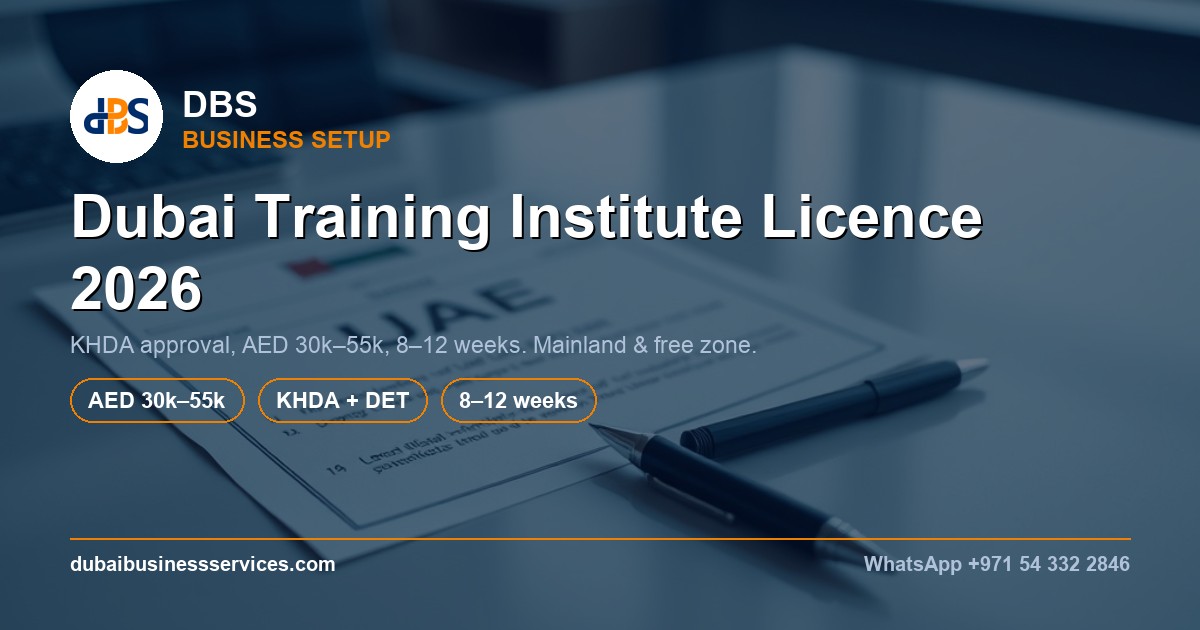
A Dubai training institute licence is a regulatory approval from KHDA (Knowledge and Human Development Authority) or DET (Dubai Education Trust) that permits you to deliver professional, vocational, or academic training. Licence costs range from AED 30,000 to AED 55,000 all-in. The process typically takes 8–12 weeks, with separate pathways for mainland and free-zone entities.
What Is a Dubai Training Institute Licence and Who Issues It?
A Dubai training institute licence is the regulatory permit required to operate a training centre or educational institution in the Emirate. The primary issuing authority is KHDA (Knowledge and Human Development Authority) for most academic and professional training programmes. For vocational and technical training aligned with national workforce development, DET (Dubai Education Trust) and MOHRE (Ministry of Human Resources and Emiratisation) may also oversee approval. When you set up a Dubai business setup in the training sector, these authorities verify your curriculum, trainer qualifications, facilities, and governance structure before granting the licence.
Ready to launch your training centre? WhatsApp DBS at +971 54 332 2846 for a free 20-minute scoping call.
Mainland vs. Free-Zone Training Licences: Which Path?
You can establish a training institute either on the mainland (under DED/KHDA jurisdiction) or within a free zone (such as DMCC, DAFZA, or JAFZA). Mainland licences allow you to recruit UAE nationals, sponsor employee visas, and operate across the broader Dubai market without restrictions. Free-zone licences offer simplified company registration and often faster approval timelines, but restrict visa sponsorship and may limit your ability to hire Emirati staff. Most training institutes choose mainland registration to access the full talent pool and comply with Emiratisation quotas. Licence costs range from AED 30,000 to AED 55,000 for both structures.
Licence Costs and Required Fees (2026)
| Cost Component | Estimated Range (AED) |
|---|---|
| Business Registration (DED) | 2,500–3,500 |
| KHDA Initial Approval & Inspection | 15,000–22,000 |
| Professional Licence (Annual) | 8,000–18,000 |
| Office Setup & Compliance (e.g., furniture, IT, permits) | 5,000–12,000 |
| Total All-In (Year 1) | 30,000–55,000 |
Costs vary by training focus (vocational, IT, languages, corporate) and facility size. DBS provides transparent, fixed-fee packages; ask us to compare your specific scenario.
Timeline: How Long Does KHDA Approval Take?
The typical licence approval timeline in 2026 is 8–12 weeks, broken down as follows:
- Weeks 1–2: Document preparation and submission (curriculum, trainer CVs, facility lease, compliance forms)
- Weeks 3–5: DED business registration and initial KHDA intake review
- Weeks 6–9: KHDA site inspection, trainer verification, and curriculum assessment
- Weeks 10–12: Final approval, licence issuance, and registration with MOHRE (if applicable)
Fast-track options exist through Dubai business setup consultants who pre-vet documentation, reducing back-and-forth delays.
Required Documents and Approvals Checklist
To obtain your training institute licence, you must submit:
- Business Plan: Mission, target audience, financial projections
- Curriculum Documents: Detailed course outlines, learning objectives, and assessment methods
- Trainer Qualifications: CVs, teaching certificates, and relevant industry experience (minimum Bachelor’s degree typically required)
- Facility Lease or Ownership: Copy of office/classroom space agreement (minimum floor area varies by programme type)
- Compliance Certifications: Health & safety, fire safety, accessibility audits
- Governance & Finance: Articles of association, audited financial statements, bank letters
- MOA Amendment: If your existing company needs to add training as a new activity
KHDA and DET cross-verify trainer credentials and inspect premises before final approval is granted.
Visa Sponsorship and Emiratisation Quotas
Once your training institute licence is approved on the mainland, you gain the right to sponsor employee visas. However, Emiratisation quotas apply: you must hire a defined percentage of Emirati staff depending on your company size and sector classification. For training institutes with 1–5 employees, the quota is typically 5–10%; for 50+ staff, it may reach 5–15%. MOHRE monitors compliance annually. Free-zone training companies are exempt from Emiratisation but cannot sponsor local hires. This makes mainland registration essential if you plan to build a team.
Unsure about your visa and quota obligations? DBS has guided 80,000+ entrepreneurs since 2009. Contact us today for clarity.
Vocational vs. Academic Training: Different Approvals?
Vocational Training (e.g., plumbing, electrical, hospitality skills) is primarily overseen by MOHRE and DET. You must align courses with the national Skills Framework and may require additional trainer certifications in the specific trade. Academic Training (e.g., languages, IT certifications, professional development) falls under KHDA and emphasises curriculum rigour and trainer qualifications. Corporate Training (in-house workshops for private firms) often requires only basic commercial registration if no public enrolment occurs. Costs and timelines are broadly similar (AED 30,000–55,000, 8–12 weeks), but approval bodies and documentation differ. DBS advisors can confirm which pathway applies to your institute.
Frequently asked questions
What licence do I need to open a training institute in Dubai?
You need a KHDA Professional Licence (for academic/professional training) or MOHRE/DET Approval (for vocational training). Both require DED business registration first. The licence permits you to deliver structured training programmes and employ educators. Costs range from AED 30,000 to AED 55,000 all-in, with approval taking 8–12 weeks. Free-zone registration is an alternative if you accept visa and recruitment restrictions.
How do I get KHDA approval for a training centre in Dubai?
Submit your application to KHDA after registering with DED. You must provide curriculum documents, trainer CVs (Bachelor’s degree minimum), a facility lease, compliance certifications, and governance papers. KHDA then conducts a site inspection and verifies trainer qualifications within 6–8 weeks. Approval is granted once all checks pass. Hiring a Dubai business setup consultant accelerates this by pre-vetting documents.
How much does a training institute licence cost in Dubai in 2026?
Total all-in cost is AED 30,000–55,000 in year one. This covers DED registration (AED 2,500–3,500), KHDA approval and inspection (AED 15,000–22,000), annual professional licence (AED 8,000–18,000), and initial office setup (AED 5,000–12,000). Renewal fees apply annually. Exact cost depends on your training focus, facility size, and trainer count. DBS provides fixed-fee, transparent quotes.
Can a free-zone company offer training in Dubai mainland?
No, a free-zone training licence is valid only within that free zone (DMCC, DAFZA, JAFZA, etc.). To serve the broader mainland market, you must register on the mainland under DED/KHDA. Free-zone benefits include simpler setup and faster approval, but you forfeit visa sponsorship rights and face Emiratisation exemptions. Most growing training institutes choose mainland registration for flexibility.
Which approvals are needed for vocational vs. academic training?
Academic and professional training requires KHDA approval and emphasis on trainer qualifications. Vocational training (trades, technical skills) requires MOHRE and DET alignment with the national Skills Framework, plus specific trade certifications. Corporate in-house training may only need basic commercial registration. Timeline and cost (AED 30,000–55,000, 8–12 weeks) are similar, but approval bodies and documentation requirements differ.
How long does KHDA approval take for a training institute?
Approval typically takes 8–12 weeks end-to-end. Weeks 1–2 cover document prep, weeks 3–5 involve DED registration and KHDA intake, weeks 6–9 include KHDA site inspection and assessment, and weeks 10–12 finalise approval and registration. Delays occur if documents are incomplete. Working with DBS, most applicants complete the process within 10 weeks by submitting polished, pre-vetted files.
What visa and Emiratisation rules apply to training institutes?
Mainland-registered training institutes can sponsor employee visas and must follow Emiratisation quotas (typically 5–15% Emirati hires depending on company size). MOHRE enforces compliance annually. Free-zone institutes are exempt from quotas but cannot sponsor local staff. Visa eligibility applies only to mainland companies. If you plan to build a diverse team, mainland registration is essential and is factored into the AED 30,000–55,000 setup cost.
Get expert help in 20 minutes
Need clarity on your Dubai setup? Talk to DBS Documents Clearing LLC — 80,000+ entrepreneurs served since 2009. WhatsApp +971 54 332 2846 or email inquiry@dubaibusinessservices.com for a free 20-minute scoping call.