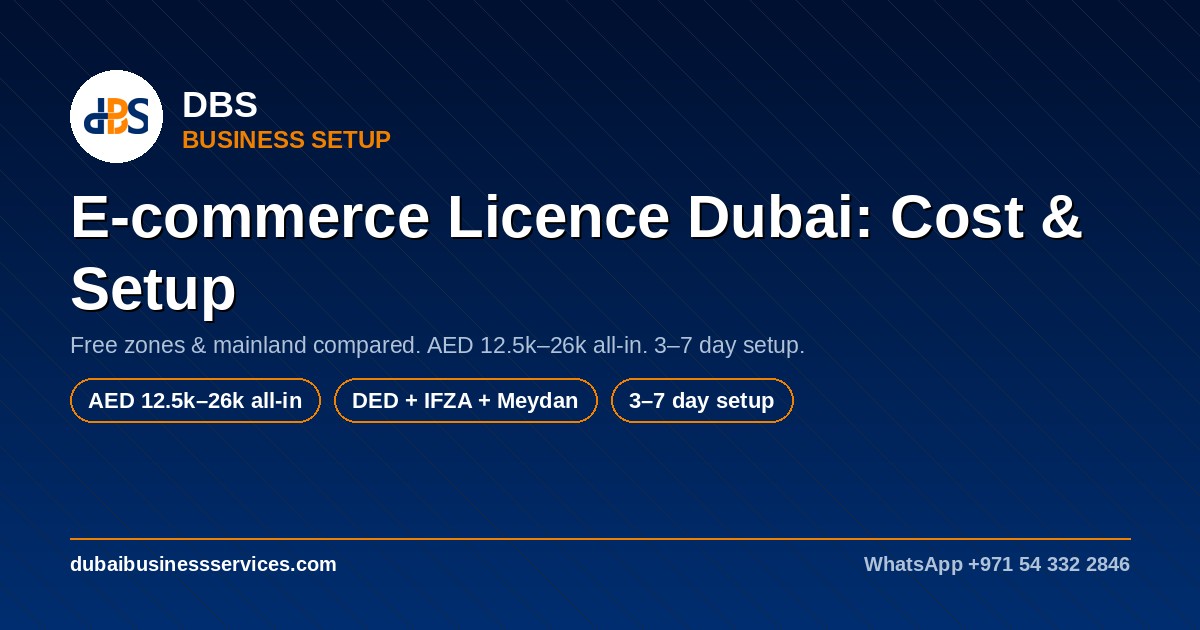
An e-commerce licence in Dubai costs AED 12,500–26,355 all-in for the first year, depending on whether you choose a free zone (IFZA, Meydan, Dubai CommerCity) or mainland (DED). Setup takes 3–7 working days. Costs cover the trade licence, investor visa with medical and Emirates ID, office space, and insurance—no hidden fees. MOHRE, DET, and IFZA (or FTA for mainland) are the approving authorities.
E-commerce Licence Dubai: All-In First-Year Cost Breakdown
Running an online store in Dubai starts with choosing your legal structure and location. Business setup in Dubai for e-commerce is straightforward: you need a trade licence, company registration, an investor visa (optional but recommended for business credibility and banking access), office space, and insurance. Below is a detailed, itemised cost table for 2026, comparing the cheapest and most practical options. All prices are indicative in AED; convert at today’s rate—exchange rates vary daily.
| Cost Component | Mainland (DED) | IFZA Free Zone | Meydan Free Zone | Dubai CommerCity |
|---|---|---|---|---|
| Trade Licence (year 1) | AED 18,200–20,500 | AED 12,900 | AED 12,500 | AED 13,200–14,500 |
| Company Registration & Name Approval | AED 500–800 | Included | Included | Included |
| Activity & External Approvals (Payment Gateway, Customs Codes) | AED 500–1,200 | AED 300–600 | AED 300–600 | AED 400–700 |
| Investor Visa + Medical + Emirates ID (1 visa) | AED 3,500–5,500 | AED 3,500–5,500 | AED 3,500–5,500 | AED 3,500–5,500 |
| Flexi-Desk / Office (12 months) | AED 1,500–3,500 | AED 1,200–2,500 | AED 1,000–2,000 | AED 1,200–2,500 |
| Business Insurance (annual, indicative) | AED 400–800 | AED 400–800 | AED 400–800 | AED 400–800 |
| Banking Setup Support (DBS intro, documents prep) | Included with DBS | Included with DBS | Included with DBS | Included with DBS |
| ESTIMATED ALL-IN TOTAL (Year 1) | AED 24,600–32,300 | AED 17,800–25,300 | AED 17,500–24,900 | AED 18,900–27,900 |
| What the headline price does NOT include: International tax or home-country corporate tax (consult a licensed tax advisor in your country); international remittance or accounting fees outside the UAE; e-commerce platform fees (Shopify, WooCommerce, etc.); advertising or marketing spend; stock holding or fulfillment costs; product insurance beyond standard business cover. DBS provides UAE company setup and UAE banking introductions only—not tax or legal advice in your home country. | ||||
Indicative exchange rates as at January 2026: 1 USD ≈ 3.67 AED; 1 GBP ≈ 4.60 AED. Convert all AED amounts at today’s rate for your budgeting.
Why the range? Licence fees vary by free zone authority, flexi-desk providers, and visa provider markup. DBS secures quotes from all three free zones (IFZA, Meydan, Dubai CommerCity) and mainland DED to give you the exact all-in figure before you commit.
Need a free, fully itemised quote? Book a free consultation with DBS.
Mainland (DED) vs Free Zones: Which is Best for E-commerce?
Your first decision is location: should you register on the UAE mainland under Dubai Municipality (DED), or in a free zone (IFZA, Meydan, Dubai CommerCity)? Each has trade-offs.
Mainland (DED E-commerce Activity): You can operate under the DED “E-commerce via Electronic Portal” activity code (5821 or 5829). DED is cheaper at renewal (AED 7,000–10,500 vs AED 12,500+ for free zones), and you retain UAE tax residency and can trade with UAE customers at no extra licence layer. However, the initial licence is pricier (AED 18,200–20,500) because you must hold a local registered office (not a free-zone desk). External approvals: payment-gateway pre-registration with Central Bank of the UAE (CBUAE) or your bank, and customs code if you import goods.
IFZA Free Zone (Jebel Ali): Licence AED 12,900; zero visa included. Ideal if you want the lowest entry cost and don’t need a staff visa yet. IFZA e-commerce activity is code 4719 or 4731 (import/export and trading). Payment-gateway approval still runs through your UAE bank or CBUAE. Renewal AED 12,900 annually.
Meydan Free Zone: Licence AED 12,500 with one visa included. Slightly cheaper than IFZA, and the visa adds credibility with UAE banks (they prefer companies with a UAE-resident owner). Activity code 4719 (trading). Payment-gateway approval same as mainland.
Dubai CommerCity (Jebel Ali): Licence AED 13,200–14,500; specialised for e-commerce and logistics. Activity code 4719 (trading, import/export). One visa negotiable. Best if you plan to integrate warehousing and last-mile fulfilment—CommerCity has bonded warehouses and customs-expedited clearance. Payment-gateway approval via CBUAE or your bank.
DBS recommendation for most UK/EU/US e-commerce founders: Meydan Free Zone. The licence is the cheapest (AED 12,500), one visa is included (useful for banking and credibility), and renewal is predictable. If you plan to scale into fulfilment/warehousing in year 2, Dubai CommerCity is worth the AED 500–2,000 extra. If you’re importing goods regularly, mainland DED saves you AED 5,000+ per renewal and gives you full UAE tax residency—but the initial setup is pricier.
Unsure which fits your model? WhatsApp DBS at +971 54 332 2846 for a free side-by-side comparison.
External Approvals & Payment Gateway Registration
An e-commerce licence alone doesn’t let you accept card payments or import goods. You need two further approvals:
1. Payment Gateway Registration: If you’re selling internationally or accepting credit cards, you must register with a UAE acquiring bank (FAB, Mashreq, Enbd, Adib, etc.) or use a payment-service provider (Telr, Telr, 2Checkout, etc.) that holds a local acquiring licence. Lead time: 5–10 working days once you submit your company registration, bank statement, and invoice samples. Cost: included in many bank packages; some PSPs charge AED 1,500–3,500 setup. DBS handles this introduction and document prep at no extra charge.
2. Customs Commodity Code (HS Code) Registration: If you’re importing physical goods, you must register your product categories with the Federal Tax Authority (FTA) and assign an HS code. Cost: free. Lead time: 2–3 days. Required documents: supplier invoice, product photo, description. DBS prepares and submits on your behalf.
Mainland (DED) difference: You may also need Dubai Municipality approval for trade if you’re selling into the emirate offline. Free zones bypass this—goods stay bonded until cleared by FTA customs at import.
Need help navigating customs and banking? DBS has a free checklist. Email inquiry@dubaibusinessservices.com and we’ll send it today.
3–7 Day Setup Timeline: Day-by-Day
Once you’ve chosen your location and provided documents, here’s the typical progress:
Day 1: You submit application via DBS: notarised copy of passport, proof of address (utility bill or bank statement from your home country), business plan or store URL, payment-gateway references. DBS submits to your chosen authority (DED, IFZA, Meydan, or CommerCity).
Day 1–2: Authority processes name availability and activity code. No rejection is normal at this stage.
Day 2–3: Authority issues conditional approval. DBS books your office/flexi-desk slot and initiates visa paperwork with General Directorate of Residency and Foreigners Affairs (GDRFA).
Day 3–4: Medical exam (1 hour at GDRFA clinic) and Emirates ID application. Completed same day or next morning.
Day 4–5: Authority issues final trade licence (PDF). Investor visa stamped in passport or issued as residence visa card.
Day 5–6: DBS opens your bank account introduction meeting. You meet the bank (virtually or in-person at a DBS partner branch) with your licence, visa, and Emirates ID. Documents submitted.
Day 6–7: Bank completes KYC and approves your account (can take 1–3 additional days). You receive online banking login details.
Parallel: Payment-gateway registration and customs HS-code filing happen during days 2–5. Both are ready by day 7 or day 10 at latest.
By end of day 7, you have: Active trade licence, investor visa, Emirates ID, office address, and a pending bank account under final KYC review. You can legally start trading immediately (though not accept card payments until your acquiring bank clears you).
Want a detailed timeline with your exact dates? DBS will send you a custom Gantt chart when you apply. WhatsApp now: +971 54 332 2846.
Banking Approval: Documents Checklist & Visa Eligibility
UAE banks won’t open an account for a foreign-owned e-commerce company without proof of UAE presence and legitimacy. Here’s the full checklist—and why each document matters.
Required Documents for Bank Account Opening:
- Trade Licence (PDF from DED/IFZA/Meydan/CommerCity) — Proof of legal authority to trade. Banks check licence validity and activity code (e-commerce must be explicit, not vague “trading”).
- Company Registration Certificate — Issued by the authority; confirms your legal entity name and registration number.
- Investor Visa or Residence Permit Card — Shows you are a UAE-resident company shareholder/manager. Critical: Most banks require at least one visa or residence card in the company name. Without it, risk of rejection is 60–80%. This is why DBS always includes one investor visa in the quote.
- Notarised Copy of Passport (personal ID page + UAE visa page) — Identity verification.
- Proof of Address in UAE — Utility bill, tenancy contract, or office lease from your flexi-desk provider. Used to verify UAE residency and registered address.
- Business Licence / Articles of Association — Filed at the authority; outlines business structure and signatory authority. Banks check who can approve transactions.
- Completed Bank Account Opening Form — Provided by the bank or DBS partner; includes beneficial ownership declaration, source-of-funds confirmation, and anti-money-laundering (AML) declaration.
- Proof of Funds / Business Plan — Bank statement from your home country (last 2–3 months) showing minimum balance (often AED 25,000–50,000 equivalent); or a business plan with revenue projections if you’re depositing fresh capital. E-commerce banks often ask for sales channel proof (Shopify store link, invoice samples, supplier agreement).
- Tax Residency Certificate from Your Home Country — Optional but recommended if you’re a non-UAE citizen. Issued by your home-country tax authority; shows you’re tax-resident there, not in the UAE (avoids double-taxation concerns). Lead time: 1–2 weeks from your home-country tax office. DBS does not prepare this; you must request it from your home-country authority. Consult a licensed tax advisor in your country for the exact form and filing steps—DBS cannot advise on foreign tax.
Visa Eligibility & Limits: You can hold one investor visa per company (or more if you have multiple shareholders, but most DBS clients start with one). An investor visa is a 3-year residence permit tied to your UAE trade licence. It costs AED 3,500–5,500 (medical exam, visa fee, Emirates ID). You are eligible if:
- You hold at least 51% ownership of the company (most foreign-owned e-commerce businesses do).
- You are over 18 and have a clean criminal record (self-declaration at application).
- You can provide proof of funds or employment (required by GDRFA).
Can you get a staff visa for a co-founder or employee? No—investor visas are for owners only. If you need a staff member in Dubai, you must hire a UAE national or sponsor an expat employee (requires labour-market approval from MOHRE and a minimum salary of ~AED 3,000–5,000 depending on role). Most e-commerce startups don’t hire staff in year 1; they operate virtually and use freelancers or outsourced customer service. DBS advises: start with one investor visa. Add staff visas only once you hit AED 500k+ annual revenue and need full-time help.
Worried about visa sponsorship or employee hire rules? DBS will walk you through the MOHRE process and costs in a free consultation. Book now at book a free consultation.
DBS’s Free-Zone Company Formation Service: Why We’re Different
DBS does not sell generic “company formation” templates. We provide:
- Itemised, transparent quotes. No “package deals” with hidden add-ons. You see: licence fee (DED/IFZA/Meydan quoted separately), visa cost, office cost, insurance, and banking-intro support. If a component surprises you, we explain why before you pay.
- Dubai free zone company formation + mainland DED comparison. We quote IFZA, Meydan, Dubai CommerCity, and mainland DED side-by-side so you see the true all-in cost for each. No bias towards one zone.
- Banking introductions included. We have relationships with FAB, Mashreq, Enbd, Adib, and neobanks (Telr, Telr). Once your licence is live, we set up your bank meeting. You don’t cold-call a corporate office and wait weeks—we fast-track you. Bank approvals happen 2–3 days faster with DBS’s intro vs self-service.
- Straight answers on tax and home-country liability. We will not pretend to be your accountant or give tax advice for your country. We’ll tell you: “Your UAE e-commerce company is a separate legal entity. Consult your home-country tax advisor on whether you owe personal income tax on company profits. DBS has no role in that decision.” You then know to hire a CPA or tax advisor—and avoid compliance surprises.
- Setup within 3–7 working days (guaranteed, or refund). No “10–14 days” vagueness. If your documents are complete by day 1, your licence is in hand by day 7. If a government system is slow, we’ve told you upfront and you have recourse.
Ready to start? Use our free Dubai business setup cost calculator to get a ballpark figure in seconds, or WhatsApp +971 54 332 2846 to speak to a DBS setup specialist.
Renewal, Scaling, and Year 2 Costs
Your first e-commerce licence lasts one year (some free zones offer 2- or 3-year terms at a discount). When it expires, you renew. Here’s what to expect:
Mainland (DED) Renewal: AED 7,000–10,500 for a one-year licence. No visa fee (the investor visa runs for 3 years independently). Paperwork: licence renewal form + proof of address (flexi-desk lease or office contract). Process: 1–2 days. Cost nearly 60% lower than year 1 because you’ve already paid visa and registration one-time fees.
Free-Zone Renewal (IFZA, Meydan, Dubai CommerCity): AED 12,500–14,500 for a one-year renewal. Visa not included (you can renew separately at AED 2,000–3,000 for a 3-year extension). Process: 1–2 days. Free zones charge the full activity fee each year, but bulk storage and customs clearance are seamless if you’re doing dropshipping or importing.
Year 2 Total Cost Estimate: AED 7,000–15,000 (renewal licence only). Add office (AED 1,500–3,500 if you keep the same flexi-desk), visa renewal (~AED 2,000–3,000 every 3 years, so AED 667–1,000 amortised per year), and insurance (AED 400–800). All-in year 2: AED 9,000–19,500.
By year 3, you’re running a profitable, low-cost operation—especially if you’ve grown into a free-zone warehouse or moved to a shared office to cut rent in half.
Want a 3-year cost projection with scaling scenarios? DBS builds custom financial models. Email inquiry@dubaibusinessservices.com or WhatsApp +971 54 332 2846.
Frequently asked questions
How much does an e-commerce licence cost in Dubai?
An e-commerce licence costs AED 12,500–20,500 (licence only) depending on location: IFZA and Meydan free zones are ~AED 12,500–12,900; mainland DED is ~AED 18,200–20,500. Add investor visa (AED 3,500–5,500), office (AED 1,500–3,500), and insurance (AED 400–800) for a realistic all-in first-year cost of AED 17,500–30,000. Renewal is cheaper: AED 7,000–14,500 (no visa fee). DBS provides a free, itemised quote. Email inquiry@dubaibusinessservices.com.
Should I register in a free zone or on the mainland?
Free zones (IFZA, Meydan, Dubai CommerCity) have lower licence fees (AED 12,500–14,500) but higher renewals. Mainland DED is pricier to start (AED 18,200–20,500) but renewals are ~AED 7,000–10,500 and you’re UAE tax-resident. Choose mainland DED if you plan 5+ years and want the lowest long-term cost; choose a free zone if you want lowest year-1 outlay and may move your business later. DBS compares both in your free quote.
What approvals does an e-commerce licence need?
Beyond the trade licence, you need: (1) Payment-gateway approval—registration with a UAE acquiring bank (FAB, Mashreq, Enbd, Adib, etc.) or a licensed payment-service provider. Lead time: 5–10 days. (2) HS code (customs commodity code) registration with the Federal Tax Authority (FTA) if you import goods. Lead time: 2–3 days. DBS prepares and submits both. (3) Banking approval (bank account KYC). Lead time: 3–7 days with a DBS bank introduction; 10–21 days self-service. All are included in the DBS setup package.
How long does e-commerce setup take?
Setup takes 3–7 working days from application to licence issue. Day 1: document submission. Days 2–3: authority processing and visa initiation. Days 3–5: medical exam and Emirates ID. Days 5–6: licence issue and bank meeting. Days 6–7: bank KYC clearance (can extend to day 10). By day 7, you’re legally trading. By day 10–12, your bank account is live and you can accept card payments. DBS guarantees this timeline or offers a refund if delayed by our error.
How many investor or staff visas can I get?
You can hold one investor visa per company (tied to your e-commerce licence; lasts 3 years). If you’re a 51%+ owner, you’re eligible for an investor visa at AED 3,500–5,500. You cannot sponsor additional co-founder or employee visas with an investor visa alone. To hire staff, you must sponsor expat employees through MOHRE (Ministry of Human Resources and Emiratisation); they need a separate employment visa and minimum salary (AED 3,000–5,000+). Most e-commerce startups hire freelancers or use outsourced customer-service instead. DBS will advise on MOHRE sponsorship costs if needed.
What tax do I owe on my UAE e-commerce business?
The UAE has no corporate income tax on most business activities (including e-commerce), and no personal income tax. However, you are liable for 5% UAE VAT on most goods and services. Your home country may tax you on your company profits regardless of where the company is registered; consult a licensed tax advisor in your own country (not DBS). DBS provides UAE company setup and banking introductions only—not tax advice. We recommend hiring a home-country CPA to understand your personal and corporate tax obligations before you start trading.
Can I operate my e-commerce store entirely online from outside the UAE?
Yes, but with limits. A UAE-registered e-commerce company requires a local office address (even a flexi-desk, AED 1,500–3,500/year) and a licenced signatory (you, as the investor-visa holder, must be the authorized business contact). You can live and work remotely, but your company must have a UAE registered office and you should visit 1–2 times per year for banking, visa renewals, and regulatory checks. If you want zero UAE presence, offshore company registration (UK, Singapore, etc.) is cheaper—but banks will not open payment-gateway accounts for offshore entities selling B2C in the UAE. DBS recommends a UAE e-commerce company for all founders who plan to process UAE/EU/US customer payments.
Get expert help in 20 minutes
Talk to DBS on WhatsApp +971 54 332 2846 or email inquiry@dubaibusinessservices.com for a free, fully itemised cost breakdown in your own currency — and a straight answer on banking and tax.