E-Invoicing in the UAE (2026): 7 Proven Rules to Stay Compliant and Avoid AED 5,000 Fines
Last updated: 2026-06-20
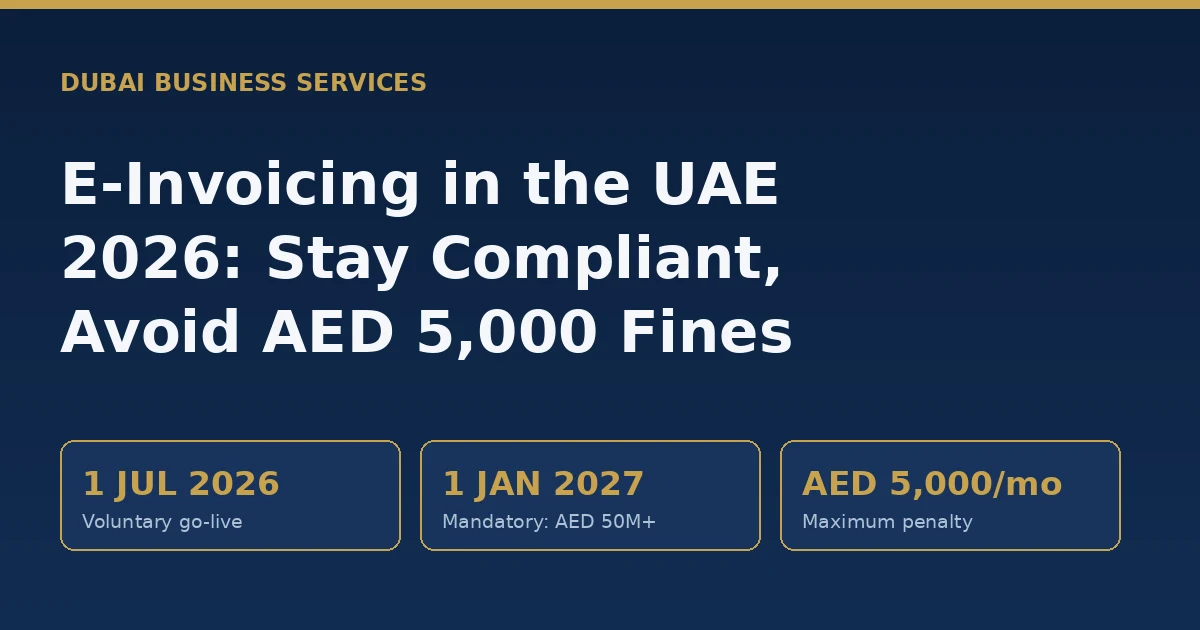
E-invoicing UAE becomes a phased legal requirement in 2026: voluntary adoption opens 1 July 2026, and large companies must comply from 1 January 2027. Businesses earning AED 50 million or more must appoint an Accredited Service Provider by 30 October 2026 or risk fines up to AED 5,000 per month. The UAE Ministry of Finance and Federal Tax Authority (FTA) built the system on the global Peppol model, covering mainland and free zone firms.
What the UAE E-Invoicing Mandate Actually Means for Your Business
For years, a Dubai invoice could be a PDF, a Word file, or even a printed page stamped at the counter. That era is ending. Under the new framework, only a structured electronic invoice exchanged through an accredited platform will count as a valid tax document. If you sell to other businesses or to government entities, the way you bill is about to change at a regulatory level — and the same authorities that enforce e-invoicing UAE rules also oversee corporate tax and VAT compliance, so getting this right protects your wider standing with the FTA.
The reform is part of a broader digital-tax push announced by the UAE Ministry of Finance. Its goal is to give the FTA near real-time visibility of B2B and B2G transactions, reduce VAT fraud, and cut the cost of processing paperwork. Global e-invoicing studies (Billentis, 2024) show that moving from paper to structured digital invoices reduces invoice-handling costs by up to 80% per document, which is one reason governments across the Gulf are adopting it quickly.
Want a quote? WhatsApp DBS at +971 54 332 2846 →
How UAE E-Invoicing Works: The Five-Corner Peppol Model
The UAE has not built a single government portal where you upload invoices. Instead, it adopted a Peppol-based Decentralised Continuous Transaction Control and Exchange (DCTCE) framework — commonly called the five-corner model. Understanding the five corners makes the rest of the rollout easy to follow.
- Corner 1 — The supplier: your business, issuing the invoice from your accounting system.
- Corner 2 — The supplier’s Accredited Service Provider (ASP): a government-accredited platform that converts your invoice into the required structured XML format and transmits it.
- Corner 3 — The buyer’s ASP: receives and validates the invoice on the customer’s side.
- Corner 4 — The buyer: your customer, who receives a validated digital invoice.
- Corner 5 — The Federal Tax Authority: receives the tax-relevant data reported automatically by the ASPs.
The practical takeaway: a valid e-invoice is a structured XML file built to the UAE’s PINT AE data dictionary and sent through an ASP. A PDF emailed to a client — even a beautifully designed one — is no longer a legal tax invoice under this system (Ministry of Finance, 2026).
Confused about this? Ask DBS — WhatsApp +971 54 332 2846 →
The UAE E-Invoicing Timeline: 4 Phases You Need to Know
The Ministry of Finance is rolling the mandate out in stages so businesses have time to prepare. These are the four milestones that matter in 2026 and 2027:
- Legislative foundation (2024–2025): Federal Decree-Law No. 16 of 2024 and No. 17 of 2024 amended the VAT Law and Tax Procedures Law to define electronic invoices and the reporting obligation.
- Voluntary go-live — 1 July 2026: businesses may begin issuing e-invoices through accredited providers ahead of the mandatory deadline. Early adopters can test integrations without penalty exposure.
- ASP appointment deadline — 30 October 2026: companies with annual revenue of AED 50 million or more must have appointed an Accredited Service Provider. This deadline was extended from the original 31 July 2026 date.
- Mandatory Phase 1 — 1 January 2027: e-invoicing becomes compulsory for the AED 50 million-plus revenue group on B2B and B2G transactions. Smaller businesses and government bodies follow in later phases announced by the Ministry of Finance.
Need help mapping these dates to your accounting cycle? WhatsApp +971 54 332 2846 →
Who Must Comply — Including Free Zone Companies
One of the biggest misconceptions is that free zone companies are exempt. They are not. The mandate applies to all UAE businesses and government entities in scope for B2B and B2G transactions — whether VAT-registered or not, and whether mainland or free zone — unless a specific exclusion applies.
The first compliance wave is defined by size, not by location: any taxable person with annual revenue of AED 50 million or more falls into Phase 1 from 1 January 2027. Business-to-consumer (B2C) sales are outside the initial scope, but the Ministry of Finance has signalled that consumer transactions will be brought in during a later phase. In short, if you invoice another company or a government department, you should assume you are in scope and plan accordingly.
If your structure spans VAT registration in the UAE and multiple trade licences, an early readiness review prevents nasty surprises in 2027.
Ready to start? WhatsApp +971 54 332 2846 →
The 7 Proven Rules to Get E-Invoicing Compliant in 2026
These are the seven steps DBS walks every client through to move from paper and PDF billing to a fully compliant e-invoicing setup.
- Confirm your revenue band. Calculate your last 12 months of revenue. If you are at or above AED 50 million, you are in Phase 1 with a 1 January 2027 hard deadline.
- Verify your VAT and Tax Procedures standing. Make sure your Tax Registration Number and FTA records are accurate, because e-invoicing data ties directly to your tax profile.
- Choose an Accredited Service Provider (ASP). Only providers accredited by the Ministry of Finance can transmit valid e-invoices. Appoint one before 30 October 2026 if you are in the large-business band.
- Map your invoice data fields. Align your current invoice fields to the UAE PINT AE data dictionary so every mandatory field (TRN, line items, tax breakdown) is captured.
- Integrate your accounting or ERP system. Connect your software to the ASP via API so invoices flow automatically into structured XML rather than being re-keyed.
- Run a pilot during the voluntary window. Use the period from 1 July 2026 to issue and receive test invoices, catching errors before they carry a penalty.
- Train your finance team and document the process. Make sure staff know that a PDF is no longer a valid tax invoice and that exceptions are logged for audit.
Save 40 hours — let DBS handle it. WhatsApp +971 54 332 2846 →
What E-Invoicing Compliance Costs in the UAE (2026)
There is no government fee to “register” for e-invoicing itself — the cost sits in the supporting compliance and software layer. The matrix below is a fresh DBS estimate of the real readiness budget for a typical SME, separating statutory items from the service work involved.
| Readiness Item | Government Fee (AED) | DBS Service (AED) | Estimated Total (AED) | Notes |
|---|---|---|---|---|
| VAT registration (prerequisite) | 0 | From 1,500 | From 1,500 | No FTA fee; required tax base for e-invoicing |
| ASP subscription (annual) | 0 | 3,000–12,000 | 3,000–12,000 | Varies by invoice volume and provider tier |
| Accounting / ERP integration | 0 | 2,500–15,000 | 2,500–15,000 | One-off; depends on existing software |
| Data-field mapping & pilot | 0 | From 2,000 | From 2,000 | PINT AE alignment + voluntary-window testing |
| Late / non-compliance penalty | Up to 5,000/month | 0 | Avoidable | The cost of doing nothing before the deadline |
For most SMEs, a fully managed first-year readiness package lands in the AED 8,000–25,000 range — a fraction of the penalty exposure for missing the 2027 deadline.
Skip the paperwork — WhatsApp DBS at +971 54 332 2846 →
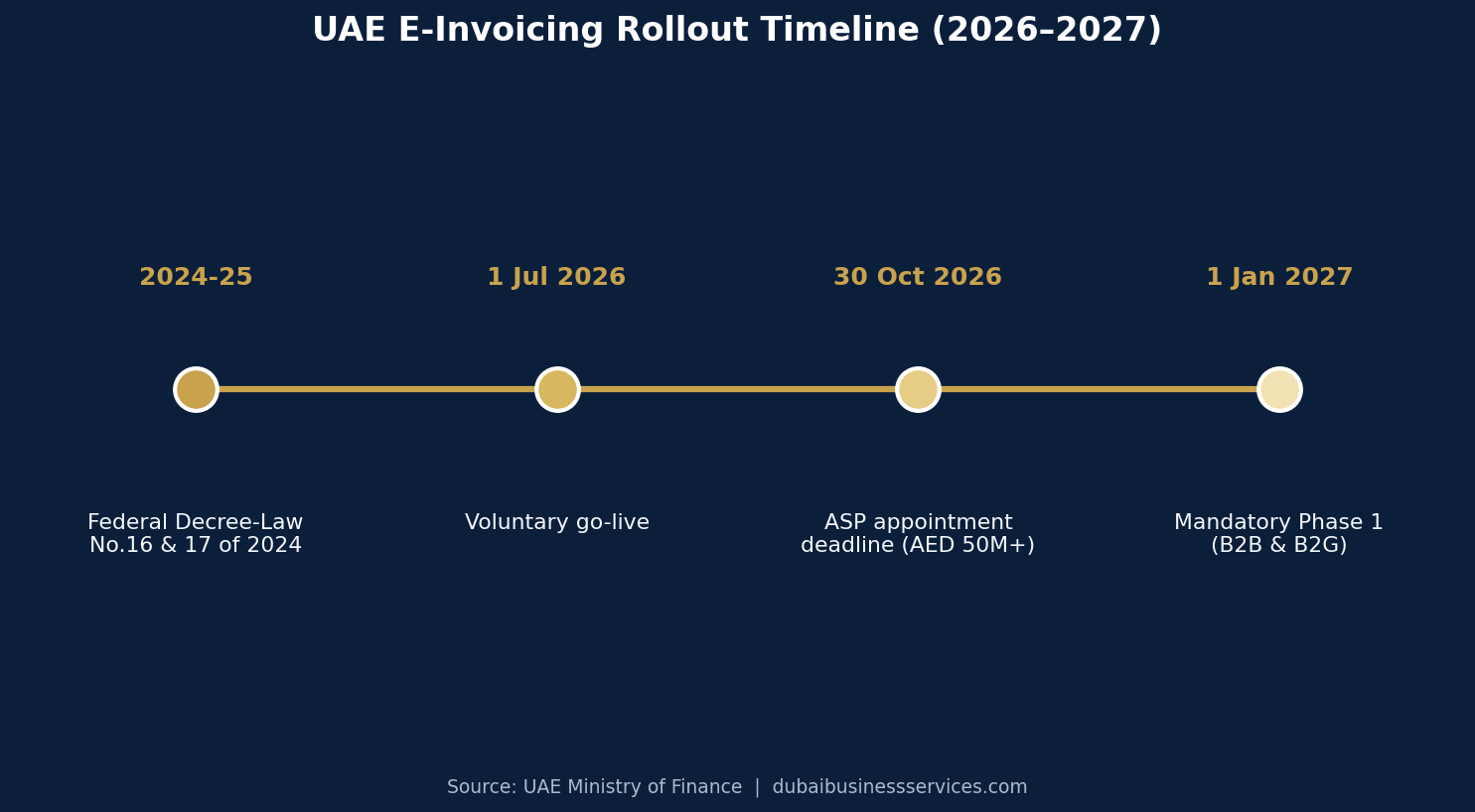
Embed this infographic: <a href="https://www.dubaibusinessservices.com/e-invoicing-uae-2026/"><img src="https://www.dubaibusinessservices.com/wp-content/uploads/2026/06/e-invoicing-uae-timeline-2026-2027-dubai-2026.png" alt="UAE E-Invoicing 2026-2027 rollout timeline | Dubai Business Services 2026"></a>
Penalties for Non-Compliance — and How to Avoid Them
Non-compliance with the UAE e-invoicing framework can trigger administrative penalties of up to AED 5,000 per month for certain violations, alongside the existing penalty regime under the Tax Procedures Law. Failing to issue a valid structured invoice, or continuing to rely on PDFs after your phase begins, exposes you to fines that compound monthly.
The good news is that every penalty here is avoidable with preparation. Businesses that use the voluntary window from 1 July 2026 to test their setup, and that appoint an ASP well before the 30 October 2026 deadline, carry effectively zero penalty risk. The companies that struggle are the ones that treat a 2027 deadline as a 2027 problem. Reviewing your position now — alongside any open corporate tax penalty waiver matters — keeps your entire FTA profile clean.
Confused about your exposure? Ask DBS — WhatsApp +971 54 332 2846 →
The DBS Advantage for E-Invoicing Readiness
DBS Group has served 80,000+ entrepreneurs since 2009, and an estimated 18% of our active corporate clients already exceed the AED 50 million Phase 1 threshold (DBS internal estimate, 2025). That scale means we have mapped the e-invoicing requirement against real UAE company structures — mainland LLCs, free zone entities, and groups with multiple licences.
Where a software vendor sells you a platform and a Big Four firm sells you a legislative memo, DBS sits in between: we assess your specific structure, coordinate VAT and corporate tax standing, recommend and onboard an Accredited Service Provider, and manage the integration and pilot end to end. We also align e-invoicing readiness with practical needs such as opening or upgrading a business bank account so your payment and invoicing flows stay consistent. One managed file, one point of contact, zero scramble before 2027.
Ready to start? WhatsApp +971 54 332 2846 →
Frequently Asked Questions About E-Invoicing in the UAE
When does e-invoicing become mandatory in the UAE?
E-invoicing becomes mandatory for businesses with annual revenue of AED 50 million or more from 1 January 2027, with a voluntary adoption window opening on 1 July 2026. Smaller businesses and government entities are scheduled for later phases announced by the Ministry of Finance (2026).
Is e-invoicing mandatory for free zone companies in the UAE?
Yes. Free zone companies are not exempt. The mandate applies to all UAE businesses in scope for B2B and B2G transactions, whether mainland or free zone and whether VAT-registered or not, unless a specific exclusion applies. Only narrowly defined transactions sit outside the framework (Ministry of Finance, 2026).
What is an Accredited Service Provider (ASP)?
An ASP is a platform accredited by the UAE Ministry of Finance to convert invoices into the required structured XML format and transmit them through the Peppol network. Large businesses (AED 50 million-plus revenue) must appoint an ASP by 30 October 2026 to remain compliant.
Are PDF invoices still valid in the UAE under the new rules?
No. Once your phase begins, only a structured XML invoice transmitted through an Accredited Service Provider qualifies as a valid e-invoice. PDFs, scanned copies, and paper invoices are not legally valid tax documents under the UAE framework (Ministry of Finance, 2026), even if you also send them to the customer.
What are the penalties for not complying with UAE e-invoicing?
Reported penalties reach up to AED 5,000 per month for certain e-invoicing violations, on top of the existing Tax Procedures Law penalty regime. Because fines can compound monthly, the cost of inaction grows quickly — making early preparation in the 2026 voluntary window the cheapest path to compliance.
Do I need to be VAT-registered to issue e-invoices?
The e-invoicing mandate can apply whether or not you are VAT-registered, because it covers B2B and B2G transactions in scope regardless of VAT status. That said, accurate VAT and Tax Registration Number records are essential, since e-invoicing data links directly to your FTA tax profile (FTA, 2026).
How long does it take to become e-invoicing compliant?
For a typical SME, full readiness — appointing an ASP, mapping data fields, integrating accounting software, and running a pilot — takes around four to eight weeks. Starting during the voluntary window from 1 July 2026 leaves ample time before the 1 January 2027 mandatory deadline for large businesses.
How much does e-invoicing compliance cost in the UAE?
There is no direct government fee for e-invoicing. Costs come from ASP subscriptions (roughly AED 3,000–12,000 per year), software integration (AED 2,500–15,000 one-off), and advisory support. A fully managed first-year readiness package typically falls between AED 8,000 and AED 25,000 for an SME (DBS estimate, 2026).
Get E-Invoicing Ready Before the 2027 Deadline
The UAE e-invoicing mandate is not optional, and the businesses that prepare during the 2026 voluntary window will glide into 2027 while others scramble. DBS Documents Clearing LLC handles the full readiness journey — revenue assessment, ASP selection, integration, and pilot — so your invoicing stays compliant and audit-ready.
Talk to a DBS consultant today: WhatsApp +971 54 332 2846 or email inquiry@dubaibusinessservices.com.
By Salem Basheer, DBS Documents Clearing LLC. Last updated: 2026-06-20.