UAE Free Zones by Industry 2026: Match Your Sector to the Right Zone
Last updated: 2026-08-24
UAE free zones by industry fall into three groups: sector-regulated zones such as DIFC and Dubai Healthcare City, generalist zones such as IFZA and Meydan, and industrial zones such as JAFZA. More than 45 free zones operate across the seven emirates in 2026, and only a subset licences any given regulated activity. DBS Group, serving 80,000+ entrepreneurs since 2009, matches the activity to the zone before any fee is paid.
Why Free Zone Specialisation Decides Your Licence — Not Price
Most founders shop for a free zone the way they shop for a flight: cheapest fare wins. That approach breaks the moment a regulator gets involved. A zone’s licence schedule is a closed list of activities the authority is permitted to issue, and no amount of negotiation adds an activity that sits outside its mandate. This is the single reason a founder who understands UAE free zones by industry before signing sets up once, while the founder who chases the lowest headline fee sets up twice.
The distinction is legal, not commercial. Each free zone operates under its own founding decree and its own registrar. Dubai International Financial Centre runs a common-law jurisdiction with its own courts and its own regulator, the DFSA. Dubai Healthcare City licences clinical operators under a dedicated health regulator. Jebel Ali Free Zone exists to serve a port. A generalist zone such as IFZA or Meydan issues broad trading and consultancy licences and deliberately stays out of regulated territory.
The Three Zone Types You Are Actually Choosing Between
Sector-regulated zones pair a company licence with an industry regulator. You receive two approvals, not one: the free zone licence and the sector permit. DIFC, ADGM, Dubai Healthcare City, Dubai Knowledge Park and Dubai Maritime City all work this way. Setup runs 4 to 12 weeks because the regulator, not the registrar, sets the pace.
Generalist zones issue commercial, service and general-trading licences with no external regulator in the loop. IFZA, Meydan, SHAMS, RAKEZ and Ajman Free Zone sit here. Licences issue in 3 to 10 working days and start from roughly AED 5,750 in government fees for a single-activity package (2026).
Industrial and logistics zones sell land, warehousing and port access alongside the licence. JAFZA, DAFZA, KEZAD and Dubai Industrial City belong to this group. The licence fee is the smallest line on the invoice; the lease is the real number.
What a Specialty Actually Buys You
A specialised zone delivers four things a generalist zone does not. First, activity codes that exist nowhere else — a fund manager cannot be licensed outside DIFC or ADGM in the UAE’s common-law framework. Second, a regulator who understands the file, which compresses approval cycles. Third, a cluster: DMCC hosts over 25,000 member companies (2025), and proximity to counterparties is a commercial asset in commodities. Fourth, credibility with banks, because compliance teams price a DIFC entity and a generic trading company differently.
Need help with this step? WhatsApp DBS at +971 54 332 2846 →
The 13 Sector-Specialised UAE Free Zones Worth Knowing in 2026
The list below maps each sector to the zone that holds the licensing mandate for it. It is not a ranking; it is a matching exercise.
1. Commodities, Gold and Precious Metals — DMCC
Dubai Multi Commodities Centre holds the mandate for physical commodity trade, gold and diamond dealing, and tea and coffee trading. It is the only Dubai zone with a purpose-built vault infrastructure and a Dubai Gold & Commodities Exchange on the doorstep. Government licence fees run AED 34,000 to AED 50,000 for a standard trading licence with a flexi-desk (2026). The DMCC free zone cost breakdown sets out the line items in full.
2. Financial Services, Funds and Wealth — DIFC
Dubai International Financial Centre licences banks, asset managers, brokers, insurers and family offices under the DFSA. DIFC reported 6,900+ active registered companies (2025). Two fees apply: the DIFC commercial licence and a separate DFSA authorisation fee tied to the regulatory category. Budget 12 to 20 weeks for a Category 3 or 4 authorisation.
3. Fintech and Innovation — DIFC Innovation Hub
The Innovation Testing Licence gives fintechs a restricted, time-boxed DFSA authorisation at a fraction of full licensing cost — from roughly AED 5,500 in the first year (2026). Firms operate under a defined test plan for up to 24 months before converting to a full licence.
4. Media, Broadcast and Production — Dubai Media City and Dubai Studio City
These zones licence publishing, advertising, broadcast, film production and post-production. A freelance permit for a single individual starts from roughly AED 7,500 in government fees (2026), which is the cheapest legitimate route to a UAE residence visa for a solo creative professional.
5. Healthcare, Clinics and Pharma — Dubai Healthcare City
DHCC licences clinics, day surgery centres, diagnostic labs and pharmaceutical distributors. Two layers apply: the DHCC company licence and the facility licence, plus individual practitioner licences for every clinician. No clinic opens on the company licence alone.
6. Technology and Software — Dubai Internet City and Dubai Silicon Oasis (DIEZ)
Dubai Internet City serves enterprise technology firms and hosts the regional offices of the large platforms. Dubai Silicon Oasis, now part of Dubai Integrated Economic Zones, is the cost-efficient route for a software company that needs a credible tech address without DIC’s premium.
7. Logistics, Re-Export and Manufacturing — JAFZA
Jebel Ali Free Zone connects directly to Jebel Ali Port, the largest container port between Rotterdam and Singapore. JAFZA is the correct answer for any business moving physical volume, holding customs-bonded stock, or manufacturing for re-export.
8. Aviation and Aerospace — DAFZA
Dubai Airport Freezone sits inside the airport perimeter. It suits aircraft parts distribution, high-value electronics, pharmaceuticals requiring cold-chain air freight, and any goods where hours matter more than cents per kilo.
9. Education, Training and HR — Dubai Knowledge Park and Dubai International Academic City
These zones licence training institutes, HR consultancies, recruitment firms and higher-education branch campuses. A KHDA permit is mandatory before any course is delivered commercially — the free zone licence alone does not authorise teaching.
10. Design, Fashion and Architecture — Dubai Design District (d3)
d3 licences design studios, fashion labels, architecture practices and creative agencies, and pairs the licence with retail and showroom space in the same district.
11. Maritime and Ship Management — Dubai Maritime City
Ship management, chartering, marine survey, yacht brokerage and ship repair sit here, under the Dubai Maritime Authority’s oversight rather than a general trade registrar.
12. Life Sciences, Energy and Environment — Dubai Science Park
Dubai Science Park licences laboratories, biotech firms, energy consultancies and environmental services, with lab-ready premises that a generalist zone cannot offer.
13. General Trading and Consultancy — IFZA, Meydan, SHAMS, RAKEZ, Ajman
The generalist tier. These zones licence trading, consultancy, e-commerce, marketing and management services quickly and cheaply. They are the right answer when no regulator is involved — and the wrong answer when one is. The IFZA all-in setup cost is the benchmark most founders compare against.
For a cost-and-ownership view of the same landscape rather than a sector view, the top 10 free zones for foreign investors covers the commercial angle.
Want a quote? WhatsApp +971 54 332 2846 →
2026 Sector Licence Fee Matrix — What Each Specialty Actually Costs
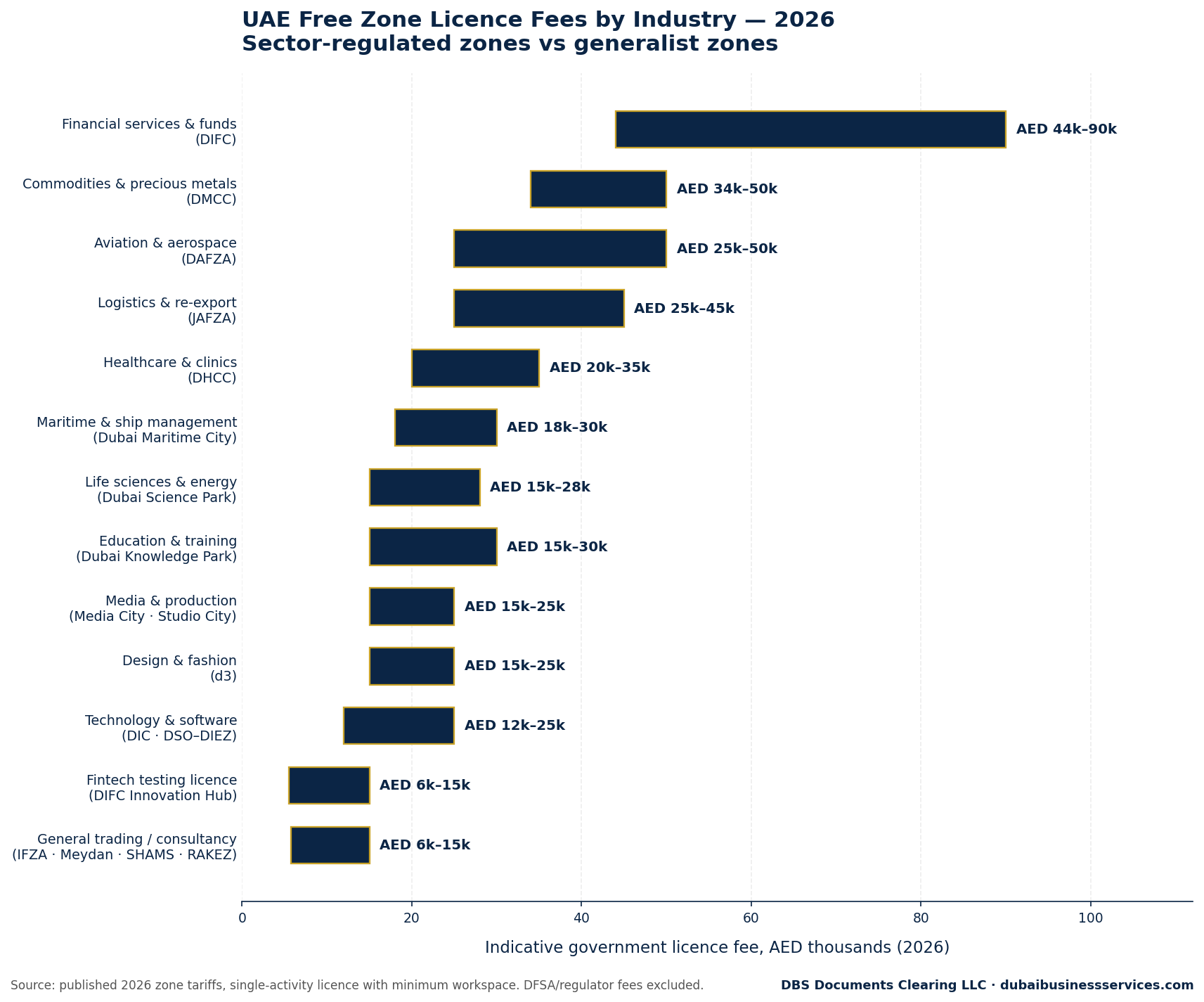
The table below is a per-sector tariff matrix, not a generic zone comparison. Government fees are indicative 2026 published ranges for a single-activity licence with the zone’s minimum workspace product. DBS service fees are quoted per file because activity count, visa quota and regulator load change the work involved.
| Activity (best-fit zone) | Government Fee (2026) | DBS Service | Total | Notes |
|---|---|---|---|---|
| Commodities & precious metals (DMCC) | AED 34,000–50,000 | Quoted on WhatsApp | Government fee + DBS fee | Flexi-desk mandatory; crypto activity is a separate approval |
| Financial services & funds (DIFC) | AED 44,000–90,000+ | Quoted on WhatsApp | Government fee + DBS fee | DFSA authorisation billed separately by category |
| Fintech testing licence (DIFC Innovation Hub) | AED 5,500–15,000 | Quoted on WhatsApp | Government fee + DBS fee | Restricted scope, up to 24 months |
| Media & production (Dubai Media City / Studio City) | AED 15,000–25,000 | Quoted on WhatsApp | Government fee + DBS fee | Freelance permit from AED 7,500 |
| Healthcare & clinics (DHCC) | AED 20,000–35,000 | Quoted on WhatsApp | Government fee + DBS fee | Facility and practitioner licences are additional |
| Technology & software (DIC / DSO–DIEZ) | AED 12,000–25,000 | Quoted on WhatsApp | Government fee + DBS fee | DSO is the lower-cost tech route |
| Logistics & re-export (JAFZA) | AED 25,000–45,000 | Quoted on WhatsApp | Government fee + DBS fee | Warehouse lease is the dominant cost |
| Aviation & aerospace (DAFZA) | AED 25,000–50,000 | Quoted on WhatsApp | Government fee + DBS fee | Airside bonded storage available |
| Education & training (Dubai Knowledge Park) | AED 15,000–30,000 | Quoted on WhatsApp | Government fee + DBS fee | KHDA permit required before delivery |
| Design & fashion (d3) | AED 15,000–25,000 | Quoted on WhatsApp | Government fee + DBS fee | Showroom space bundled on request |
| Maritime & ship management (Dubai Maritime City) | AED 18,000–30,000 | Quoted on WhatsApp | Government fee + DBS fee | Maritime authority endorsement required |
| Life sciences & energy (Dubai Science Park) | AED 15,000–28,000 | Quoted on WhatsApp | Government fee + DBS fee | Lab-grade premises available in-zone |
| General trading & consultancy (IFZA, Meydan, SHAMS, RAKEZ, Ajman) | AED 5,750–15,000 | Quoted on WhatsApp | Government fee + DBS fee | Fastest issuance; no sector regulator |
Embed this infographic — copy the HTML below:
<a href="https://www.dubaibusinessservices.com/various-free-zones-uae-different-specialties/"><img src="https://www.dubaibusinessservices.com/wp-content/uploads/2026/08/uae-free-zone-licence-fees-by-industry-dubai-2026-infographic.png" alt="UAE free zone licence fees by industry 2026 | Dubai Business Services 2026" width="800" /></a><p>Infographic by <a href="https://www.dubaibusinessservices.com/various-free-zones-uae-different-specialties/">DBS Documents Clearing LLC</a></p>Two numbers explain why the cheap row at the bottom is not automatically the right row. In DBS’s 2025 file review, 38% of clients who arrived asking for a licence amendment were sitting in a generalist zone that could not licence the second activity their business had grown into. Of the 80,000+ setups DBS Group has processed since 2009, 62% of sector-regulated files required at least one approval beyond the free zone authority itself (2025). Amending a licence costs less than a new one; migrating between zones costs more than getting it right the first time.
Ready to start? WhatsApp +971 54 332 2846 →
How to Choose Your UAE Free Zone in 5 Steps
Step 1 — Write the activity, not the industry
“Fintech” is not an activity. “Arranging credit” and “operating a money services business” are activities, and they carry different regulatory categories and different capital requirements. Write the exact commercial act you will perform and invoice for.
Step 2 — Identify the regulator before the zone
If a federal or emirate regulator governs your activity — the Central Bank, the DFSA, a health authority, KHDA, VARA for virtual assets in Dubai outside DIFC — that regulator narrows the zone list to one or two options. The zone follows the regulator, never the reverse.
Step 3 — Test the second and third activity
Ask the zone in writing whether it will licence the activities you expect to add in years two and three. This single question prevents the most expensive mistake in UAE company formation.
Step 4 — Price the workspace, not the licence
Visa quota is tied to workspace type. A flexi-desk supports a small quota; an office unlocks more. The free zone visa quota limits differ sharply between zones and decide how large the company grows before it relocates.
Step 5 — Confirm the tax position in writing
Qualifying Free Zone Person status is not automatic. Confirm that your activity is qualifying, that your substance sits inside the zone, and that non-qualifying revenue stays within the de minimis threshold before you commit.
Confused about this? Ask DBS — WhatsApp +971 54 332 2846 →
Corporate Tax, Substance and the 0% Qualifying Income Test
UAE corporate tax applies at 9% on taxable income above AED 375,000 under Federal Decree-Law No. 47 of 2022 (2025). A Qualifying Free Zone Person pays 0% on qualifying income and 9% on everything else, under the framework set by Cabinet Decision No. 100 of 2023 (2025). The status is conditional and it is lost, not reduced, when conditions fail.
Three conditions decide the outcome. Adequate substance must sit inside the free zone — staff, assets and core income-generating activity, not a mailbox. Income must fall inside the qualifying activity list, which centres on trade with other free zone entities and on defined international activity. Non-qualifying revenue must stay under the de minimis threshold: the lower of 5% of total revenue or AED 5 million (2025). Breach it and the entity is taxed at 9% on all income for that tax period and the following four.
Sector choice interacts with this directly. A commodities trader in DMCC selling to other free zone entities has a clean qualifying profile. A consultancy in a generalist zone invoicing mainland UAE clients does not — that revenue is mainland-sourced and taxable. The full mechanics sit in the 0% qualifying income rules for free zone trading, and the structural trade-off against a mainland licence is set out in the mainland vs free zone comparison.
Registration with the Federal Tax Authority is mandatory for every free zone company regardless of whether tax is payable. Filing is annual, within nine months of the financial year end.
Save 40 hours — let DBS handle it. WhatsApp +971 54 332 2846 →
The DBS Advantage: What We Fix Before It Costs You
DBS Group has cleared documents and licences in the UAE since 2009. The value in a specialised-zone file is not the application form — every consultancy fills those. It is the sequencing.
Three failures repeat. The first is applying to the zone before the regulator, which produces a licence that cannot legally be used and a renewal fee that arrives anyway. The second is a name and activity mismatch, where the trade name implies an activity the licence does not carry, and the bank rejects the account on that basis. The third is understated visa quota, where a founder commits to a flexi-desk and discovers in month four that hiring requires a relocation and a fresh lease.
DBS runs the regulator conversation first, confirms activity codes in writing before any fee is paid, and sizes workspace against a three-year headcount plan rather than a first-year budget. For sector-regulated files — healthcare, financial services, education, maritime, virtual assets — DBS maintains direct government liaison channels and prepares the regulator submission in parallel with the zone application rather than in sequence, which removes 2 to 5 weeks from a typical timeline.
Skip the paperwork — WhatsApp DBS at +971 54 332 2846 →
Frequently Asked Questions
How many free zones are there in the UAE in 2026?
More than 45 free zones operate across the seven emirates in 2026, with over 20 in Dubai alone. Roughly a dozen hold genuine sector mandates; the remainder issue general trading, service and e-commerce licences. The UAE government portal at u.ae maintains the authoritative list by emirate.
Which UAE free zone is best for my industry?
The regulator decides, not the zone. Financial services means DIFC or ADGM, clinical healthcare means Dubai Healthcare City, commodities means DMCC, logistics means JAFZA. If no regulator governs your activity, a generalist zone such as IFZA or Meydan is correct and costs 60–80% less.
How much does a specialised free zone licence cost in the UAE in 2026?
Government licence fees run AED 5,750 to AED 15,000 in generalist zones and AED 15,000 to AED 90,000+ in sector-regulated zones for a single activity (2026). Regulator authorisation fees in DIFC and ADGM sit on top and are billed by category, not by licence.
Can I change my free zone after the company is registered?
Yes, but it is a new incorporation in the destination zone plus a liquidation or transfer in the origin zone, and it triggers fresh visa applications and a new bank account. Budget 6 to 12 weeks and expect to pay the full setup cost twice.
Do free zone companies pay 9% corporate tax in the UAE?
A Qualifying Free Zone Person pays 0% on qualifying income and 9% on non-qualifying income above AED 375,000 (2025). Failing the substance test, the qualifying activity test, or the de minimis threshold of 5% of revenue or AED 5 million removes the 0% rate for five tax periods.
Can a free zone company trade with mainland UAE clients?
Yes, through a mainland distributor, a mainland branch, or by taking a dual licence where the zone offers one. Direct invoicing of mainland customers is permitted, but that revenue is non-qualifying and taxed at 9% above the AED 375,000 threshold (2025).
How long does a specialised free zone licence take to issue?
Generalist zones issue in 3 to 10 working days. Sector-regulated zones run 4 to 12 weeks because the regulator sets the pace: DIFC Category 3 and 4 authorisations typically take 12 to 20 weeks, and DHCC facility licensing adds a site inspection.
Do I need an office to get a UAE free zone licence?
Every free zone requires a registered workspace product, from a flexi-desk to a full office. Flexi-desks start from roughly AED 5,750 bundled into generalist packages (2026) and support a small visa quota. Sector-regulated zones such as DHCC and DIFC require physical premises for most licence categories.
What is the cheapest UAE free zone in 2026?
SHAMS, Ajman Free Zone, RAKEZ, IFZA and Meydan compete at the entry tier, with government fees from roughly AED 5,750 for a single-activity licence without a visa allocation (2026). None of them licence regulated activities, so the saving is real only when no regulator is involved.
Get the Zone Right the First Time
Matching a sector to a UAE free zone is a one-hour conversation that prevents a six-figure correction. DBS Documents Clearing LLC confirms your activity codes, identifies the regulator, and issues a written zone recommendation before you pay a single government fee.
WhatsApp: +971 54 332 2846 · Email: inquiry@dubaibusinessservices.com
Sources: UAE Government Portal — Free Zones · Federal Tax Authority · UAE Ministry of Economy · Virtual Assets Regulatory Authority
Written by Salem Basheer, DBS Documents Clearing LLC. Last updated: 2026-08-24.