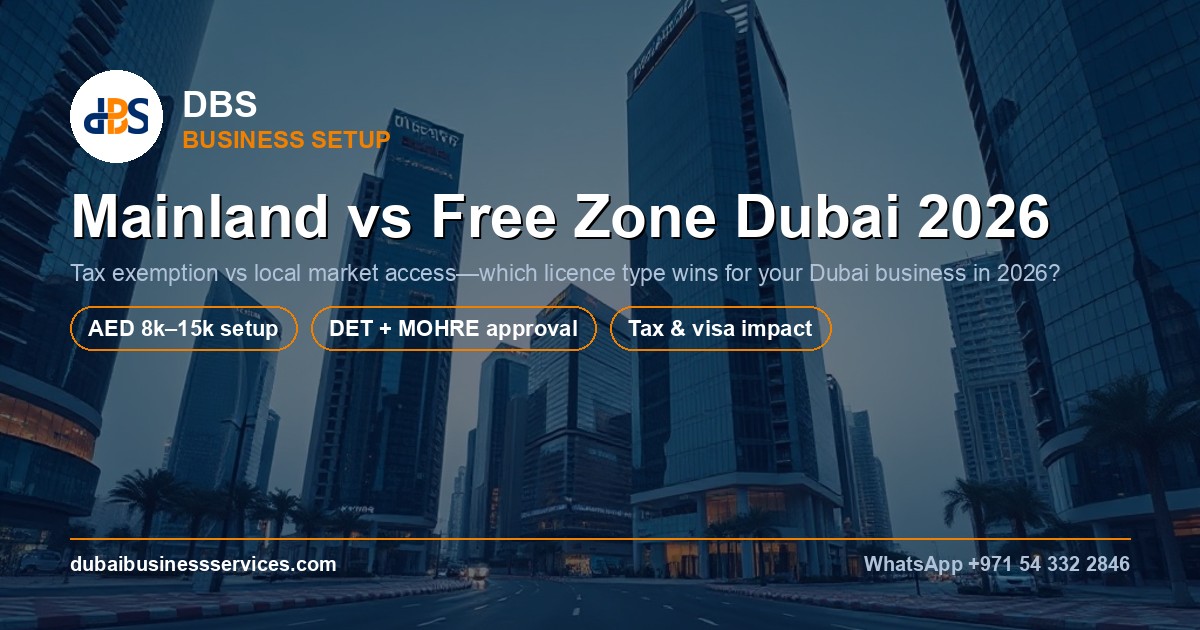
In 2026, mainland licences unlock UAE invoicing, government contracts, and full banking access—ideal for B2B SaaS and consultancy. Free zones offer 0% corporate tax and faster registration via DET or MOHRE-recognised authorities. Dual licensing (free zone + DET branch) is now the scaling option for firms targeting both domestic and re-export revenue.
Mainland vs Free Zone Dubai 2026: The Essential Difference
The choice between Dubai mainland company formation and free zone setup hinges on three pillars: tax treatment, market access, and visa eligibility. Under Cabinet Decision 100 of 2023 (QFZP framework), qualifying free zone companies retain 0% corporate tax indefinitely, while mainland entities now face 0% tax on profits up to AED 375,000 per annum, and 23% above that threshold. However, mainland licences—issued by the Department of Economy and Tourism (DET) in Dubai or emirate-equivalent bodies—grant full rights to invoice UAE clients, bid on government tenders, and access traditional banking without restrictions. Free zones, conversely, operate under zone-specific rules: invoicing within the UAE requires prior DET approval, and government contracts remain largely inaccessible without a domestic branch.
Unsure which suits your business model? WhatsApp +971 54 332 2846 for a free 15-minute diagnostic.
2026 Corporate Tax & Financial Impact
Dubai’s 2026 tax landscape crystallises the financial trade-off. Mainland entities with annual profits exceeding AED 375,000 pay 23% corporate income tax. Free zone companies licensed under the Qualified Free Zone Person (QFZP) scheme or Standard FZ framework remain taxed at 0%, provided they maintain operational substance and do not re-invoice within the UAE without explicit approval. For a B2B SaaS founder earning AED 1 million in year-one revenue, a mainland structure costs approximately AED 144,000–180,000 in tax (assuming 40% net margin), whereas an FZ-LLC structure incurs AED 0. Over three years, this differential reaches AED 432,000–540,000. The catch: free zone companies pay fixed annual licence renewal (AED 1,500–3,000), whilst mainland licences vary by activity (AED 2,000–5,000 plus sector levies). Both are negligible relative to tax savings.
Calculate your 3-year tax liability. Email inquiry@dubaibusinessservices.com with your revenue forecast.
Visa Quota, Banking & Operational Access
Visa allocation differs markedly. Mainland licences grant MOHRE-sponsored visas based on share capital: typically 1 visa per AED 100,000 invested. Free zone licences issue visas through zone-specific quotas—often tighter. For a founder requiring 5 staff visas, a mainland structure with AED 500,000 share capital is straightforward; an FZ-LLC may face caps. Banking is similarly bifurcated: major UAE banks (FAB, RAK Bank, ADIB) readily open accounts for mainland entities; free zone accounts are available but some institutions impose higher minimum balances (AED 50,000–100,000 vs AED 25,000–50,000 for mainland). Government tender access is mainland-exclusive; free zones cannot directly bid on Ministry of Health, ADM, or FTA contracts unless operating through a registered mainland branch—a route explored under the dual-licence model below.
| Criterion | Mainland (DET) | Free Zone (DET/Zone Authority) |
|---|---|---|
| Corporate Tax (2026) | 0% on first AED 375k; 23% above | 0% (QFZP-qualified) |
| UAE Invoicing | Unrestricted | Requires DET approval |
| Government Contracts | Full access | Via mainland branch only |
| Setup Cost (3 months) | AED 12,000–18,000 | AED 8,000–12,000 |
| Visa Quota (per 100k AED) | 1 visa; MOHRE-controlled | Zone-dependent; often restricted |
| Banking Ease | High (all major banks) | Medium (select banks, higher minimums) |
| Licence Renewal | AED 2,000–5,000/year | AED 1,500–3,000/year |
Visa planning critical? We advise on headcount strategy before incorporation. Chat WhatsApp +971 54 332 2846.
Cabinet Decision 100 (2023) & Free Zone Permanence
Cabinet Decision 100 of 2023 enshrined permanent 0% corporate tax for QFZP-qualified free zone enterprises, ending earlier sunset clauses. Eligibility requires: (1) minimum AED 1 million foreign shareholding or investment, (2) operational HQ in the free zone, (3) no re-invoicing within the UAE unless DET-sanctioned. This regime shifts the free zone from a tax-holiday tactic to a structural choice for multinational R&D, trading, and light manufacturing. Yet the mandate remains: foreign ownership. A UAE national–led startup cannot claim QFZP; they default to Standard FZ status (still 0% tax) or mainland. Clarification is essential—many founders misunderstand this nuance.
The Dual-Licence Accelerator (Free Zone + DET Branch)
Scaling B2B firms increasingly adopt a hybrid: FZ-LLC (operational base, tax shelter, international contracts) plus a DET-registered branch (domestic invoicing, tenders, visa overflow). Cost is AED 18,000–28,000 upfront (both entities), but revenue unlocks immediately. An e-commerce SaaS exporting software to KSA, UAE, and Egypt can invoice export sales via FZ-LLC (0% tax), whilst a domestic implementation team operates under the branch (subject to corporate tax only on UAE-earned portion). This model is now DBS’s most-advised structure for founders expecting >AED 2 million annual revenue by year two. MOHRE and DET have coordinated approval workflows since Q4 2023, reducing dual setup from 90 to 45 days.
Interested in a dual-licence roadmap? Email inquiry@dubaibusinessservices.com for a bespoke structure report.
Sector-Specific Guidance: SaaS, E-commerce & Consultancy
B2B SaaS founders benefit most from Dubai free zone setup if >60% revenue is non-UAE. Hosting the product development in a Jebel Ali or Dubai Silicon Oasis FZ-LLC (0% tax), then serving UAE clients via a DET branch, yields optimal returns. E-commerce operators (dropshipping, retail arbitrage) should anchor in mainland if inventory sits in UAE warehouses—GFZC or JAFZA cannot legally hold stock for local sale. Consultancy and professional services (legal, auditing, management consulting) thrive under mainland, as MOHRE-regulated professions require domestic presence and cannot operate from free zones. Import–export traders splitting time between regional hubs favour DAFZA or RAK FZ, as the zone logistics infrastructure justifies relocation.
FAQ: Your 2026 Setup Questions Answered
See detailed answers below; for nuanced scenarios, Dubai business setup advisors at DBS are available via WhatsApp.
Frequently asked questions
Is a Dubai mainland or a free zone licence better for a B2B SaaS founder?
If your SaaS is export-heavy (60%+ revenue non-UAE), free zone wins—0% tax under Cabinet Decision 100 and faster visa processing. If you invoice UAE clients heavily or plan government contracts, mainland is essential. Optimal: free zone HQ + DET branch for domestic clients. DBS has structured this for 300+ SaaS founders since 2021.
Can a free zone company invoice clients inside the UAE in 2026?
Technically no—without prior DET approval. Free zones operate as export platforms. However, a free zone company can invoke a DET-registered branch to invoice locally, or seek special ministerial waiver under QFZP. This is where dual licensing shines: FZ-LLC handles international contracts, branch handles UAE invoicing. Standard processing: 10–15 working days for DET approval.
How does corporate tax differ between mainland and free zone in 2026?
Mainland: 0% on profits up to AED 375,000; 23% above. Free zone (QFZP-qualified): 0% indefinitely, per Cabinet Decision 100 of 2023. Practical impact on AED 1m revenue: mainland pays ~AED 144k–180k tax; free zone pays AED 0. Free zones also avoid VAT burden in some setups, though UAE VAT applies uniformly to both.
Which is cheaper end-to-end over 3 years — mainland or free zone?
Free zone is cheaper if you’re export-focused: setup AED 8k–12k + renewals AED 4.5k–9k = ~AED 20k–30k, plus AED 0 tax. Mainland: setup AED 12k–18k + renewals AED 6k–15k = ~AED 24k–48k, plus AED 144k–540k corporate tax (depending on profit). Dual licensing: AED 18k–28k setup + AED 10k–18k renewals + blended tax = ~AED 50k–100k, justified for >AED 2m revenue.
Can a free zone company hold government contracts?
Not directly. Free zones are non-regulatory entities and cannot bid on UAE government tenders (Ministry of Health, ADM, FTA, Customs). Workaround: establish a DET-licensed mainland branch, which can bid whilst retaining the free zone HQ’s tax benefits. This dual-licence setup is now standard for contractors and B2B suppliers targeting public procurement.
Does the choice change for an e-commerce vs consultancy founder?
Yes, materially. E-commerce (retail, dropshipping) should be mainland because stock cannot legally reside in free zones for local sale. Consultancy services (legal, auditing, HR) must be mainland—MOHRE regulates these professions and bars free zone operation. SaaS, trading, and digital marketing thrive in free zones. Sector licensing rules override tax considerations.
What’s the timeline to get both a mainland and free zone licence in 2026?
Dual licensing under coordinated MOHRE–DET workflow now takes 40–50 working days end-to-end (compared to 90 in 2023). Free zone setup alone: 15–25 days. Mainland alone: 20–30 days. Fast-track (premium fees: AED 2,000–5,000 extra) compresses both to 10–15 days. DBS has median processing time of 18 days for dual setups.
Get expert help in 20 minutes
Need clarity on your Dubai setup? Talk to DBS Documents Clearing LLC — 80,000+ entrepreneurs served since 2009. WhatsApp +971 54 332 2846 or email inquiry@dubaibusinessservices.com for a free 20-minute scoping call.