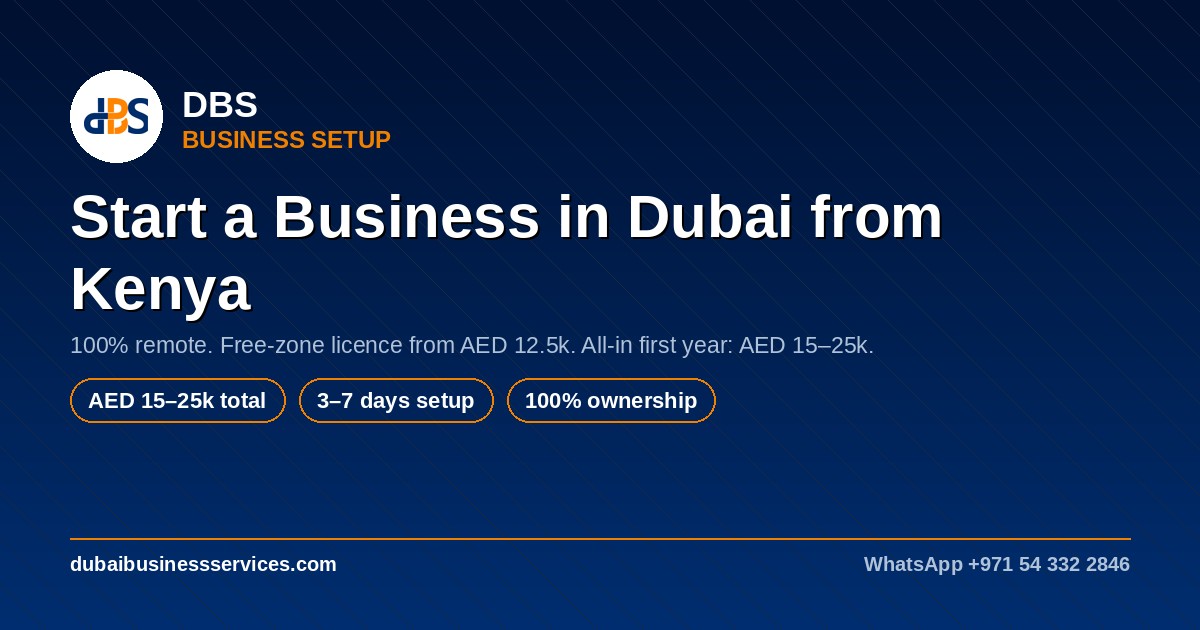
Kenyans can start a business in Dubai entirely remotely. Registration takes 3–7 working days; total first-year cost is AED 15,000–25,000 (≈KES 490,000–815,000 at indicative current rates — convert at today’s rate for accuracy; rates move). DET (Dubai Economy and Tourism) and MOHRE (Ministry of Human Resources and Emiratisation) process the licence and visa applications.
Opening a Dubai Business from Kenya: Full Costs in AED & Kenyan Shillings
Starting a business setup in Dubai from Kenya is straightforward and fully remote. Below is an itemised breakdown of realistic costs. All figures are indicative ranges; exchange rates move daily — we recommend converting at today’s live rate on XE.com or your bank.
| Cost Item | AED Range | KES Range (Indicative at ~32–33 KES/AED) | Notes |
|---|---|---|---|
| Licence (Free Zone) | AED 12,500–12,900 | KES 400,000–425,700 | Meydan (~AED 12,500; 1 visa incl.) or IFZA (~AED 12,900; zero-visa). Both have remote onboarding from Nairobi. |
| Licence (Mainland, no visa) | AED 18,200–19,500 | KES 582,400–643,500 | Cheaper if you don’t need a residence visa. Processed by DET. |
| Licence (Cheapest UAE-wide) | AED 4,888–5,750 | KES 156,416–189,750 | Ajman or SHAMS free zone (licence-only, minimal services). |
| Investor/Partner Visa (2-year) | AED 6,000–9,000 | KES 192,000–297,000 | If included in free-zone package, often bundled. Standalone: gov fees + attestation + medical ~AED 3,500–7,500 + visa processing. |
| Medical Exam & Emirates ID | AED 300–800 | KES 9,600–26,400 | Required if taking a visa. DHA clinic in Dubai or Nairobi-based partner (remote kit + lab). |
| Business Bank Account Setup | AED 0–500 (admin); Min balance AED 0–50,000 | KES 0–16,500 (admin); Min balance KES 0–1,650,000 | Wio AED 0 minimum; Mashreq NeoBiz ~AED 10k. Opening takes 1 week to several months (KYC friction for non-residents). |
| Flexi-Desk / Virtual Office (optional, annual) | AED 1,200–3,600 | KES 38,400–118,800 | For registered address in free zones. Not mandatory if already with a zone provider. |
| Business Insurance (first year) | AED 800–2,000 | KES 25,600–66,000 | Professional indemnity, public liability, or crime cover (industry-dependent). Optional but recommended. |
| LEAN FIRST-YEAR ALL-IN (Free Zone + 1 Visa) | AED 15,000–25,000 | KES 490,000–815,000 | Licence + visa + medical + bank account (min balance not counted as cost; only admin fees). Excludes working capital. |
| Annual Renewal (Year 2 onwards) | AED 7,000–20,000 | KES 224,000–660,000 | Licence renewal, visa renewal, compliance fees, annual audit (if required by structure). VAT registration adds ~AED 300–600 admin annually. |
Contact Dubai Business Services on WhatsApp +971 54 332 2846 for a free, fully itemised cost breakdown in Kenyan shillings for your exact business activity.
Step-by-Step Timeline: Registration in 3–7 Working Days
Here’s the realistic day-by-day journey from Nairobi:
- Day 1 (Monday morning): You submit completed application form, passport, bank statement (proof of funds ≥AED 30,000–50,000), and POA (Power of Attorney) to DBS or your chosen zone. All documents e-signed in Kenya using DocuSign or similar.
- Day 1–2: DBS submits to DET or free zone. Applicant attestation of home-country documents (embassy stamp or notary — typical Kenya: via UAE Embassy Nairobi or Huduma Centre). For zero-visa structure, no visa fee needed.
- Day 3–4: DET/zone issues draft licence. If visa required: medical exam completed (remote kit sent to Nairobi, results to DHA). Visa application lodged with MOHRE.
- Day 5–6: Visa approval (if applicable). Licence issued as PDF/soft copy. Bank account forms e-signed.
- Day 7: Bank KYC finalised (often requires a Zoom call or in-person visit if you’re in UAE; non-residents may need a resident signatory or POA). Account activated within 1–7 more business days.
Banking is the real friction point, not formation. A zero-visa company needs no residence visa to own the licence; the bank account is where you may need in-person KYC or a UAE-resident director/signatory.
100% Foreign Ownership: No Local Sponsor Required
Unlike many jurisdictions, the UAE (since 2020 reforms) allows Kenyans to own 100% of a mainland or free-zone company. No Emirati local sponsor is required for most activities. Dubai free zone company formation makes this even simpler: you own the whole enterprise outright.
Exceptions (where a local partner/agent may help but isn’t legally required): retail, real estate, certain professional services. For trading, tech, consulting, import–export, and professional services, 100% foreign ownership is the norm.
UAE Corporate Tax 2026: What Kenyans Actually Pay
Myth to correct: Dubai is not ‘100% tax-free’ since 2023. But this is the reality:
- Personal income tax: 0% on all salary, dividends, and capital gains (genuine and permanent in the UAE).
- Corporate tax: 0% on taxable profit up to AED 375,000 per year (applies to all entities from 1 Jan 2023). Above AED 375,000, you pay 9% on the excess.
- Small Business Relief: If your revenue is ≤AED 3M in a tax period ending on or before 31 Dec 2026, you pay 0% regardless of profit level. After 1 Jan 2027, the relief threshold drops to AED 2M.
- Free-zone 0% rule (2023 onwards): Free-zone companies get 0% only on Qualifying Qualifying Foreign-sourced Income (QFZP) under UAE tax law. ‘Qualifying’ means income derived outside the UAE, or UAE-source income that meets criteria in Cabinet Decision 48/2022. A de-minimis threshold applies: if non-qualifying income exceeds the lower of 5% of total revenue or AED 5M, you lose the 0% exemption for ~5 years and pay 9% from the first dirham going forward. Non-qualifying income (e.g., services in the UAE, local sales) is taxed at 9% from the first dirham regardless.
- VAT: 5% on most goods and services if you turn over >AED 375,000 p.a. (registration is mandatory at that threshold; optional if below). No VAT on exports or international services (zero-rated).
For a Kenyan trader importing goods from Kenya to sell in Dubai, income is likely 9%-taxable as UAE-source (not QFZP). For a tech consultant serving clients globally, income is often QFZP and 0%. The key is how much revenue is actually UAE-sourced.
Consult an UAE tax advisor or DBS for your specific activity — we can model your tax liability for free.
Tax Residency, Kenya–UAE Treaty & KRA Implications
Here’s the critical part most online guides miss:
Kenya–UAE Income and Capital Gains Treaty (Article 4 — Fiscal Domicile): A Kenyan passport-holder is treated as a UAE tax resident only if you’re UAE tax-resident under UAE law (183+ days in UAE per calendar year, or 90 days plus a home or permanent workplace in the UAE). If you meet UAE tax residency, you’re covered.
However, if you remain KRA tax-resident (i.e., your permanent home is still in Kenya, and you spend <183 days in the UAE), the treaty says Kenya has taxing rights on your worldwide income, including Dubai business profits. Kenya’s tax year is calendar; the treaty tie-breaker clause is “permanent home available” — if you own/rent a home in Kenya, KRA can argue you’re Kenya-resident and tax your UAE-source income.
How to cease KRA residency: File a non-residence declaration with KRA (Form KRA PIN 06 or letter to KRA Nairobi HQ stating you’ve shifted tax residence to the UAE, plus evidence: UAE visa, tenancy agreement, electricity bill in your name, employer letter or bank statements showing UAE address). KRA typically accepts this and issues a non-resident tax number. Once you’re non-resident, Kenya taxes you only on Kenya-source income (dividends from Kenya companies, rent from Kenya property, etc.), not your UAE business.
If you’re on an investor visa and own a flat in the UAE for 183 days (even if you travel), you’re UAE tax-resident and KRA has no claim (treaty Art. 4). This is the simplest path for Kenyans moving to Dubai.
Tax Residency Certificate: To prove UAE tax residency to Kenya or a bank, request a UAE Tax Residency Certificate from FTA (Federal Tax Authority; tax.gov.ae or local DET office). It certifies you met the 183-day / 90+home test and are UAE tax-resident for treaty purposes. Costs AED 50–150 and takes 5–10 business days.
Visa Options: Investor, Golden, Green, Family Sponsorship
Investor/Partner Visa (2-year, renewable): Available if you own >10% of a UAE company with a minimum capital >AED 500,000 (mainland) or >AED 400,000–1M (free zones vary). Gov fees ~AED 1,500–3,500, plus medical ~AED 300–800, plus visa processing/attestation ~AED 2,000–4,000. Total realistic all-in: AED 6,000–9,000. Often bundled into free-zone packages (e.g., Meydan includes one visa).
Golden Visa (10-year): Requires one of: (a) AED 2M property purchase/deposit, (b) AED 2M in a UAE bank deposit, (c) AED 2M company shareholding + business plan, (d) AED 500k investment in an SME fund. Since Feb 2026, mortgaged and off-plan property now qualify (the old 50%-upfront rule was removed by Cabinet Decision 2026). Gov fees ~AED 4,695–10,140 depending on structure. Realistic all-in (inc. medical, processing, attestation): AED 8,000–15,000. Most Kenyans moving to UAE pursue this for the 10-year tenure.
Green Visa (5-year): For skilled professionals or investors. Salary criterion: AED 15,000+ per month (must be employed by a UAE company). Freelancer criterion: AED 360,000+ annual income (reported to FTA). Investor criterion: AED 1M+ share in a UAE company. All-in cost similar to Investor visa (AED 6,000–9,000).
Family Sponsorship: Dependant (spouse, child) can be sponsored on a visit or residence visa. Salary requirement: AED 4,000/month minimum for spouse (some emirates waive this). For parents, AED 20,000/month (strict). Costs AED 1,500–3,000 per person (medical, visa, attestation). Not suitable for a Kenyan starting a business alone, but useful if bringing family.
Myth to correct: There is no AED 100,000 ‘lifetime’ Golden Visa floating around. The UAE Immigration & Citizenship Programme (ICP) publicly denied this myth in July 2025.
Banking: The Real Hurdle — and How to Clear It
Registration in Dubai is fully remote and smooth. Banking, however, is where non-residents hit friction.
The challenge: Most UAE banks (FAB, ADIB, Emirates NBD) require corporate account holders to be UAE tax-resident or to have a UAE-resident director/signatory. They also request strict KYC: UBO (Beneficial Owner) declaration, certified POA, source-of-funds letter from your Kenya bank, proof of professional qualifications (if applicable), and recent bank statements from Kenya (minimum 6 months). If your Kenya bank statements are weak or from a microfinance institution, banks may reject the account.
Minimum balances & fees: Traditional corporate accounts often require AED 25,000–50,000 minimum balance. Newer fintechs offer better terms: Wio (no minimum), Mashreq NeoBiz (≈AED 10k), Adcb Hayyak (AED 5k). However, these fintech products may not suit all business types (e.g., import–export with supplier credit). Opening takes 1 week (fintech) to several months (traditional bank).
Checklist for banking approval (non-resident Kenyan founder):
- ☐ Valid passport (copy notarised by Kenya law society or UAE Embassy Nairobi)
- ☐ Proof of residence (Kenya: rental agreement, utility bill, or letter from employer; or UAE: if you’ve moved, tenancy agreement in your name)
- ☐ Bank statements from Kenya (12 months, showing steady deposits/income, >AED 30,000 equivalent minimum balance at any time)
- ☐ Source-of-funds letter from Kenya bank (certifying the origin of capital — i.e., salary, savings, business income; banks are strict on this since AML 2020 reforms)
- ☐ UBO Affidavit (signed declaration that you are the true beneficial owner and no sanctions/PEP links exist)
- ☐ Certificate of Incorporation (UAE; issued by DET or free zone after registration)
- ☐ Trade Licence (UAE; ditto)
- ☐ POA from you authorising your bank signatory (if you’re not in UAE or unable to sign in-person)
- ☐ Board Resolution or shareholder consent (if you’re the only director, still needed as a formality)
- ☐ Professional documents (if applicable: university degree, membership in professional body, e.g., CPA Kenya, ICT diploma)
- ☐ Business plan or invoice history (if you’re trading, sample invoices help; if you’re starting, a 1-page business plan suffices)
Pro tip: If your Kenya bank relationship is weak, open a personal savings account at a UAE bank before trying corporate (easier to approve; shows intent). Then leverage that to upgrade to corporate within 2–3 months. Some banks fast-track corporate if you’re a personal account holder.
DBS can guide you through the full banking dance and connect you with lenders/banks that are Kenyan-founder-friendly. Book a free consultation via our contact page.
Frequently asked questions
How much in Kenyan shillings does it cost to open a Dubai company?
Total first-year cost is approximately KES 490,000–815,000 (AED 15,000–25,000 at indicative current rates; convert at today’s live rate for precision). This covers a free-zone licence (~KES 400,000–425,700), investor visa (~KES 192,000–297,000 if included), medical exam (~KES 9,600–26,400), and bank setup fees. Annual renewal costs KES 224,000–660,000. Rates fluctuate daily; exchange at XE.com or your bank.
Can a Kenyan own 100% of a Dubai company?
Yes, absolutely. The UAE allows 100% foreign ownership in both mainland and free-zone companies for most activities (trading, tech, consulting, import–export). No Emirati local sponsor is required under the 2020 UAE ownership reforms. Exceptions are narrow (retail, real estate, a few professional services), and even then alternatives exist. Most Kenyans opt for free-zone structure to avoid any complexity.
Do I pay KRA (Kenya Revenue Authority) tax on my Dubai income?
It depends on your tax residency under the Kenya–UAE treaty (Article 4). If you’re UAE tax-resident (183+ days in the UAE per calendar year, or 90 days plus permanent home/business there), KRA has no claim and you’re only UAE-taxed. If you remain Kenya-resident (home still in Kenya, <183 days in UAE), KRA can tax your worldwide income, including Dubai profits. File a non-residence declaration with KRA (Form KRA PIN 06 + evidence of UAE move) to cease KRA residency and stop the double-claim.
Do I need to travel to Dubai to register my company?
No. The entire registration process (DET licence, free-zone application, POA, document attestation, e-signature) is handled remotely from Nairobi. Documents are e-signed using DocuSign; home-country attestation is done at the UAE Embassy in Nairobi or a notary. The only step that may require in-person presence is bank KYC if the bank insists on face-to-face; many now accept Zoom for non-residents.
How does a Kenyan open a UAE business bank account?
Submit certified UAE trade licence, passport copy (notarised), Kenya bank statements (12 months, AED 30k+ balance history), source-of-funds letter from your Kenya bank, UBO affidavit, POA (if not signing in-person), and professional credentials. Non-residents face stricter KYC; most banks require a UAE-resident signatory or a 1-week to several-month review. Newer fintechs (Wio, Mashreq NeoBiz) are faster. Minimum balance: AED 0–50,000 depending on bank.
What is the UAE corporate tax rate on my Dubai business?
0% on profit up to AED 375,000 per year. Above that, 9%. If your revenue is ≤AED 3M (tax period ending by 31 Dec 2026), you’re eligible for Small Business Relief and pay 0% on all profit. Free-zone companies get 0% only on Qualifying Foreign-sourced Income (QFZP); non-qualifying income (UAE-source) is 9% from the first dirham. Consult an adviser to confirm your income category. Personal income is always 0% (no personal tax in the UAE).
What visa options are available when I set up a company in Dubai?
Investor visa (2-year, renewable): ~AED 6,000–9,000 all-in; requires >10% company ownership (capital AED 500k+). Golden Visa (10-year): AED 8,000–15,000; needs AED 2M property, deposit, or company investment (mortgaged/off-plan property now eligible since Feb 2026). Green Visa (5-year): Skilled salary AED 15k+/mo or freelance income AED 360k+/yr. Most Kenyans choose free-zone + investor visa for simplicity and lower cost.
Get expert help in 20 minutes
Talk to DBS on WhatsApp +971 54 332 2846 or email inquiry@dubaibusinessservices.com for a free, fully itemised cost breakdown in your currency.