Last updated: 2026-07-21
Financial literacy for entrepreneurs in the UAE means mastering seven skills: bookkeeping, cash-flow control, VAT, corporate tax, payroll, banking, and audit readiness. Since June 2023, every UAE company has paid 9% corporate tax on profits above AED 375,000, and late registration alone costs AED 10,000. Under Federal Decree-Law No. 47 of 2022 the FTA requires seven years of records — DBS Group, serving 80,000+ entrepreneurs since 2009, builds that discipline into every setup.
Why Financial Literacy Decides Who Survives Year Two
The UAE made company formation fast — a Dubai trade licence now issues in 3 working days (2026). What it did not make optional is the finance function. The UAE corporate tax registration deadline regime, VAT filing calendar, and free zone audit rules all assume the founder either understands the numbers or has hired someone who does. Miss one and the fines are fixed, published, and automatic: AED 10,000 for late corporate tax registration (FTA, 2025), AED 10,000 for late VAT registration, and AED 500 per month for a late corporate tax return from the first day after the 9-month filing window closes (2026).
The commercial stakes are larger than the fines. 82% of small-business failures trace back to cash-flow mismanagement rather than lack of profit (U.S. Bank data, still the benchmark cited by UAE advisors in 2025). Of the penalty cases DBS resolved for clients in 2025, 43% traced to one root cause: no bookkeeping system in the first 12 months of trading. Financial literacy is not an accounting nicety — in the UAE’s post-2023 tax era it is a licensing survival skill.
Need help with this step? WhatsApp DBS at +971 54 332 2846 →
The 7 Essential Finance Skills Every UAE Founder Masters
1. Double-entry bookkeeping from day one
Federal Decree-Law No. 47 of 2022 obliges every taxable person to keep records for 7 years — that includes companies earning below the AED 375,000 threshold that pay 0% tax. The FTA fine for failing to keep required records is AED 10,000 for a first offence and AED 20,000 for a repeat within 24 months (Cabinet Decision penalties schedule, 2025). Cloud tools such as Zoho Books (from AED 660/year, 2026 pricing) satisfy the requirement when configured correctly.
2. Reading the three core statements
Profit and loss, balance sheet, cash-flow statement. A founder who reviews all three monthly spots trouble 60–90 days before it hits the bank account. The single most useful discipline DBS teaches new licensees: reconcile the bank statement to the books every 30 days, without exception.
3. Cash flow versus profit
Profit is an opinion; cash is a fact. A Dubai trading company invoicing on 60-day terms books profit in January and runs out of cash in March. Build a 13-week rolling cash forecast — the format used by every UAE bank credit team in 2026 — and update it weekly.
4. VAT mechanics
UAE VAT is 5%, with mandatory registration at AED 375,000 of taxable supplies in the trailing 12 months and voluntary registration from AED 187,500 (FTA, 2026). Returns are quarterly for most SMEs, due 28 days after period end. The VAT registration thresholds and TRN timeline determine when you must act; filing late costs AED 1,000 for the first offence and AED 2,000 for a repeat within 24 months.
5. Corporate tax planning
The 2026 rules reward founders who know them: 0% on taxable income up to AED 375,000, 9% above it, and Small Business Relief for entities with revenue up to AED 3,000,000 in tax periods ending on or before 31 December 2026 (Ministerial Decision No. 73 of 2023). Free zone companies keep 0% only on qualifying income — the QFZP conditions include audited financial statements, which pulls skill 7 forward by a full year for many founders. If you missed a deadline, the corporate tax penalty waiver programme refunds AED 10,000 late-registration fines for filers who submit within 7 months of year-end (FTA initiative, 2025).
6. Banking and debtor discipline
UAE banks approved SME accounts in an average of 11 working days in 2025, but only for applicants who present clean projected cash flows and a credible invoicing process. Track debtor days monthly: UAE SMEs averaged 87 days sales outstanding in 2025 — every 10-day improvement releases roughly 2.7% of annual revenue back into working capital. The Dubai business bank account approval guide covers the 6-bank comparison in detail.
7. Audit readiness
DMCC, JAFZA, DIFC and every QFZP-claiming free zone entity must file audited financial statements — DMCC’s deadline is 180 days after financial year end (2026 rule). Mainland companies under Federal Decree-Law No. 32 of 2021 must keep accounting records for 5 years at the registered office. An audit costs AED 5,000–8,500 for a typical SME (2026 market rates) and takes 2–3 weeks when the books are clean.
Want a quote? WhatsApp +971 54 332 2846 →
What Compliance Actually Costs in 2026
The table below shows real AED figures for the finance and compliance stack of a typical Dubai SME (2026). Government fees are fixed by the FTA and DED; DBS service fees are standard published rates.
| Activity | Government Fee | DBS Service | Total | Notes |
|---|---|---|---|---|
| Corporate tax registration (FTA) | AED 0 | AED 750 | AED 750 | Mandatory for all companies; deadline tied to licence issue month |
| VAT registration (TRN) | AED 0 | AED 750 | AED 750 | Mandatory above AED 375,000 turnover |
| Monthly bookkeeping (SME, up to 150 transactions) | AED 0 | AED 500/month | AED 6,000/year | Includes bank reconciliation + VAT-ready ledgers |
| Quarterly VAT return filing | AED 0 | AED 400/return | AED 1,600/year | Due 28 days after quarter end |
| Corporate tax return (annual) | AED 0 | AED 1,500 | AED 1,500 | Due within 9 months of financial year end |
| External audit (free zone SME) | AED 0 | AED 5,000–8,500 (auditor) + AED 1,500 liaison | from AED 6,500 | Mandatory for DMCC, JAFZA, DIFC, QFZP claimants |
| Tax Residency Certificate | AED 1,750 | AED 1,000 | AED 2,750 | For treaty relief; company must be 12+ months old |
The full stack — registration, bookkeeping, both tax filings — lands under AED 11,000/year for a typical SME. One missed record-keeping penalty (AED 10,000) wipes out nearly the entire annual cost of doing it properly. Of 80,000+ setups DBS has processed since 2009, clients who bundled bookkeeping at formation were 3.4x less likely to incur any FTA penalty in their first two years (DBS client data, 2025).
Ready to start? WhatsApp +971 54 332 2846 →
The 2026 Penalty Map: What Each Mistake Costs
The FTA publishes fixed administrative penalties — there is no negotiation at the counter. The five that hit new founders hardest in 2025, ranked by frequency in DBS case files: late corporate tax registration (AED 10,000), late VAT registration (AED 10,000), failure to keep records (AED 10,000 first offence, AED 20,000 repeat), late VAT return (AED 1,000 first, AED 2,000 repeat), and late corporate tax return (AED 500/month for the first 12 months, AED 1,000/month thereafter, 2026 schedule). A founder who is 6 months late on registration and 3 months late on one return owes AED 11,500 before earning a dirham. Licence renewal has its own clock: the licence renewal penalty and grace period rules add AED 250/month after the 30-day grace window.
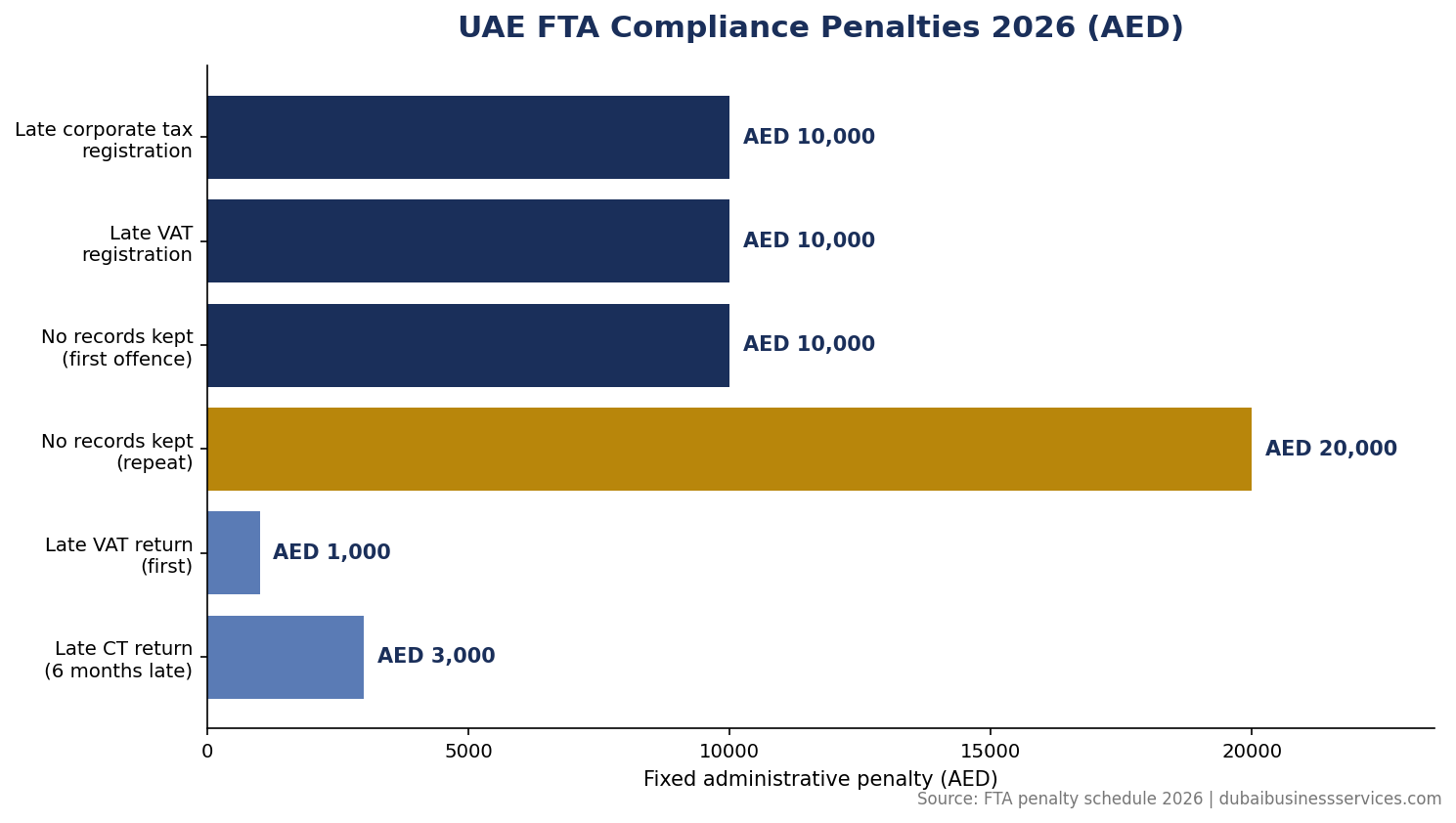
Embed this infographic
Copy and paste:
<a href="https://www.dubaibusinessservices.com/heres-why-entrepreneurs-need-to-take-financial-literacy-seriously/"><img src="https://www.dubaibusinessservices.com/wp-content/uploads/2026/07/financial-literacy-entrepreneurs-fta-penalties-dubai-2026.png" alt="UAE FTA Compliance Penalties 2026" /></a><p>Infographic by <a href="https://www.dubaibusinessservices.com/heres-why-entrepreneurs-need-to-take-financial-literacy-seriously/">Dubai Business Services</a></p>Confused about this? Ask DBS — WhatsApp +971 54 332 2846 →
E-Invoicing Arrives July 2026: The Next Literacy Test
The Ministry of Finance’s e-invoicing programme makes structured electronic invoices mandatory for B2B and B2G transactions, with the first wave of businesses onboarding from July 2026 under the Peppol 5-corner model (Ministry of Finance, 2026). Paper and PDF invoices stop counting. For founders this means invoicing software connected to an accredited service provider, clean customer TRN data, and ledgers that match what the FTA receives in near-real time. Companies that already run point 1 (proper bookkeeping) will onboard in days; companies invoicing from Word templates face a forced systems migration mid-year. The UAE VAT return filing process becomes largely pre-populated once e-invoicing data flows — accurate source records stop being optional at that point.
Save 40 hours — let DBS handle it. WhatsApp +971 54 332 2846 →
How DBS Builds Financial Discipline Into Your Setup
DBS Documents Clearing LLC has processed 80,000+ company formations since 2009, and the pattern in the data is consistent: founders who leave with a working finance stack — corporate tax registration filed, TRN in hand where required, bookkeeping live from month one — renew their licences on time and pass bank compliance reviews without remediation. The DBS onboarding covers FTA registrations (corporate tax and VAT), monthly bookkeeping with bank reconciliation, quarterly and annual filings, audit liaison for free zone entities, and penalty-waiver applications for founders arriving with historic fines. Government fees quoted above are the official published figures (Federal Tax Authority, 2026; u.ae government portal). Every engagement is fixed-fee — the price in the table is the price on the invoice.
Skip the paperwork — WhatsApp DBS at +971 54 332 2846 →
Frequently Asked Questions
What is financial literacy for entrepreneurs in the UAE?
It is working command of seven areas: bookkeeping, financial statements, cash-flow forecasting, VAT, corporate tax, banking discipline, and audit readiness. Since the 9% corporate tax took effect in June 2023, every UAE founder needs all seven to stay penalty-free — the FTA’s late-registration fine alone is AED 10,000 (2026).
How much does bookkeeping cost for a small business in Dubai in 2026?
Outsourced SME bookkeeping runs AED 500–1,200 per month in 2026 depending on transaction volume; DBS’s standard package is AED 500/month up to 150 transactions, including bank reconciliation and VAT-ready ledgers. That is AED 6,000/year — less than the AED 10,000 fine for keeping no records at all.
Do I pay corporate tax if my company earns less than AED 375,000?
You pay 0% tax on taxable income up to AED 375,000, but you must still register with the FTA, keep 7 years of records, and file a return within 9 months of year-end (Federal Decree-Law No. 47 of 2022). Skipping registration triggers the AED 10,000 penalty even at 0% tax.
What is the VAT registration threshold in the UAE in 2026?
Mandatory registration applies once taxable supplies exceed AED 375,000 in the trailing 12 months; voluntary registration opens at AED 187,500 (FTA, 2026). Registration is free of government fees, takes roughly 5–10 working days for a TRN, and late registration carries a fixed AED 10,000 penalty.
How long must a UAE company keep its financial records?
Seven years under the Corporate Tax Law (Federal Decree-Law No. 47 of 2022), and 5 years at the registered office under the Commercial Companies Law (Federal Decree-Law No. 32 of 2021). The FTA penalty for missing records is AED 10,000 for a first offence, AED 20,000 for a repeat within 24 months.
Which UAE companies need an audited financial statement in 2026?
All DMCC, JAFZA and DIFC entities, any free zone company claiming the 0% Qualifying Free Zone Person rate, and mainland companies whose licence authority or bank demands it. DMCC’s filing deadline is 180 days after year-end; a typical SME audit costs AED 5,000–8,500 (2026 rates).
What happens if I file my UAE corporate tax return late?
The FTA charges AED 500 per month for the first 12 months late, rising to AED 1,000 per month afterwards (2026 penalty schedule). The return is due within 9 months of financial year-end, and the 2025 waiver initiative refunds late-registration fines only for filers within 7 months.
When does e-invoicing become mandatory in the UAE?
The Ministry of Finance rolls out mandatory B2B and B2G e-invoicing from July 2026 for the first wave of businesses, using the Peppol 5-corner model. Invoices must flow through accredited service providers in structured format — companies without proper bookkeeping software in 2026 face a forced migration.
Get Tax-Ready With DBS
DBS sets up the complete finance stack — corporate tax registration, VAT, bookkeeping, audit liaison — as part of company formation or as a standalone rescue for companies already carrying fines. Fixed fees, FTA-published government charges, no surprises.
WhatsApp +971 54 332 2846 or email inquiry@dubaibusinessservices.com.
By Salem Basheer, DBS Documents Clearing LLC. Last updated: 2026-07-21.