UAE VAT return filing is the mandatory submission of Form VAT 201 to the Federal Tax Authority through the EmaraTax portal for each tax period. Every return and its payment fall due within 28 days of the period ending, and a late return triggers an AED 1,000 penalty on a first offence (2026). These deadlines are enforced by the Federal Tax Authority under Cabinet Decision No. 129 of 2025.
Last updated: 2026-07-01
If your business is VAT-registered in the UAE, the return is not a formality you can push to the bottom of the pile. It is a recurring legal obligation with hard deadlines, a specific nine-box form, and — since 14 April 2026 — a completely rewritten penalty regime. Getting UAE VAT return filing right protects your cash flow, your Tax Residency standing, and your ability to renew licences and visas without a compliance flag. This guide walks you through exactly who must file, when, how, and what it costs when you get it wrong.
Who Must File a UAE VAT Return in 2026
Any business registered for VAT must file a return for every tax period, even a “nil” period with no sales. VAT registration itself is mandatory once taxable turnover exceeds AED 375,000 in the previous 12 months (or is expected to in the next 30 days), and voluntary from AED 187,500. Once you hold a Tax Registration Number (TRN), the filing clock starts — there is no “we had no activity” exemption. For the full registration process, see our guide to VAT registration and your TRN.
The Federal Tax Authority (FTA) assigns each business a tax period when it registers. Most businesses file quarterly (every three months); larger businesses with annual turnover above AED 150 million are placed on monthly periods. Your period end dates are shown inside your EmaraTax dashboard and never change unless the FTA reassigns them in writing.
Confused about which period applies to you? Ask DBS — WhatsApp +971 54 332 2846 →
VAT Return Filing Deadlines and Tax Periods
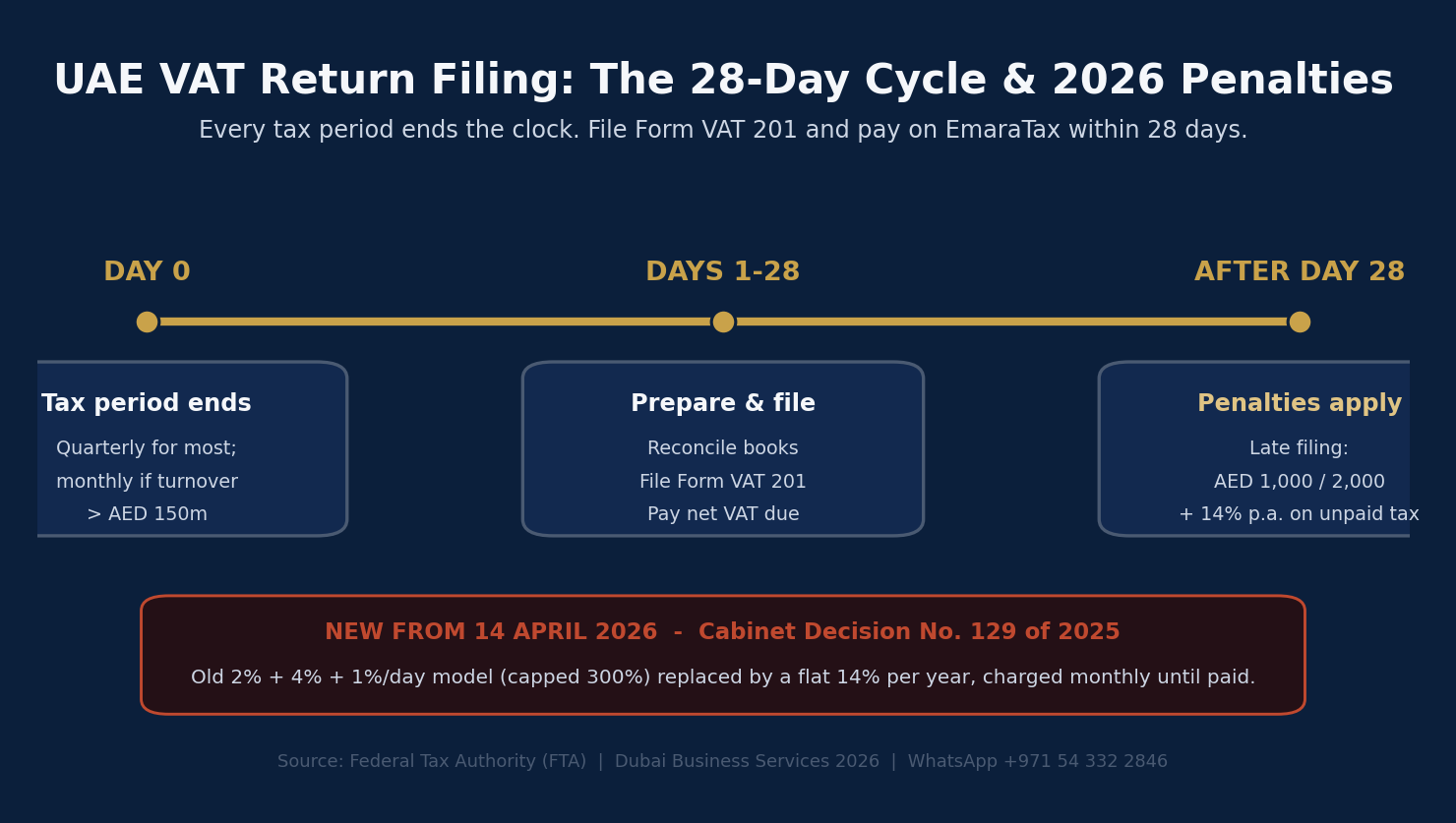
The single most important number in UAE VAT is 28. Both the return and the payment are due within 28 days of the end of the tax period. Miss either and the penalties are separate and cumulative. When the 28th lands on a weekend or a UAE public holiday, the FTA’s practice is to accept filing on the next working day, but you should never rely on that grace — settle early.
| Tax Period Ends | Return & Payment Due | Filing Channel | Notes |
|---|---|---|---|
| 31 March | 28 April | EmaraTax (Form VAT 201) | Q1 quarterly filers |
| 30 June | 28 July | EmaraTax (Form VAT 201) | Q2 quarterly filers |
| 30 September | 28 October | EmaraTax (Form VAT 201) | Q3 quarterly filers |
| 31 December | 28 January | EmaraTax (Form VAT 201) | Q4 quarterly filers |
| Any month-end | 28th of next month | EmaraTax (Form VAT 201) | Monthly filers (> AED 150m turnover) |
Need help mapping your deadlines? WhatsApp DBS at +971 54 332 2846 →
The 7 Essential Steps to File Your UAE VAT Return
Filing is done entirely online through EmaraTax. Follow these seven steps in order and a clean return takes under an hour once your books are reconciled.
- Reconcile your books first. Match every sales invoice, credit note, and purchase invoice to your accounting records for the period. The FTA expects your VAT 201 figures to tie back to auditable records kept for at least five years.
- Log in to EmaraTax. Sign in at the FTA’s EmaraTax portal using your UAE Pass or registered credentials, then open the taxable person profile linked to your TRN.
- Open the VAT 201 return. Under the VAT tile, select the open tax period and click “File Return.” The nine-box form loads pre-labelled with your registration details.
- Enter output tax. Report standard-rated sales (5%), zero-rated supplies, exempt supplies, and any reverse-charge amounts on imports. Each emirate has its own line for standard-rated sales — allocate carefully.
- Enter input tax. Claim the recoverable VAT on your business purchases and expenses. Blocked items — such as entertainment and most passenger vehicles — cannot be reclaimed.
- Review the net position. EmaraTax calculates VAT payable or refundable automatically. Check the net figure against your own VAT control account before you submit.
- Submit and pay. File the return, then settle any VAT payable through GIBAN bank transfer, card, or the approved channels — before the 28-day deadline, not on it.
Save 40 hours a year — let DBS handle it. WhatsApp +971 54 332 2846 →
What Goes Into Form VAT 201: The Nine Boxes
Form VAT 201 is deceptively short but every box carries legal weight. Understanding the structure is the difference between a five-minute submission and an FTA query letter.
- Standard-rated supplies (per emirate): Your 5% sales, split across the seven emirates.
- Tax refunds to tourists: Adjustments under the Tourist Refund Scheme, if applicable.
- Reverse-charge supplies: VAT you self-account for on imported goods and services.
- Zero-rated supplies: Exports and other 0% categories, reported but not taxed.
- Exempt supplies: Financial services, residential leases, and bare land.
- Goods imported into the UAE: Auto-populated from customs declarations tied to your TRN.
- Adjustments to imported goods: Corrections to the customs figure where needed.
- Standard-rated expenses: Recoverable input VAT on purchases.
- Net VAT due: The system-calculated payable or refundable balance.
Around 70% of the FTA queries DBS sees on client accounts trace back to just two boxes: mis-allocated emirate sales and over-claimed input tax on blocked expenses. Both are avoidable with a proper pre-submission review.
Want a second pair of eyes on your VAT 201? WhatsApp +971 54 332 2846 →
VAT Return Filing Costs and the New 2026 Penalty Regime
Filing the return on EmaraTax is free. The real cost sits in two places: professional support to prepare it correctly, and the penalties if you miss the deadline. The penalty side changed fundamentally on 14 April 2026 under Cabinet Decision No. 129 of 2025.
| Item | Government / FTA Charge | DBS Service | Total | Notes |
|---|---|---|---|---|
| Filing the VAT 201 return | AED 0 | Done-for-you preparation & submission | WhatsApp for quote | Free on EmaraTax; accuracy is the value |
| Late filing — first offence | AED 1,000 | Penalty avoidance via deadline management | AED 1,000 | Unchanged in 2026 |
| Late filing — repeat within 24 months | AED 2,000 | — | AED 2,000 | Per repeated offence |
| Late payment of VAT due | 14% per annum on unpaid tax | Cash-flow & payment scheduling | Accrues monthly | New flat rate from 14 Apr 2026 |
| Failure to keep records | AED 10,000 (first) / AED 20,000 (repeat) | Bookkeeping & five-year archive | AED 10,000+ | Records must be retained five years |
The Old Model vs the New 14% Rule
Before 14 April 2026, late VAT payment carried a layered penalty: 2% of the unpaid tax immediately, a further 4% after seven days, then 1% per day, capped at 300% of the tax. That escalation is gone. Cabinet Decision No. 129 of 2025 replaced it with a single, flat annualised charge of 14% per year, applied monthly on the outstanding amount from the day after the due date until you pay. The AED 1,000 late-filing penalty and the AED 10,000 late-registration penalty both remain unchanged.
| Feature | Before 14 April 2026 | From 14 April 2026 (CD 129/2025) |
|---|---|---|
| Immediate late-payment penalty | 2% of unpaid VAT | Removed |
| Secondary penalty | 4% after 7 days | Removed |
| Ongoing charge | 1% per day | 14% per annum, charged monthly |
| Maximum | Capped at 300% of tax | No fixed cap — interest accrues until paid |
| Late filing penalty | AED 1,000 / AED 2,000 | AED 1,000 / AED 2,000 (unchanged) |
The practical takeaway: short delays are now cheaper than under the old 2%+4% shock, but a long unpaid balance still compounds relentlessly at 14% a year with no cap. Filing and paying on time remains the only true protection — there is no automatic waiver for a late VAT return.
Ready to never miss a deadline again? WhatsApp +971 54 332 2846 →
Common VAT Return Filing Mistakes — and the DBS Advantage
Across more than 80,000 business setups and their ongoing compliance since 2009, DBS has watched the same avoidable errors cost clients real money. The five most common are: forgetting to file a nil return, mis-allocating standard-rated sales across emirates, reclaiming input VAT on blocked expenses, missing the 28-day payment (not just the filing) deadline, and failing to keep the five-year record trail the FTA can demand at any time.
The DBS advantage is that VAT return filing sits inside a single accountable service, not a scramble every quarter. Our tax team reconciles your books, prepares Form VAT 201, flags any refund position worth claiming, submits through EmaraTax on your behalf, and keeps the audit-ready archive — all under one point of contact who also handles your corporate tax registration deadline and the coming UAE e-invoicing rollout. Because these obligations overlap, coordinating them prevents the double-handling that catches out businesses using separate providers. If a past period slipped, we can also advise on the penalty position and any relief available.
Skip the paperwork — WhatsApp DBS at +971 54 332 2846 →
Embed this infographic
Frequently Asked Questions
How often do I have to file a VAT return in the UAE in 2026?
Most UAE businesses file quarterly, every three months, based on the tax period the Federal Tax Authority assigns at registration. Businesses with annual turnover above AED 150 million file monthly. Your exact period-end dates appear in your EmaraTax dashboard, and each return is due within 28 days of the period ending.
What is the penalty for late VAT return filing in the UAE?
A late return carries an AED 1,000 penalty on the first offence and AED 2,000 for a repeat within 24 months. Separately, unpaid VAT accrues interest at 14% per year, charged monthly from the day after the deadline, under Cabinet Decision No. 129 of 2025 effective 14 April 2026. Filing and payment penalties are cumulative.
Do I still need to file if I had no sales this period?
Yes. Once you hold a TRN, you must submit a “nil” VAT return for every tax period, even with zero sales and zero purchases. Skipping a nil return is treated as a late filing and triggers the AED 1,000 penalty. There is no dormancy exemption from VAT return filing while your registration is active.
How do I actually pay the VAT I owe?
After submitting Form VAT 201 on EmaraTax, pay the net VAT due through your GIBAN bank transfer, an approved debit or credit card, or other FTA-approved channels. The payment must clear within the same 28-day window as the return. Bank transfers can take 2–3 working days, so initiate payment early to avoid a late-payment charge.
Can I amend a VAT return after I submit it?
Yes, but the mechanism depends on the error size. Errors of AED 10,000 or less can usually be corrected in your next return; larger errors require a formal Voluntary Disclosure (Form VAT 211) through EmaraTax, typically within 20 business days of discovery. Voluntary disclosure reduces exposure compared with an FTA-detected error.
How long must I keep my VAT records?
UAE businesses must retain VAT records — invoices, credit notes, import documents, and accounting records — for at least five years, and real estate records for up to 15 years. Failure to keep proper records is penalised at AED 10,000 on the first offence and AED 20,000 for a repeat, independent of any filing penalty.
Should I hire a consultant for VAT return filing or do it myself?
Small, simple businesses can file directly on EmaraTax at no cost. However, once you deal with multiple emirates, imports, mixed supplies, or refund positions, a specialist prevents the mis-allocations that make up roughly 70% of FTA queries. DBS offers done-for-you VAT return filing so the deadline, the accuracy, and the archive are handled for you.
File With Confidence — Talk to DBS
UAE VAT return filing rewards businesses that treat it as a routine, well-managed cycle and punishes those who leave it to the 28th. DBS Documents Clearing LLC prepares, reviews, and submits your Form VAT 201 through EmaraTax, keeps your five-year archive, and coordinates VAT with your corporate tax and e-invoicing obligations under one accountable team. Get a fixed quote and stop worrying about deadlines: WhatsApp +971 54 332 2846 or email inquiry@dubaibusinessservices.com.
Author: Salem Basheer, DBS Documents Clearing LLC. Last updated: 2026-07-01.