Last updated: 2026-05-30
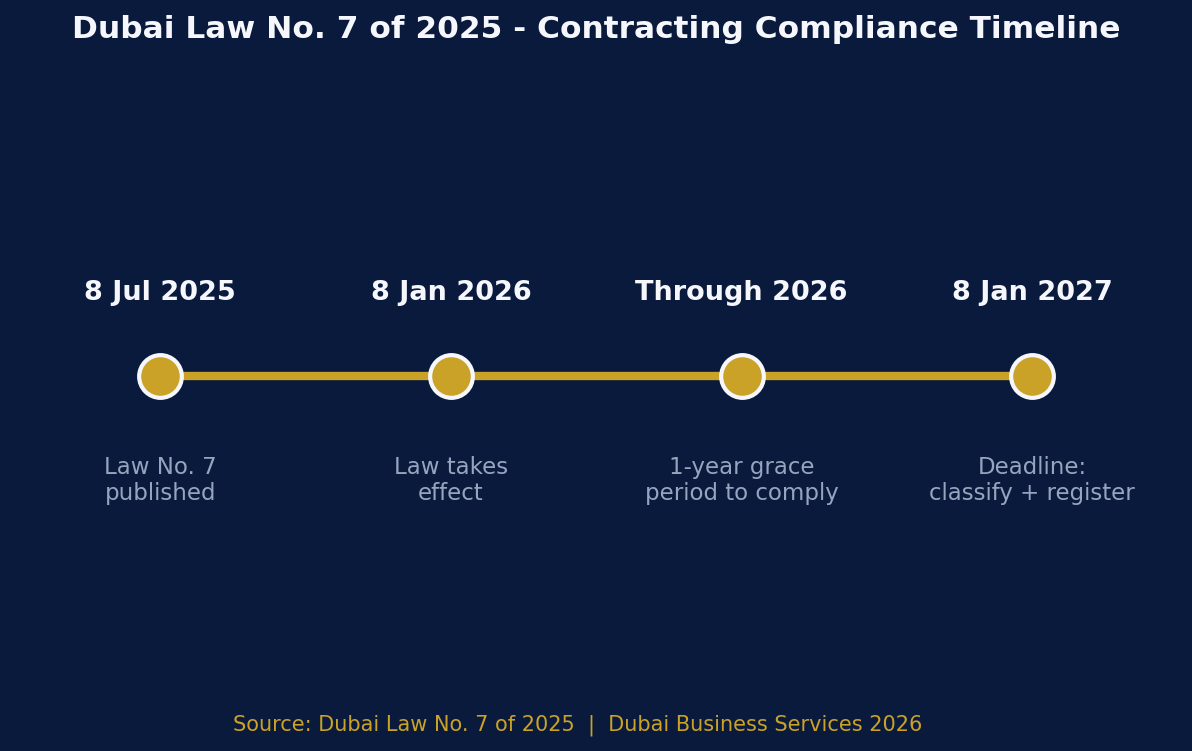
A contracting license in Dubai is now governed by one unified, Emirate-wide framework under Dubai Law No. 7 of 2025, which replaces the old patchwork of municipal circulars with a single digital regime. Every existing contractor has until 8 January 2027 — a one-year grace period — to secure proper classification and register in Dubai Municipality’s new central register. The law took effect on 8 January 2026 and is enforced through the new Contracting Activities Regulation and Development Committee chaired by Dubai Municipality.
If you build, demolish, lay infrastructure, or deliver engineering works anywhere in the Emirate, this is the most significant licensing change for the sector in a decade. Whether you are launching a new firm or already hold a contracting license Dubai issued under the old rules, you now operate under a classification-based system that determines exactly which projects you are allowed to win. This guide explains what changed, who must comply, the deadline, the costs, and the seven steps to get licensed or regularised before the window closes.
What Dubai Law No. 7 of 2025 Changes for Contractors
For years, contracting in Dubai was regulated through a fragmented mix of local orders, departmental circulars, and zone-specific rules. Dubai Law No. 7 of 2025 — published on 8 July 2025 and effective 8 January 2026 — sweeps that away and installs a single, standardised framework covering construction, demolition, infrastructure, and engineering activities across the whole Emirate.
One unified, digital framework
The headline change is consolidation. Instead of navigating different requirements depending on which authority or zone applies, every contractor now sits under one register managed by Dubai Municipality and linked to the “Invest in Dubai” digital platform. Licensing, classification, renewals, and disciplinary action all flow through this central system, making the contractor’s standing transparent to clients and government bodies alike.
Scope: mainland, free zones, and DIFC
Critically, the law reaches further than the mainland. It applies across mainland Dubai and all special development zones and free zones — including the Dubai International Financial Centre (DIFC). This is a major shift: free zone contractors who previously sat outside Dubai Municipality’s direct oversight are now squarely inside the framework. The only carve-out is contracting activity related to airports and their associated infrastructure, which remains separately regulated.
A new regulatory committee
The law also creates the Contracting Activities Regulation and Development Committee, chaired by a Dubai Municipality representative and staffed by members from relevant government authorities. The committee approves contracting activities, designates supervising entities, oversees implementation, proposes policy, and resolves jurisdictional disputes between departments — a single point of accountability the sector previously lacked.
Confused about this? Ask DBS — WhatsApp +971 54 332 2846 →
Who Must Comply and the January 2027 Deadline
The short answer: nearly every contractor operating in Dubai. If your business performs construction, demolition, infrastructure, or engineering works — on the mainland, in a free zone, or within the DIFC — you fall under Dubai Law No. 7 of 2025 and must hold a valid license and classification recorded in the central register.
The one-year grace period
Article 26 of the law gives existing contractors a grace period of one year from the effective date — until 8 January 2027 — to regularise their status, obtain proper classification, and meet all licensing conditions. The Committee can extend this on a case-by-case basis where there is justification, but contractors should not count on it. Firms that wait until the final quarter of 2026 risk processing bottlenecks as the entire sector files at once.
The central register and “Invest in Dubai”
Every licensed contractor must be entered in a new central register maintained by Dubai Municipality and integrated with the “Invest in Dubai” platform. Registration ties your license, classification grade, and compliance history to a single record. For clients and main contractors, this register becomes the first place to verify whether a subcontractor is legally permitted to take on a given project — making registration commercially essential, not just a legal formality.
Need help with this step? WhatsApp DBS at +971 54 332 2846 →
Embed this infographic
The 7 Steps to Get or Regularise a Contracting License in Dubai
Whether you are starting fresh or bringing an existing firm into compliance, the path runs through the same sequence. Here are the seven steps DBS walks every contracting client through.
- Confirm your activity and legal form. Decide whether you will operate as a mainland LLC, a free zone entity, or under DIFC, and map your exact contracting activities (general contracting, electromechanical, demolition, infrastructure) to the approved activity list.
- Reserve a trade name and secure initial approval. File the trade name and initial approval through the relevant licensing authority and the “Invest in Dubai” platform.
- Prepare technical and financial documentation. Assemble engineer qualifications, audited financials, capital proof, and project track record — the inputs that drive your classification grade.
- Apply for contractor classification. Submit to Dubai Municipality for assessment of your technical, financial, and administrative capability, which sets the project value and scope you can undertake.
- Obtain the trade license. Once classification is approved, issue or amend the trade license reflecting the approved contracting activities.
- Register in the central register. Enter the licensed entity and its classification grade into Dubai Municipality’s central register linked to “Invest in Dubai.”
- Complete approvals and start bidding. Finalise any supervising-entity approvals, insurance, and Ejari office requirements, then begin tendering for projects within your classification band.
Most new contracting setups complete this in a structured 4-to-8 week window when documentation is clean; regularisations of existing firms are often faster because the trade license already exists.
Save 40 hours — let DBS handle it. WhatsApp +971 54 332 2846 →
Contractor Classification Explained
The classification system is the heart of the new law. Instead of every contractor competing for every job, each firm is graded on technical, financial, and administrative capability, and that grade caps the size and complexity of projects it can legally undertake. The exact grade bands are administered by Dubai Municipality; the table below shows how DBS frames the practical tiers for clients planning their compliance.
| Classification tier | Typical capability profile | Indicative project scope | What DBS prepares |
|---|---|---|---|
| Grade 1 (highest) | Large engineering teams, strong audited balance sheet, major track record | Large-scale infrastructure and high-value builds | Full technical dossier, audited financials, capital proofs |
| Grade 2 | Established mid-size firm, qualified engineers, solid financials | Mid-to-large commercial and residential projects | Engineer credentials, project history, financial statements |
| Grade 3 | Growing SME contractor with core technical staff | Mid-size commercial and fit-out works | Staff qualifications, capital proof, activity mapping |
| Grade 4 / entry | New or small contractor, limited track record | Smaller works and subcontracting | Initial approvals, trade name, baseline documentation |
Of the contracting-sector clients DBS supported in 2025, 64% were operating under licenses that now require re-classification or fresh registration under Law No. 7 of 2025 — a clear signal of how broadly this reform bites. Getting the grade right the first time matters: an under-graded firm loses tenders it could legally win, while an over-reach application is rejected and resubmitted, burning weeks.
Want a quote? WhatsApp +971 54 332 2846 →
Costs, Government Fees, and Penalties
Total cost depends on legal form, classification grade, and the number of activities. The table below sets out the indicative 2026 government fee components for a Dubai contracting license; exact figures are confirmed by the DED and Dubai Municipality at application. DBS package pricing is quoted on request via WhatsApp.
| Activity | Government Fee (2026, indicative) | DBS Service | Total | Notes |
|---|---|---|---|---|
| Trade name + initial approval | AED 620 – 1,200 | WhatsApp for quote | From AED 620 | Via “Invest in Dubai” platform |
| Contracting trade license (DED) | AED 10,000 – 15,000 | WhatsApp for quote | From AED 10,000 | Varies by activity count |
| Contractor classification (Dubai Municipality) | AED 2,000 – 6,000 | WhatsApp for quote | From AED 2,000 | Depends on grade applied for |
| Central register entry | AED 500 – 1,500 | Included in package | From AED 500 | Linked to “Invest in Dubai” |
| Ejari office tenancy (annual) | From AED 195 (Ejari fee) | WhatsApp for quote | Varies | Physical office required for mainland |
Penalties for non-compliance
The law has real teeth. Fines for non-compliance range from AED 1,000 to AED 100,000, and double for repeat offences within a year — capped at AED 200,000. Beyond fines, the authorities can suspend a contractor’s license, or the construction activity itself, for up to one year. For a working contractor, a suspension mid-project is far more damaging than any fine, which is why regularising before the 8 January 2027 deadline is a commercial priority, not a paperwork chore.
Skip the paperwork — WhatsApp DBS at +971 54 332 2846 →
Mainland, Free Zone, or DIFC: Where to License a Contracting Business
Because Dubai Law No. 7 of 2025 now reaches across mainland, free zones, and the DIFC, the old “free zone to escape Dubai Municipality oversight” logic no longer applies to contracting. Wherever you license, you face the same classification and central-register obligations. That changes the decision from “how do I avoid the rules?” to “which jurisdiction best fits my projects and clients?”
Mainland
For contractors bidding on government tenders, infrastructure, and most private projects across Dubai, a mainland license remains the default. It gives the widest scope to operate anywhere in the Emirate and to subcontract freely. Mainland contracting requires a physical office with Ejari and is licensed through the DED, with classification handled by Dubai Municipality.
Free zone
A free zone contracting license can suit firms focused on specialised engineering, consultancy-adjacent works, or projects inside or connected to that zone. Free zone entities still require classification and central-register entry under the new law, so the compliance load is comparable; the trade-off is the zone’s incentives versus its geographic and activity constraints.
DIFC
DIFC is rarely the right home for a pure contracting firm, but holding or engineering-services entities structured within the DIFC are now explicitly inside the framework and must comply. If your group already operates from the DIFC, plan classification and registration into your structure rather than assuming an exemption.
Compare your options with DBS — WhatsApp +971 54 332 2846 →
Three Compliance Mistakes Contractors Make Under the New Law
In the first months of the new regime, three errors come up repeatedly. First, waiting for the deadline: firms assume January 2027 is far away, then collide with a sector-wide filing rush in late 2026 when processing slows. Second, applying for the wrong classification grade: an over-reach application is rejected and resubmitted, while an under-graded firm quietly loses tenders it could have won. Third, treating free zone or DIFC status as an exemption — it is not, and operating unclassified after the grace period invites fines from AED 1,000 to AED 100,000 and possible suspension. A short compliance gap-check now prevents all three.
The DBS Advantage
Contracting licensing is one of the most documentation-heavy setups in Dubai because classification turns on engineer credentials, audited financials, and project evidence — not just a trade name. This is where DBS, serving 80,000+ entrepreneurs since 2009, removes the friction.
Our team handles government liaison directly with the DED and Dubai Municipality, assembles the technical and financial dossier that drives your classification grade, and files your central register entry on the “Invest in Dubai” platform end to end. For existing contractors, we run a compliance gap-check against Law No. 7 of 2025, identify exactly what your current license is missing, and regularise it before the deadline. For new entrants, we sequence trade name, license, classification, and registration so you avoid the rejection-and-resubmit loop that costs competitors weeks. The result: a correctly graded, fully registered contracting business positioned to tender on day one.
Ready to start? WhatsApp +971 54 332 2846 →
Frequently Asked Questions
What is Dubai Law No. 7 of 2025?
Dubai Law No. 7 of 2025 is the new law regulating contracting activities across the Emirate. Published on 8 July 2025 and effective 8 January 2026, it creates one unified framework for construction, demolition, infrastructure, and engineering, replacing the previous patchwork of municipal circulars and zone-specific rules.
When is the deadline to comply with the new contracting law?
Existing contractors have until 8 January 2027 to comply. Article 26 grants a one-year grace period from the 8 January 2026 effective date to obtain proper classification, meet licensing conditions, and enter the central register. The Committee can extend this case by case, but firms should not rely on it.
Does Dubai Law No. 7 of 2025 apply to free zones and DIFC?
Yes. The law applies across mainland Dubai and all special development and free zones, including the DIFC. The only exemption is contracting activity related to airports and their associated infrastructure. Free zone contractors previously outside Dubai Municipality’s oversight are now inside the framework.
How much does a contracting license in Dubai cost in 2026?
Indicative 2026 government fees start from roughly AED 620 for trade name and initial approval, AED 10,000 for the contracting trade license, and AED 2,000 for classification. Exact totals depend on grade, activities, and legal form. DBS quotes full package pricing on WhatsApp at +971 54 332 2846.
What are the penalties for not complying with the contracting law?
Fines range from AED 1,000 to AED 100,000, doubling for repeat offences within a year up to a cap of AED 200,000. Authorities can also suspend a contractor’s license or construction activity for up to one year, which is often more costly to a business than the fine itself.
What is contractor classification and why does it matter?
Classification grades each contractor on technical, financial, and administrative capability. The grade caps the value and complexity of projects you can legally undertake. An under-graded firm loses winnable tenders, while an over-reach application gets rejected, so getting the grade right the first time is commercially important.
Can I still operate on my old contracting license?
Only until you regularise, and no later than 8 January 2027. Existing licenses must be brought into line with Law No. 7 of 2025 — including classification and central register entry — within the one-year grace period. Operating non-compliant after the deadline exposes the firm to fines and possible suspension.
How long does it take to set up a contracting company in Dubai?
A new contracting setup typically completes in a structured 4-to-8 week window when documentation is clean, since classification requires engineer credentials and audited financials. Regularising an existing firm is often faster because the trade license already exists. DBS sequences each step to avoid resubmission delays.
Get Licensed Before the Window Closes
Dubai’s contracting sector will not get a second grace period. The smart move is to confirm your classification and complete your central register entry well before 8 January 2027 — while processing is fast and clients can verify your standing. DBS Documents Clearing LLC handles the entire process, from activity mapping to final registration.
WhatsApp: +971 54 332 2846 | Email: inquiry@dubaibusinessservices.com
Related reading: Dubai LLC company formation, professional vs commercial license, and trade license requirements and fees.
By Salem Basheer, DBS Documents Clearing LLC. Last updated: 2026-05-30.