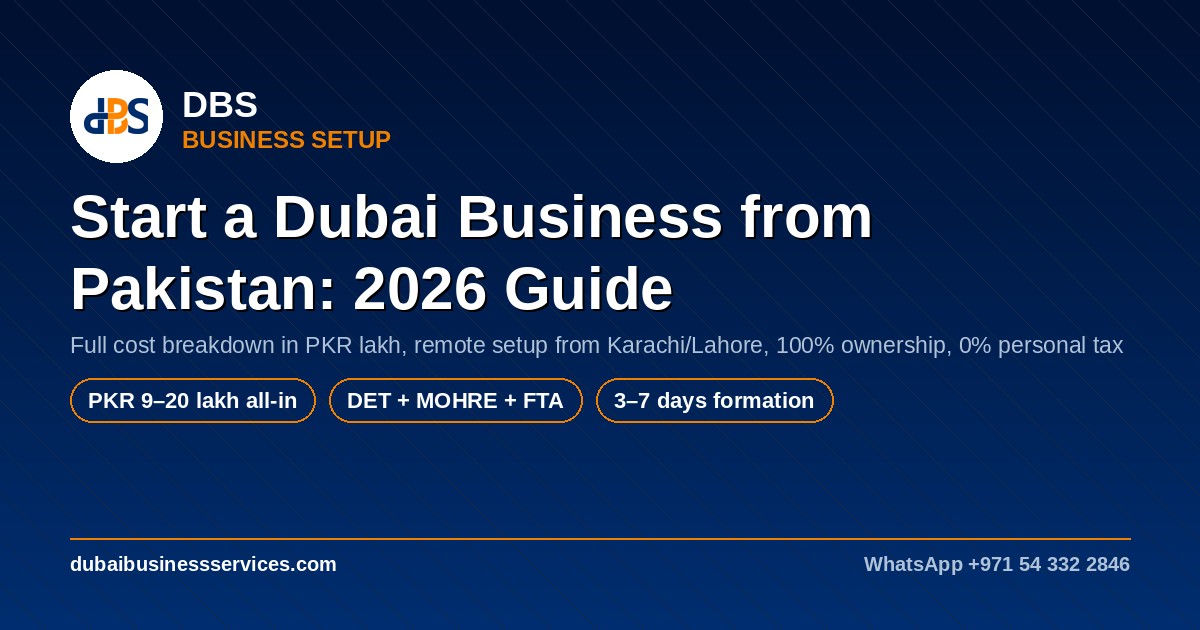
Starting a Dubai business from Pakistan costs AED 15,000–25,000 all-in for a lean first year (approx. PKR 9–20 lakh, converted at today’s rate). Formation is fully remote, taking 3–7 working days via the Department of Economy and Tourism (DET). Investors enjoy 0% personal income tax and can hold 100% ownership—but banking approval is the real friction.
Can Pakistanis Start a Dubai Company? Yes—Remotely, 100% Owned
Pakistani nationals can establish and own a Dubai business entirely from home. Formation documents are e-signed and submitted remotely to the Department of Economy and Tourism (DET). There is no mandatory local sponsor requirement for most business activities—unlike decades past—and business setup in Dubai is now accessible to any international founder. A zero-visa licence company needs no UAE residence visa to be owned. The real bottleneck is not formation; it is opening a corporate bank account, which involves stricter KYC for Pakistani passport holders and typically requires either in-person approval or a UAE-resident signatory or power of attorney.
DBS offers remote document preparation and banking guidance. WhatsApp +971 54 332 2846 for a free cost breakdown tailored to your situation.
All-In Cost Breakdown (AED + Indicative PKR Lakh)
Below is a realistic lean first-year cost table for a mainland licence (AED 18,200–26,355) or free-zone licence (AED 12,500–12,900). All figures are indicative; actual costs vary by jurisdiction, activity, and visa tier. Convert AED to PKR at today’s live rate—do not use a fixed historical rate, as currencies move daily.
| Cost Item | AED Range (Mainland) | AED Range (Free Zone, e.g., Meydan, IFZA) | Indicative PKR Lakh* (at today’s rate) |
|---|---|---|---|
| Trade Licence (1 year) | AED 18,200–22,000 | AED 12,500–12,900 | PKR 13–16 lakh |
| Company Registration + Ejari* | AED 1,500–2,500 | Included or AED 800–1,200 | PKR 1–2 lakh |
| Investor/Partner Visa (1 person, 2-yr) | AED 6,000–9,000 | AED 6,000–9,000 | PKR 4–6 lakh |
| Medical Test + Emirates ID (visa holder) | AED 500–1,200 | AED 500–1,200 | PKR 0.3–0.8 lakh |
| Flexi Desk / Virtual Office (1 month sample) | AED 500–1,500 | AED 300–1,000 | PKR 0.3–1 lakh |
| Business Insurance (annual estimate) | AED 600–1,500 | AED 600–1,500 | PKR 0.4–1 lakh |
| TOTAL FIRST YEAR (LEAN) | AED 27,300–37,700 | AED 20,700–27,600 | PKR 19–27 lakh |
| *Ejari is the Dubai rental contract database. Bank minimum balance (often AED 25k–50k) is held in your account, not spent upfront. Rates convert live—typical AED 1 ≈ PKR 60–68 (check XE.com for your rate). Prices are 2026 estimates and vary by emirate, free-zone operator, and visa tier. | |||
Budget Summary: A realistic lean first-year all-in cost is AED 15,000–25,000 if you skip the visa (zero-visa licence) or choose the cheapest jurisdiction (e.g., Ajman at AED 4,888–5,750 licence-only, plus registration and bank minimums). Add AED 6,000–9,000 if you take a 2-year investor visa. Annual renewal typically costs AED 7,000–20,000 depending on licence type and add-ons.
7-Day Setup Timeline: Day-by-Day Roadmap
Formation is fully remote and can be completed in 3–7 working days. Here is a typical sequence:
| Day | Action | Who Does It |
|---|---|---|
| Day 1 | Provide name, activity code, visa preference, proof of address to DBS; DBS prepares paperwork | Founder + DBS |
| Day 2–3 | E-sign Memorandum of Association (MOA), Articles of Association, Power of Attorney; submit to DET | Founder (remote), DBS (submission) |
| Day 3–4 | DET approves company name and issues Commercial Registration (CR) number | DET |
| Day 4–5 | Trade Licence issued by DET; if visa applied, MOHRE (Ministry of Human Resources and Emiratisation) visa processing begins | DET + MOHRE |
| Day 5–7 | Visa stamped in passport (if applied); company-name registration with Dubai Municipality if needed | Immigration + Municipality |
| Post-Day 7 | Bank account application (separate process; often takes 1–4 weeks) | Founder + Bank |
Banking is not part of formation—it is a parallel step that often takes longer. See below for the KYC checklist.
Banking for Pakistani Founders: The Real Friction
Opening a UAE corporate bank account is harder than forming the company. Pakistani passport holders face enhanced due diligence. Here is a typical bank requirements checklist:
- Company documents: Memorandum of Association, Articles of Association, Commercial Registration (CR) certificate, Trade Licence, Board Resolution (signatory approval).
- Founder/Shareholder docs: Valid passport + scanned UAE visit visa (or investor visa when issued), proof of address (utility bill or bank statement from home country, dated within 3 months), and a notarised and attested Power of Attorney if you are not visiting in person.
- Source of funds: Bank statement or letter from your Pakistani bank, explaining where money will come from (salary, savings, business income). This is strictly reviewed for money-laundering red flags.
- UBO (Beneficial Ownership) Declaration: Confirming you are the ultimate beneficial owner (required under UAE AML regulations).
- UAE Tax Residency status: Declaration or certificate that you are/are not a UAE tax resident (needed for tax reporting).
- In-person KYC or resident signatory: Most banks require either you to visit in person for final approval or a UAE-resident director/POA holder to sign. Some digital banks (e.g., Wio Bank) offer 100% remote account setup with minimal balances; traditional banks (e.g., FAB, ADIB, Mashreq) often want in-person approval or a resident signatory.
Minimum balances: Average corporate accounts require AED 25,000–50,000 held in the account; some fintech alternatives (Wio Bank, Mashreq NeoBiz) allow AED 0 or AED 10,000. Approval timeline: 1 week to 4 months, depending on bank appetite and document quality.
DBS guides clients through banking KYC and can recommend banks with proven Pakistani-founder approval rates. WhatsApp +971 54 332 2846 for banking strategy.
UAE Tax Rules for Pakistani Residents (2026)
The UAE tax system is often called ‘tax-free,’ but that is a myth since 2023. Here is the real picture for a Pakistani founder:
- Personal Income Tax: 0% on worldwide income (salaries, dividends, capital gains). This applies whether you are a UAE resident or non-resident.
- Corporate Tax: 0% on taxable profit up to AED 375,000; 9% on profit above that. Free-zone companies get 0% only on Qualifying Income under the Qualified Free Zone Person (QFZP) regime; non-qualifying income is taxed at 9% from the first dirham. Small Business Relief provides 0% if your revenue does not exceed AED 3 million for tax periods ending on or before 31 December 2026.
- VAT: 5% (standard rate). You must register for VAT once turnover exceeds AED 375,000 (mandatory) or voluntarily if below that threshold.
- Tax Residency: You are a UAE tax resident if you spend 183+ days in the UAE in a calendar year, or 90 days if you have a home or permanent business establishment in the UAE. A tax residency certificate from the Federal Tax Authority (FTA) is needed for treaty claims.
- Pakistan Tax: Pakistani residents are taxed on worldwide income, including UAE business profits and salary. If you remain a Pakistan tax resident, your UAE income is still reportable under Pakistan’s worldwide taxation rules. The UAE–Pakistan tax treaty (signed 2009, but not yet ratified as of 2026) would provide relief from double taxation if finalised; until then, you may be liable in both countries. Consult a Pakistan tax advisor (CA) in Karachi, Lahore, or Islamabad.
- Enhanced Bank Due Diligence: Many UAE banks apply extra scrutiny to Pakistani passport holders due to AML/CFT regulatory guidance. Prepare clear source-of-funds documentation (e.g., income tax returns, bank statements from Pakistan).
Visas: Investor, Partner, Golden, and Green Options
Pakistani founders have several visa pathways to live and work legally in the UAE while running their business. Dubai free zone company formation is one route; below are your visa options:
- Investor/Partner Visa (2 years, renewable): Available if you own/invest in a UAE business. Cost: AED 6,000–9,000 (medical, Emirates ID, visa fee, processing). Allows you to live and work as the company director.
- Golden Visa (10 years, renewable): Requires one of: AED 2 million property investment, AED 2 million bank deposit, or ownership of a company with minimum requirements. Government fees: AED 4,695–10,140. Key change (Feb 2026): Mortgaged and off-plan properties now qualify; the old 50%-upfront-payment rule is removed. Myth correction: There is NO AED 100,000 ‘lifetime’ Golden Visa—the UAE Immigration & Citizenship Programme publicly denied this in July 2025.
- Green Visa (5 years, renewable): For skilled professionals or investors. Criteria: (a) employment at AED 15,000/month or above, (b) freelance/self-employment income of AED 360,000/year or more, or (c) company ownership with a minimum investment of AED 1 million (or 51% of the company). Cost: Similar to investor visa.
- Family Sponsorship: You can sponsor parents (AED 20,000/month salary requirement) or spouse/children (AED 4,000/month salary requirement) once established.
Remote Setup from Pakistan: Karachi, Lahore, Islamabad Onboarding
The entire formation process is digital. You do not need to travel to Dubai to set up the company. Here is how it works:
- Documents prepared: DBS drafts your Memorandum of Association and Articles of Association using your details and activity code. You review online.
- E-signature: You e-sign all documents using DocuSign, AdobeSign, or UAE-approved e-signature platforms. No notarisation in Pakistan is required for company formation, but a notarised Power of Attorney (for a visa or bank account) does need to be attested by the Pakistani diplomatic mission in the UAE (if required by the bank or visa authority).
- Submission: DBS submits e-signed documents to the Department of Economy and Tourism (DET) via the DED online portal.
- Approvals: DET reviews and issues your Commercial Registration (CR) and Trade Licence within 3–7 days. These are issued digitally and can be printed or saved as PDFs.
- Visa processing (if applied): MOHRE (Ministry of Human Resources and Emiratisation) processes the visa application in parallel. Stamping typically occurs within 5–7 days if you visit a UAE embassy or through an approved visa centre in Karachi or Lahore (if available via a partner visa company).
- Bank account: Once you have your Trade Licence and CR, you can apply to UAE banks. Many banks now offer video KYC for non-residents, though some still require in-person or a resident signatory. This is where the process often slows down.
DBS handles remote onboarding for clients in Karachi, Lahore, and Islamabad, including document coordination and visa processing guidance. Book a free consultation via WhatsApp +971 54 332 2846.
FAQs: Your Common Questions Answered
Frequently asked questions
How much in PKR (lakh) does it cost to open a Dubai company from Pakistan?
A lean first-year cost is approximately PKR 9–20 lakh (AED 15k–25k at today’s exchange rates). This includes a trade licence (AED 12.5k–22k), registration, bank minimum balance, and insurance. Add PKR 4–6 lakh (AED 6k–9k) if you apply for a 2-year investor visa. Always convert AED to PKR at the live daily rate—do not use a fixed rate. DBS provides a free, itemised breakdown in rupees.
Can a Pakistani own 100% of a Dubai company?
Yes. Since 2020, 100% foreign ownership is permitted in most business activities. You do not need a local sponsor or Emirati partner. Zero-visa licences and free-zone companies (e.g., Meydan, IFZA) allow full Pakistani ownership without requiring a UAE residency visa. Mainland licences also allow 100% foreign ownership for eligible activities. Check your specific activity code with DBS.
Is there a UAE–Pakistan tax treaty or CEPA covering business setup?
A bilateral tax treaty (signed 2009) exists but has not been ratified as of 2026, so it is not yet in force. You may face double taxation on UAE business income: once in the UAE (corporate tax 9% if profit exceeds AED 375k) and once in Pakistan (if you are a Pakistani tax resident on worldwide income). A CEPA (Comprehensive Economic Partnership Agreement) is under negotiation but not finalised. Consult a Pakistan CA for your specific tax residency status and filing obligations.
How hard is it to open a UAE business bank account as a Pakistani founder?
Challenging, but not impossible. Pakistani passports trigger enhanced anti-money-laundering due diligence. Banks typically require: notarised Power of Attorney, source-of-funds letter from your Pakistan bank, UBO declaration, and either in-person KYC or a UAE-resident signatory. Approval takes 1–4 weeks. Digital banks (Wio, Mashreq NeoBiz) are faster; traditional banks slower. DBS recommends banks with proven Pakistani-founder success rates.
Can I set up a Dubai company entirely remotely from Karachi or Lahore?
Yes. Company formation is 100% digital: e-sign MOA and Articles, submit via DET portal, collect CR and Trade Licence online (3–7 days). Bank account applications can start remotely, though most banks require in-person approval or a resident POA holder. Visa processing requires you to attend a UAE embassy in Karachi/Lahore or arrange visa stamping in Dubai. The full setup is possible without leaving Pakistan until you are ready to open a bank account.
What is the difference between a free-zone and mainland Dubai company?
Free-zone licences (Meydan, IFZA: AED 12.5k–12.9k) offer 0% corporate tax on qualifying income, no UAE sales tax on exports, and often no visa requirement. Mainland licences (DET: AED 18.2k–22k) allow operation anywhere in Dubai but are taxed at 9% if profit exceeds AED 375k (unless Small Business Relief applies, capped at AED 3M revenue until 31 Dec 2026). Free zones suit exporters and tech; mainland suits local service providers. Choose based on your business model.
Is the UAE really 100% tax-free? What about the Golden Visa cost in rupees?
No, the UAE is not 100% tax-free since 2023. Corporate profit above AED 375k is taxed at 9%; VAT is 5% at AED 375k+ turnover. Personal income tax remains 0%. A Golden Visa (10 years) requires AED 2M investment (property, deposit, or company); government fees are AED 4.7k–10.1k (approx. PKR 3–7 lakh). As of Feb 2026, mortgaged and off-plan properties qualify. There is no AED 100k lifetime Golden Visa—the UAE denied this claim in July 2025.
Get expert help in 20 minutes
Talk to DBS on WhatsApp +971 54 332 2846 or email inquiry@dubaibusinessservices.com for a free, fully itemised cost breakdown in your currency.