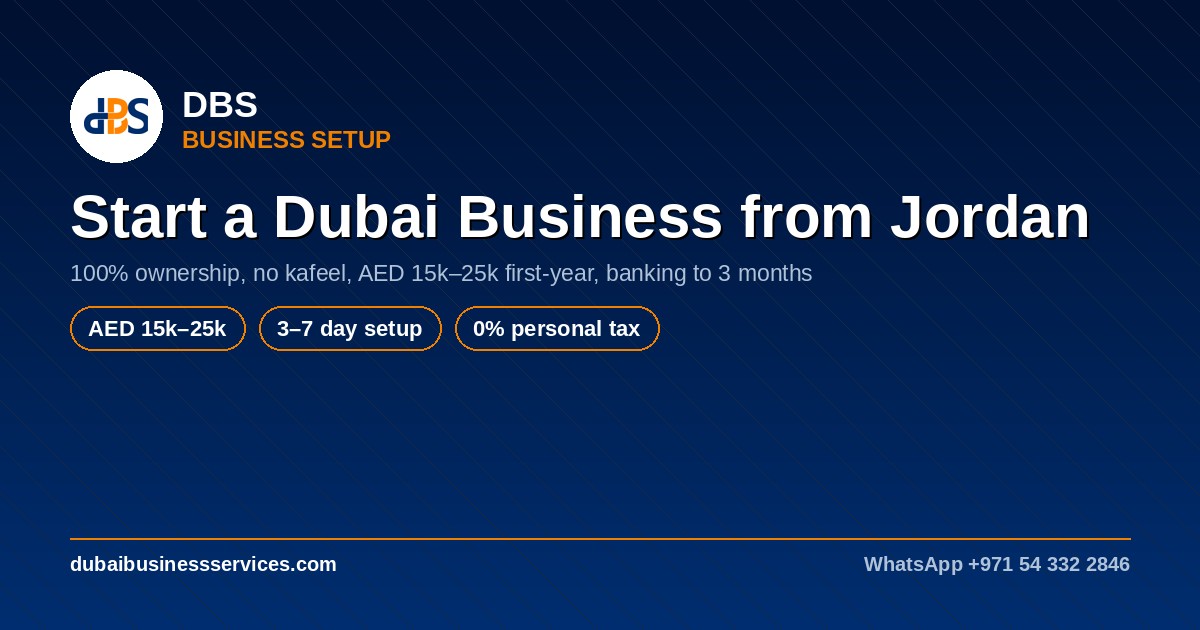
Jordanians can start a business in Dubai in 3–7 working days with 100% foreign ownership and zero kafeel requirement. Formation costs range AED 15,000–25,000 first-year (approximately JOD 3,200–5,350 at current rates); the DET and MOHRE handle registration, whilst tax sits at 0% corporate on qualifying free-zone income or up to AED 375,000 profit mainland. The real timeline friction is bank-account approval, not company registration—formation is fully remote via e-signed POA and home-country attestation.
Why Jordanians Choose Dubai: Ownership, Tax & the ‘No Kafeel’ Rule
UAE law grants 100% foreign ownership across most activities—no kafeel (local sponsor), no equity share mandated. Unlike some regional markets, Jordanian entrepreneurs own their business outright. Business setup in Dubai is transparent and costs predictable. Corporate tax is 0% on profits up to AED 375,000 mainland (2026 Small Business Relief applies until 31 December 2026 for revenue ≤ AED 3M), and 0% on Qualifying Income in free zones under the Qualifying Free Zone Person (QFZP) rules—though non-qualifying income faces 9% from dirham one. Personal income tax remains 0% across the UAE. This combination—no kafeel, clear ownership, low corporate tax—makes Dubai attractive for Jordanians seeking regional expansion.
Complete Cost Breakdown: Formation, Visas, Bank Account & Insurance
Transparent all-in costs separate formation, immigration, banking and insurance. Below is the realistic first-year spend for a Jordanian opening a free-zone company (e.g. Meydan or IFZA) with one investor visa:
| Item | Range (AED) | Indicative JOD (÷4.67 approx.) | Notes |
|---|---|---|---|
| Free-Zone Licence (Meydan, 1 visa incl.) | AED 12,500–13,200 | JOD 2,680–2,825 | Includes trade name, registration, one investor/partner visa |
| IFZA Licence (zero initial visa) | AED 12,900–13,500 | JOD 2,763–2,892 | Dubai Silicon Oasis; visa added at ~AED 3,500–4,000 each |
| Ajman/SHAMS Licence (mainland equivalent) | AED 4,888–5,750 | JOD 1,046–1,231 | Cheapest UAE-wide option; no visa included |
| Mainland Dubai Licence (no visa) | AED 18,200–22,000 | JOD 3,898–4,711 | General Trading; DET + MOHRE registration |
| Mainland Dubai with 1 Investor Visa | AED 26,355–29,500 | JOD 5,642–6,318 | Licence + one 2-year visa (GDRFA/MOHRE) |
| Investor/Partner Visa (2-year, per person) | AED 3,500–7,500 | JOD 750–1,606 | All-in: medical, Emirates ID, processing (DET/MOHRE) |
| Flexi-Desk/Co-working (1st year, optional) | AED 2,000–3,500 | JOD 428–750 | Business address; often free or bundled with licence |
| Corporate Bank Account Setup (balances) | AED 0–25,000 min. balance | JOD 0–5,354 | Wio AED 0; Mashreq NeoBiz ~AED 10k; others AED 25–50k |
| General Liability Insurance (1st yr) | AED 1,500–3,000 | JOD 321–643 | Optional but advisable; depends on activity |
| REALISTIC LEAN FIRST-YEAR TOTAL | AED 15,000–25,000 | JOD 3,213–5,355 | Meydan/IFZA + visa + modest insurance; excludes bank min. balance |
| Annual Renewal (Year 2+) | AED 7,000–20,000 | JOD 1,499–4,283 | Licence + visa renewal (visa ~AED 3,500–7,500); no medical re-exam |
⚠️ Indicative at current rates (February 2026). Convert at today’s rate via XE.com or your bank. No hidden fees; all items cited from DET, FTA tax.gov.ae, MOHRE, and free-zone schedules.
Note: A company with zero investor visas (purely nominee/remote directors) costs less (~AED 12,500 licence-only, free-zone) but cannot hire UAE residents on-site and requires strict compliance with visa rules.
Day-by-Day Setup Timeline: Remote Formation (3–7 Working Days)
Once documents are ready, the legal registration moves fast. Banking, however, is typically the bottleneck. Here’s what to expect:
| Stage | Timeline | Who Does It | Key Requirement |
|---|---|---|---|
| Day 1–2: Document Prep | 1–2 working days (your time) | You + local authority (MOJ/notary) | Passport copy, POA e-signed, home-country attestation (via Jordan MFA) |
| Day 2–3: Submission to DET/Free Zone | Same day after receipt | DBS agent or free-zone portal | All docs e-signed or wet-seal POA certified |
| Day 3–5: DET/MOHRE Registration | 2–4 working days | Department of Economic Territory / Labour Dept. | Visa processing (medical, Emirates ID, police clearance if needed) |
| Day 5–7: Licence Issue + Visa Stamping | 1–3 working days after clearance | GDRFA (Residency) + Free Zone / DCCI | Licence number issued; visa ready for collection/delivery |
| Week 2–4: Bank Account Application | 1 week to several months ⚠️ | Your bank (chosen bank) | KYC docs, UBO declaration, source-of-funds letter (this is the real friction) |
Setup registration is 3–7 working days; bank approval can take 1 week to 3+ months depending on bank policy and non-resident KYC strictness.
Banking for Non-Residents: The Real Friction
Formation is fully remote. Banking—the step that actually funds operations—is where most Jordanian founders face delays. Key facts:
- Minimum Balances: Wio Bank AED 0 (ideal for remote); Mashreq NeoBiz ~AED 10,000; most traditional banks AED 25,000–50,000.
- Non-Resident KYC: Banks increasingly demand a UAE-resident signatory (co-director or Power of Attorney holder) or in-person KYC visit.
- Documentation: Clean UBO (ultimate beneficial owner) declaration, notarised source-of-funds letter from Jordan, trade licence, director/shareholder passports (certified copies). Allow 1–2 weeks for Jordan Ministry of Foreign Affairs apostille on your home-country attestation.
- Timeline: If you visit Dubai: same-day or 1-week approval (many banks). Remote with POA: 2–8 weeks (policy-dependent).
Consult your chosen bank early; many accept fully remote applications now, but turnaround varies. A UAE-resident co-signatory or agent can accelerate approval.
Tax: Corporate, Personal & Jordan Residency
Jordanians often worry about double taxation. Here’s the 2026 picture:
- UAE Corporate Tax (2026):
- Mainland: 0% on profits ≤ AED 375,000 (Small Business Relief, through 31 Dec 2026 if revenue ≤ AED 3M); 9% above.
- Free Zones: 0% on Qualifying Income under QFZP rules. Non-qualifying income = 9%. The QFZP de-minimis threshold is the lower of 5% of revenue or AED 5M in qualifying income; breach it and lose 0% for ~5 years.
- Personal Income Tax: 0% in the UAE, regardless of residency or visa type.
- Tax Residency Certificate (TRC): You need ≥183 days in the UAE in a calendar year (or ≥90 days + a UAE tie—e.g. residence visa, property, employment) to claim TRC status for UAE income. Dubai free zone company formation does not automatically grant TRC; you must spend the required days.
- Jordan Obligations: If you remain a Jordanian tax resident (≥183 days in Jordan), you may owe Jordanian income/corporate tax on worldwide income, including UAE profit. Consult a Jordanian tax adviser on your specific status and any tax treaty relief (UAE–Jordan do not have a bilateral income tax treaty, but dividends, interest and royalties may qualify for relief under UAE domestic rules if paid to a Jordanian resident). UAE–Jordan cooperation on information exchange has increased; declare UAE income to Amman if required.
- VAT: 5% in the UAE on most supplies. Mandatory registration at AED 375,000 revenue; optional below that. Jordan has VAT (in transition); co-file both if needed.
Immigration Visas: Investor, Golden & Green Options
Three visa pathways for Jordanian founders:
- Investor/Partner Visa (2-year, renewable):
- All-in cost: AED 3,500–7,500 (medical, Emirates ID, police, visa).
- Requirement: Equity stake in the company (no minimum prescribed, but typically ≥5% or founder role).
- Medical: ~AED 150–250 (DHA or private clinic); expires after 3 years.
- Fastest route for most Jordanians; included in many free-zone licence packages.
- Golden Visa (10-year, renewable):
- Requirement: AED 2M property (owned/mortgaged/off-plan, no 50%-upfront rule post-Feb 2026), OR AED 2M time deposit, OR AED 500k+ company investment + 25% revenue threshold (complex; rarely chosen for startups).
- Government fees: AED 4,695–10,140 (varies by pathway and authority).
- No visa renewal stress; allows full UAE residency for family.
- No AED 100,000 ‘lifetime’ option exists: ICP denial confirmed July 2025. Ignore any agent claiming this.
- Green Visa (5-year, renewable):
- Skilled Worker: AED 15,000/month salary; Freelancer: AED 360,000/year revenue; Investor: AED 1M+ company share (less common for solopreneurs).
- Cost: Included in registration; no separate visa fee.
- Useful if you employ yourself at AED 15k/mo on your own payroll or meet freelance thresholds.
The investor visa (2-year) is the norm for startup founders; upgrade to Golden if property/capital threshold is met.
Why ‘Dubai is 100% Tax-Free’ Is Outdated; What’s Actually True in 2026
Pre-2023, UAE marketed itself as fully tax-free. The 2023 corporate-tax introduction changed that. Current reality:
- Corporate tax is NOT 0% universally (it’s 9% above AED 375k threshold mainland, or on non-qualifying income free-zone).
- Personal income IS genuinely 0%—no income tax on wages, dividends, interest, or capital gains.
- Free zones offer 0% corporate on qualifying income (often on trading/services revenue; interest/dividends may be taxable).
- Real tax efficiency comes from (a) staying under AED 375k profit mainland, (b) structuring as a free-zone Qualifying Free Zone Person, and (c) legitimate expense management.
Marketing Dubai as ‘tax-free’ is now inaccurate; it’s ‘low-tax’ with specific reliefs for startups and free-zone activity. Plan accordingly.
Key Documents Checklist: What You Need to Supply
Form a company remotely by providing:
- Passport: Colour copy (front + back), valid ≥6 months.
- Power of Attorney (POA): Notarised by Jordanian notary public, then apostilled by Jordan’s Ministry of Foreign Affairs (required for UAE official recognition). E-signed POA from your bank/notary, or wet-seal wet-ink version.
- Bank Reference Letter: From your Jordanian bank (address, account history, standing); optional but helps bank KYC in UAE.
- Home-Country Police Clearance (if over 30 or requested): From Jordan Public Security Directorate; obtain electronically via their portal or visit a station.
- UBO (Ultimate Beneficial Owner) Declaration: Self-declaration of true owner and source of funds (for bank AML).
- Source-of-Funds Letter: Notarised statement from you or your bank explaining the origin of your capital (e.g. personal savings, business income, inheritance). UAE banks require this for non-residents.
- Trade Licence Application Form: Pre-filled by your Dubai Business Services agent or free-zone portal; you sign electronically.
DBS can guide you on Jordan-side attestations; allow 1–2 weeks for MFA apostille if applying by post (faster in-person or online if available).
The Real 100% Ownership, No Kafeel Advantage
Unlike some neighbouring jurisdictions (e.g. Saudi Arabia’s old kafeel system, some GCC states’ local-partner rules), UAE law allows Jordanians to own 100% of companies across most sectors—no local sponsor required, no equity sacrifice. This applies to:
- Free-zone companies (Meydan, IFZA, JAFZA, Dubai Silicon Oasis, Hamriyah).
- Mainland general trading, import/export, professional services (accounting, consulting, engineering design).
- Restricted sectors (e.g. retail, F&B, real-estate development) may require local sponsorship or Emirati partnership, but most core business activities do not.
This transparency and 100% control is a significant draw for regional entrepreneurs. Combined with 0% personal income tax and predictable corporate tax on profits above AED 375k, the UAE remains competitive for Jordanian capital.
Frequently asked questions
How much does it cost (in Jordanian dinar) to open a Dubai company from Jordan?
First-year all-in cost is approximately JOD 3,200–5,350 (AED 15,000–25,000) for a free-zone company with one investor visa, licence, modest insurance and business address. Renewal years cost roughly JOD 1,500–4,300 (AED 7,000–20,000). Bank-account minimum balances (AED 0–25,000) are separate and depend on your chosen bank. Use XE.com or your bank’s rate to convert to today’s dinar equivalent; rates fluctuate.
Can Jordanians own 100% of a Dubai company with no kafeel?
Yes. UAE law grants 100% foreign ownership across most activities—no kafeel (local sponsor) or mandatory Emirati equity required. This applies to free-zone and mainland companies (general trading, services, importing, consulting, etc.). Restricted sectors like retail, F&B, or real-estate development may need local partnership, but most business types allow full Jordanian control. Consult DBS on your specific activity.
Do I need to travel to Dubai to register my company?
No. Company formation is fully remote: you e-sign a Power of Attorney (notarised and apostilled by Jordan’s Ministry of Foreign Affairs), supply passport scans, and provide source-of-funds documentation. DET, MOHRE and free-zone portals accept remote submissions. Registration completes in 3–7 working days. Opening a bank account is where you may need a visit or a UAE-resident co-signatory for KYC; this can take 1 week to several months.
How do Jordanians open a UAE business bank account from abroad?
Submit complete KYC docs (passport, notarised UBO declaration, source-of-funds letter apostilled from Jordan, trade licence, bank reference from home) to your chosen bank (Wio, Mashreq NeoBiz, FAB, etc.). Banks accept remote applications but many demand either a UAE-resident signatory (co-director/POA holder) or in-person KYC visit. Non-resident approval typically takes 2–8 weeks if fully remote, or same-day to 1 week with a visit. Wio (AED 0 minimum) and NeoBiz (~AED 10k) are friendlier to remote applicants.
Do I pay tax back home in Jordan on my Dubai company income?
Depends on your tax residency status. If you remain a Jordanian tax resident (≥183 days/year in Jordan), Jordan may claim worldwide income tax on your UAE profit. UAE–Jordan have no bilateral income tax treaty. You should report UAE income to the Jordanian tax authority and consult a local tax adviser on relief eligibility. If you establish UAE tax residency (≥183 days in UAE or 90 days plus a UAE tie), you claim UAE corporate tax (0% up to AED 375k profit, then 9%) and may obtain relief on Jordanian tax via treaty or domestic rules. Declare to both authorities if required.
What is the cheapest free zone in Dubai for Jordanians?
Meydan and IFZA offer competitive all-in costs: Meydan ~AED 12,500–13,200 (includes one investor visa), IFZA ~AED 12,900–13,500 (zero visa included, add ~AED 3,500–4,000 per visa). For absolute lowest licence-only (no visa), mainland Ajman/SHAMS is ~AED 4,888–5,750. Choose based on visa needs, business type and proximity preference. DBS can compare all options for your activity.
What happens if my Dubai company earns more than AED 375,000 profit per year?
Mainland: 9% UAE corporate tax applies on profit above the AED 375,000 threshold (Small Business Relief expires 31 Dec 2026 if revenue ≤ AED 3M). Free zones: 0% on Qualifying Income under QFZP rules (de-minimis = lower of 5% revenue or AED 5M); breach this and lose 0% for ~5 years. Non-qualifying income (e.g. interest, certain investments) is 9% from dirham one regardless. Personal income remains 0%. Work with a UAE accountant to structure income tax-efficiently and stay compliant.
Get expert help in 20 minutes
Talk to DBS on WhatsApp +971 54 332 2846 or email inquiry@dubaibusinessservices.com for a free, fully itemised cost breakdown in your own currency — and a straight answer on banking and tax.