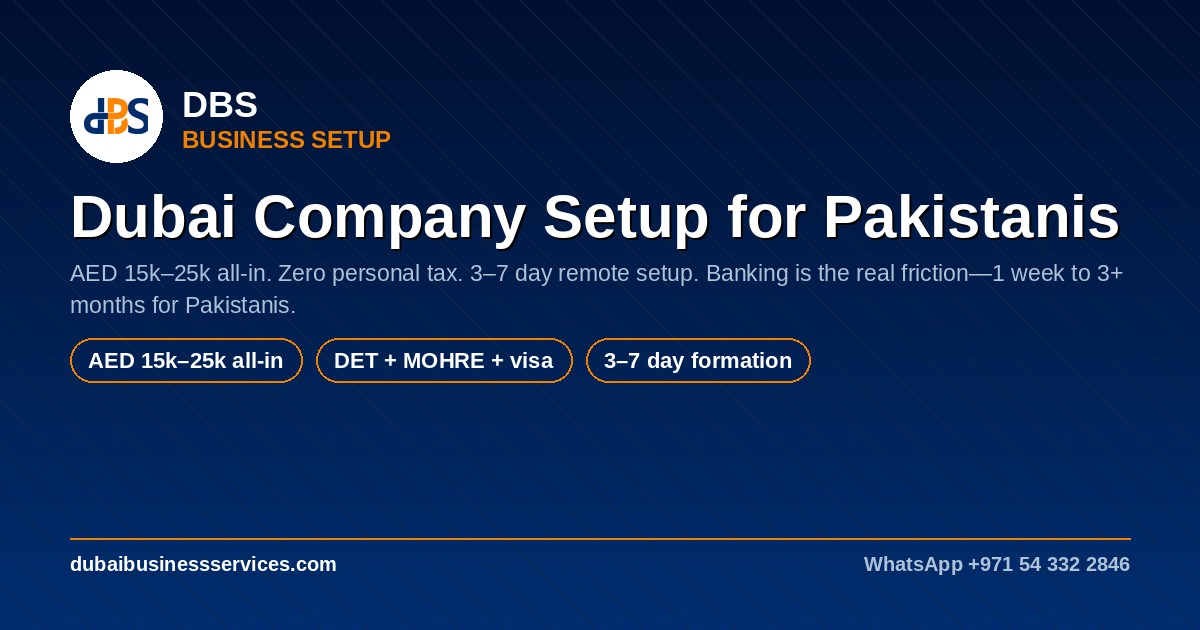
Pakistani entrepreneurs can register a 100% foreign-owned Dubai company in 3–7 working days for AED 15,000–25,000 (all-in: licence, registration, investor visa, initial compliance), with zero personal income tax and corporate tax deferral up to AED 375,000 taxable profit. Formation is fully remote; the real friction is UAE bank-account opening (1 week to several months) and Pakistan-resident income-tax compliance with Pakistan’s FBR. Cite DET registration, MOHRE labour file and tax.gov.ae corporate tax rules.
Can You Start a Dubai Business from Pakistan? Yes—Remotely in 3–7 Days
Pakistani nationals can own 100% of a business setup in Dubai without physical travel during registration. All paperwork—including e-signed documents, power of attorney, and home-country attestation—can be processed remotely. The Dubai Economy and Tourism Authority (DET) accepts remote applications for trade-licence registration. However, residence visas and bank-account KYC may require in-person attendance or a UAE-based signatory (more below). Pakistan’s Federal Board of Revenue (FBR) taxes residents on worldwide income; the UAE has no double-taxation agreement (CEPA) with Pakistan, so you’ll owe Pakistani tax on Dubai profits.
First-Year Cost Breakdown: AED 15,000–25,000 All-In (Plus Banking)
Here is a realistic, itemised cost table for a Pakistani entrepreneur launching a zero-visa or one-visa company in Dubai in 2026:
| Item | AED Range | PKR Indicative (÷0.061–0.067) | Notes |
|---|---|---|---|
| Free-zone licence (Meydan, IFZA, RAK, Ajman) | AED 12,500–15,900 | ~PKR 1.87–2.61 lakh | Meydan ~AED 12,500 (1 visa); IFZA ~AED 12,900 (zero-visa); Ajman/SHAMS licence-only ~AED 4,888–5,750 |
| DET trade licence (mainland alternative) | AED 18,200–26,355 | ~PKR 2.72–3.94 lakh | AED 18,200 (no visa); +AED 8,155 per visa (up to 2 recommended) |
| MOHRE labour file & regulations | AED 150–500 | ~PKR 0.022–0.075 lakh | Registration with Ministry of Human Resources & Emiratisation |
| Investor/partner visa (2-year, 1 person) | AED 3,500–7,500 | ~PKR 0.52–1.12 lakh | Emirates ID, medical exam, attestation; realistic all-in ~AED 6,000–9,000 incl. agency fees |
| Business bank account setup (one month) | AED 0–50,000 (balance) | Balance req’d: ~PKR 0–7.46 lakh | Wio AED 0 minimum; Mashreq NeoBiz ~AED 10,000; traditional banks AED 25,000–50,000. Opening 1 week–several months; Pakistani passport may face stricter non-resident KYC |
| Company flexi-desk/office address (12 mo) | AED 800–2,500 | ~PKR 0.12–0.37 lakh | Virtual office or hot-desk; not always mandatory if using bank-provided address |
| General liability & professional insurance (1 yr) | AED 500–1,500 | ~PKR 0.075–0.224 lakh | Optional but recommended for B2B credibility |
| Attestation & documentation (Pakistan side) | AED 200–800 | ~PKR 0.03–0.12 lakh | Home-country authorisation; notary, embassy stamp |
| TOTAL FIRST-YEAR (licence + visa + registration) | AED 15,000–25,000 | ~PKR 2.24–3.74 lakh | Does NOT include bank balance or agency markups. Excludes annual renewal (AED 7,000–20,000 yr 2+). |
Indicative FX at current rates (as of 2026): convert at today’s spot rate via XE.com or your bank. PKR ranges shown assume AED 1 = PKR 14.93–16.39 (use your live rate).
Free-Zone vs Mainland: Which Is Cheaper for Pakistanis?
Free zones (Meydan, IFZA, RAK, Ajman): Licence AED 12,500–15,900 (includes 1–2 visas or zero-visa options). Corporate tax is 0% on Qualifying Free-Zone Income (QFZP rules: non-qualifying income taxed at 9%; de-minimis 5% of revenue or AED 5M). No labour-law enforcement in some zones; streamlined setup.
Mainland (DET, Dubai): Licence AED 18,200 (no visa) or AED 26,355+ (with 1–2 visas). Corporate tax: 0% on profit ≤ AED 375,000 (expires 31 Dec 2026; extension expected); 9% above. Mainland companies face full MOHRE labour regulations. Residence visas are standard; easier banking.
Budget play: Ajman or SHAMS free zone (~AED 4,888–5,750 licence-only, zero visa) + separate investor visa (~AED 6,000–9,000) = AED 10,888–14,750 vs Meydan one-visa package ~AED 12,500. Minimal spread; choose zone for activity type and banking ease.
Step-by-Step 3–7 Day Registration Timeline
Day 1–2: Document prep (home office, Pakistan). Gather passport copy (attested by your bank or NADRA), POA template, business plan, and UBO declaration. Have documents stamped/attested by Pakistani authorities or embassy in your city (3–5 days for urgent turnaround; DBS can guide remotely).
Day 3–4: DET/free-zone application. DBS or your agent submits application to Dubai Economy and Tourism (DET) or chosen free-zone authority. DET issues preliminary approval in 24 hours. Parallel: MOHRE labour file initiated.
Day 5–6: Licence issuance & banking docs package. Physical trade licence printed; you receive soft copy. Investor visa application submitted to GDRFA (General Directorate of Residency & Foreigners Affairs). Banking compliance checklist issued.
Day 7+: Banking KYC & account opening (separate track). Submit banking package (passport, licence, visa approval letter if in-hand, UBO form, proof of funds) to chosen bank. Resolution takes 1 week to 3+ months depending on Pakistani passport non-resident status and bank’s appetite. Some banks require a UAE-resident signatory or POA holder to collect the account card.
Banking: The Real Friction Point for Pakistani Entrepreneurs
Formation is fast and remote. Banking is slow and personal. Here’s why:
- Corporate-account minimum balances: Wio (digital) AED 0; Mashreq NeoBiz AED ~10,000; traditional banks (FAB, Emirates NBD, DIB) AED 25,000–50,000. These are non-negotiable for non-resident Pakistani account-holders.
- KYC for non-residents: Pakistani passports face enhanced due diligence (FATF mutual evaluation outcomes; AML-CTF screening). Banks routinely ask for a 2-year banking history, a UAE-resident signatory, or proof of senior management presence.
- Open-time reality: Account opened within 1 week for a resident (UAE visa) with home-country business. Opens in 4–12 weeks for a non-resident Pakistani founder, even with a licence in hand. Some banks defer to the account-holder’s location and require in-person video-verification KYC or a POA holder to sign cheques.
- Documents checklist: Certified passport, trade licence (certified), visa approval letter or residence visa stamp, Memorandum & Articles of Association, Board Resolution (account opening), UBO declaration (signed, notarised), proof of funds (bank statement, parent company support letter, sale deed), IBAN for remittances, beneficial-ownership documentation.
Pro tip: Use a UAE-resident director or co-founder to expedite banking. If impossible, FinTech banks (Wio, Magnati) may open faster than traditional lenders for service-based businesses.
Tax Reality for Pakistani Residents: 0% Personal, But Worldwide Income
UAE personal income tax: Zero. Your salary, dividends or profit drawn into a UAE bank account is not taxed in the Emirates.
UAE corporate tax (2026 onwards):
- 0% relief (expires 31 Dec 2026): Applies to taxable profit ≤ AED 375,000 per year. Extension expected; no formal announcement yet as of early 2026.
- Small Business Relief (SBR): 0% on revenue ≤ AED 3M per financial period (if period ends on or before 31 Dec 2026).
- Standard rate: 9% on taxable profit above AED 375,000 (or revenue thresholds).
- Free-zone Qualifying Income: 0% under Qualified Free-Zone Person (QFZP) rules if de-minimis ≤ 5% revenue or AED 5M non-qualifying income. Breach loses 0% status for ~5 years; non-qualifying income taxed at 9% from dirham one.
- VAT 5% (UAE): Register if turnover exceeds AED 375,000. No input-VAT recovery on import into free zones (supply-chain implication).
Pakistan tax on the same income (FBR): Residents are taxed on worldwide income. No UAE–Pakistan CEPA (Comprehensive Economic Partnership) double-tax treaty exists. You owe Pakistani tax on your Dubai profit at Pakistani rates (~5–35% on corporate, depending on structure and incentive eligibility). Pakistani non-residents are taxed on Pakistan-sourced income only, but visa holders commonly maintain resident status for home-country banking and property.
Banking & scrutiny: Pakistani account-holders in UAE banks face enhanced compliance. Ensure clean source-of-funds documentation, transparent income flow, and annual tax compliance in Pakistan to avoid account freezes or reporting issues.
Investor & Residence Visa Options: Costs & Timelines
Investor/Partner Visa (2-year, renewable):
- Realistic all-in cost: AED 6,000–9,000 per person (incl. emiratisation fee, medical exam, Emirates ID, agency handling).
- Requires minimum shareholding or manager role in the company.
- Timeline: 10–14 working days after licence issuance.
- Allows residence in UAE; easier banking (KYC treated as in-country non-resident rather than full foreign).
Golden Visa (10-year, prestigious):
- Investment routes: AED 2M property purchase, AED 2M bank deposit, or AED 2M company stake + turnover/employment thresholds.
- Government fees alone: ~AED 4,695–10,140 (varies by route and renewal).
- New rules (Feb 2026): Mortgaged property and off-plan property now qualify (50%-upfront rule removed). This lowers effective capital locked in.
- Myth debunked: There is no AED 100,000 ‘lifetime’ Golden Visa (ICP proposal denied July 2025).
- Spouses & children (u/21) included; no separate visa cost for dependents.
Green Visa (5-year, skilled):
- Salaried employment (AED 15,000/month+), self-employed freelancer (AED 360,000/year income), or investor (AED 1M share in a company).
- Separate path; no company-formation requirement for salaried or freelancer routes.
In PKR terms (FX ~1 AED = 14.93–16.39 PKR): Investor visa all-in ~PKR 0.895–1.47 lakh; Golden Visa gov fees ~PKR 0.70–1.52 lakh; company stake component (AED 2M) ~PKR 2.99–3.28 crore.
Myth: “Dubai is 100% Tax-Free.” Reality: It’s Nuanced
Dubai is not entirely tax-free as of 2023. The accuracy:
- Personal income: 0% (genuine, no loopholes).
- Corporate profit: 0% only up to AED 375,000/year (expires end-2026, likely extended; above that, 9%).
- Free-zone income: 0% on Qualifying Income; non-qualifying portion taxed at 9%.
- Property/capital gains: No tax (genuine exemption).
- VAT: 5% on most goods and services (mandatory from AED 375k turnover).
- Traders on simplified books: Often below VAT registration threshold and benefit from low corporate-tax relief.
For a Pakistani founder earning AED 300,000 profit/year: UAE tax is 0%; Pakistan tax is due (if resident). Budget 5–25% effective tax in Pakistan depending on declared income, incentives and structure.
Can I Do This Entirely Remotely? What Needs In-Person?
Fully remote: Document preparation, DET application, MOHRE filing, soft-licence issuance, visa application to GDRFA, insurance quotes.
May need in-person or UAE-resident proxy: Bank account opening (video KYC sometimes accepted for fintech; traditional banks often insist on branch visit or POA-holder presence); Emirates ID biometric collection (if claiming visa, done at GDRFA centre); cheque-book pickup and card collection (bank branch or POA holder).
Workaround: Appoint a UAE-based director, co-founder, or legal agent as POA holder. They can sign banking forms, collect documents, and represent you at GDRFA. Cost: AED 500–2,000 (agent fees) or nil if a co-founder. Dubai free zone company formation services often include POA handling.
Frequently asked questions
How much does it cost in rupees to open a Dubai company from Pakistan?
First-year all-in cost is AED 15,000–25,000 (~PKR 2.24–3.74 lakh at current FX ~1 AED = 14.93–16.39 PKR). This covers trade licence (AED 12,500–18,200), investor visa (AED 6,000–9,000, if chosen), MOHRE registration (AED 150–500), and Emirates ID/medical (AED 500–2,500). Bank balance and agency markups are separate. Renewal from year 2: AED 7,000–20,000 (~PKR 1.04–2.99 lakh).
Can Pakistanis own 100% of a Dubai company?
Yes. UAE law allows 100% foreign ownership in free zones and most mainland activities (trade, services, consulting, real estate, IT). Some sectors (banking, insurance, telecom) have local-ownership caps, but these are rare for SMEs. You do not need a local sponsor or partner. Proof: FTA regulations (2026) and DET trade-licence issuance to 100% foreign companies daily.
Do I need to travel to Dubai to register my company?
No. Licence registration, DET approval, and visa application are fully remote: e-signed POA, home-country attestation, and digital document submission. Banking account opening may require in-person KYC or a UAE-resident signatory (the main friction point). If you obtain a visa, you’ll travel once for biometric collection and settlement, but no rush—many use a local agent’s POA for account setup.
How do Pakistani nationals open a UAE business bank account?
Submit to a bank: certified passport, trade licence, visa approval letter or residence stamp, UBO form, proof of funds, Board Resolution, and M&A. Pakistani non-residents face 4–12-week delays due to enhanced due diligence (FATF screening, AML-CTF). Solution: Appoint a UAE-resident co-founder/signatory, or use fintech banks (Wio AED 0 minimum, typically 2–4 weeks). Traditional banks (FAB, Emirates NBD) require AED 25,000–50,000 balance and prefer resident account-holders.
Do I pay Pakistani tax on my Dubai company income?
Yes. Pakistan’s FBR taxes residents on worldwide income; no UAE–Pakistan double-tax treaty exists. Your Dubai profit is subject to Pakistani corporate tax (5–35% depending on structure and incentives). UAE personal income is 0%, so profit drawn as dividend is tax-free in UAE but taxable in Pakistan. Budget 10–25% effective Pakistani tax and ensure annual compliance with FBR to avoid account freezes and penalties.
What is the fastest and cheapest free zone for a Pakistani entrepreneur?
Ajman Economic Zone (SHAMS) offers licence-only ~AED 4,888–5,750 (zero visa, fast 3-day approval). Meydan Free Zone ~AED 12,500 (includes 1 visa, 5-day approval, strong banking ties). IFZA ~AED 12,900 (zero-visa option, 5 days). Cheapest all-in: Ajman licence (~AED 5k) + separate investor visa (~AED 6k–9k) = AED 11k–14k. Best balance: Meydan one-visa package at ~AED 12,500.
What are the 2026 UAE corporate tax rules for my Dubai company?
0% tax on profit ≤ AED 375,000/year (expires 31 Dec 2026; extension likely pending). Small Business Relief: 0% on revenue ≤ AED 3M (also expiring 31 Dec 2026). Above thresholds: 9% standard rate. Free-zone Qualifying Income: 0% (de-minimis: lower of 5% revenue or AED 5M non-qualifying; breach loses relief ~5 years). VAT 5% (register if turnover >AED 375k). Personal income: 0%. No profit-repatriation tax.
Get expert help in 20 minutes
Talk to DBS on WhatsApp +971 54 332 2846 or email inquiry@dubaibusinessservices.com for a free, fully itemised cost breakdown in your own currency — and a straight answer on banking and tax.