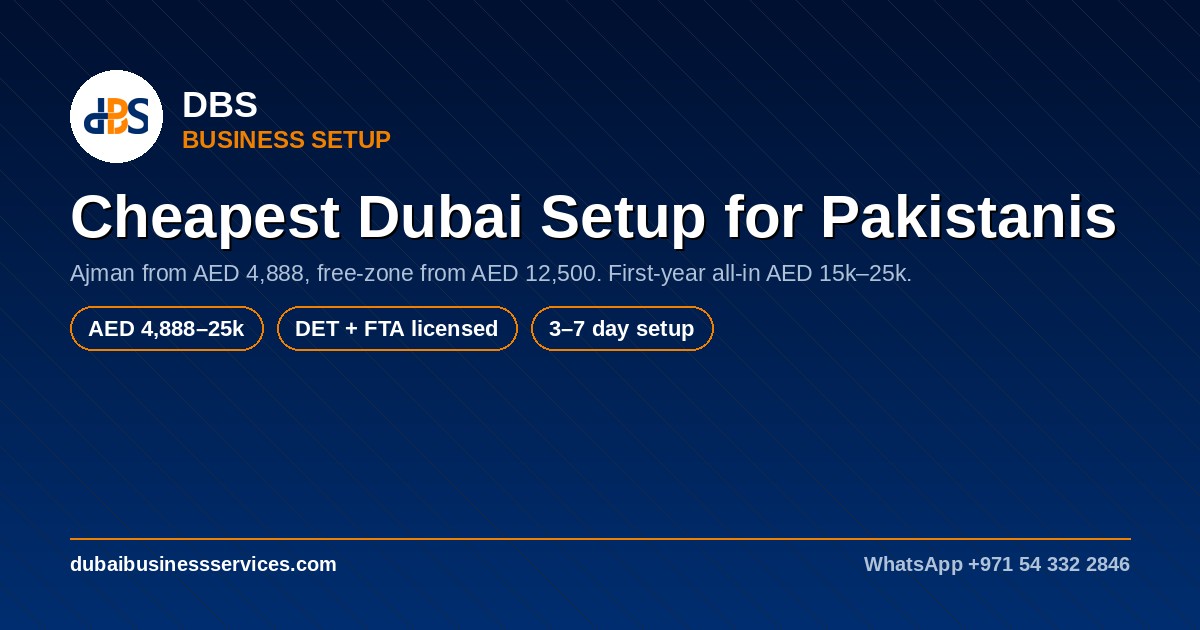
The cheapest Dubai licence for Filipinos is Meydan Free Zone at ~AED 12,500 (includes 1 visa); Ajman mainland is ~AED 4,888–5,750 licence-only. First-year all-in, expect AED 15,000–25,000 including licence, investor visa, registration, flexi-desk and insurance. DET and FTA set UAE rates; there are no hidden government fees if you avoid the paid-agency markup.
How much does the cheapest Dubai company really cost for Filipinos?
The headline licence price is only the start. Setting up a business setup in Dubai for Filipinos requires you to budget beyond the trade licence itself. The actual first-year cost lands in the range of AED 15,000–25,000 once you factor in visa, medical, Emirates ID, workspace and compliance. This article breaks down every line item so you see exactly where your AED goes — and where Filipinos often stumble.
What is the absolute cheapest licence in Dubai or the UAE?
If cost is your only metric, Ajman SHAMS Free Zone (Ajman Chamber of Commerce) or the mainland company in Ajman undercut Dubai. The licence alone runs AED 4,888–5,750 and comes with zero residency visa. You remain outside the UAE under this structure — no medical, no Emirates ID, no local address needed. The tradeoff: no UAE resident visa means banking approval is harder (foreign KYC is stricter) and you cannot claim UAE tax residency. Most Filipinos want to relocate, so this option rarely fits.
What about free-zone licences for Filipinos — Meydan vs IFZA vs others?
Dubai’s two main affordable free zones for Filipinos are:
| Free Zone | Licence Cost (AED) | Included Visas | Corporate Tax | First-Year All-In (AED) |
|---|---|---|---|---|
| Meydan Free Zone | ~12,500 | 1 visa | 0% on Qualifying Income | 18,000–22,000 |
| IFZA (International Free Zone Authority) | ~12,900 | Zero visa | 0% on Qualifying Income | 16,500–20,500 (if no visa needed) |
| Ajman SHAMS | ~4,888–5,750 | Zero visa | 0% (foreign entity) | 6,000–8,500 (no residency) |
Consult DBS now: WhatsApp +971 54 332 2846 for a side-by-side cost comparison based on your activity.
What does the cheapest licence NOT include — and what are the hidden costs?
A headline price like “AED 12,500” covers only the trade licence and Ministry of Economy/Department of Economic Tenure (DET) registration. It does not include:
- Residency/investor visa (~AED 3,500–7,500, depending on entity and visa type; partner/investor visa ~AED 6,000–9,000 all-in)
- Medical fitness certificate (~AED 150–400)
- Emirates ID (~AED 100–200)
- Workspace/virtual office (flexi-desk AED 500–1,500/month or ~AED 6,000–18,000/year)
- Business insurance (Professional Indemnity, Public Liability, ~AED 800–2,500/year depending on activity)
- Banking account setup (no government fee, but may require in-person appointment; minimum balance AED 0–50,000 depending on the bank)
- MOHRE Labour Contract registration (if you hire; ~AED 200–500 per contract)
Agencies often load hidden markups here. DBS publishes all-inclusive ranges with no surprises — Dubai free zone company formation costs are front-loaded.
All-in cost breakdown: what does a real first-year Filipina freelancer or trader pay?
| Item | AED (Range) | PHP (Indicative at 1 AED ≈ 19–21 PHP) | Notes |
|---|---|---|---|
| Free-zone licence (Meydan) | 12,500 | 237,500–262,500 | Includes trade name + 1 visa |
| Visa processing (if not in licence) | 3,500–7,500 | 66,500–157,500 | Investor/partner visa; depends on company capital |
| Medical + Emirates ID | 250–600 | 4,750–12,600 | One-off for first year |
| Flexi-desk or co-working (12 months) | 6,000–18,000 | 114,000–378,000 | Shared office, meeting rooms |
| Business insurance | 800–2,500 | 15,200–52,500 | Professional Indemnity/Liability |
| Bank account (no gov fee) | 0 | 0 | See banking checklist below |
| Subtotal Year 1 | 23,050–41,100 | 437,450–865,600 | Realistic lean setup: AED 18,000–25,000 |
| Renewal (Year 2+) | 7,000–20,000 | 133,000–420,000 | Licence renewal, visa renewal, workspace |
Indicative at current rates — convert at today’s rate via XE.com or your bank. This table is USD AED 3.67 conversion; your own peso/AED rate may differ.
What is the timeline to set up and have a live bank account in Dubai?
Formation itself is fast; banking is the real bottleneck.
| Phase | Timeline | Key Actions |
|---|---|---|
| Day 1–2 | Preparation | Gather documents (passport scans, POA, home-country attestation, source-of-funds letter). DBS sends you a checklist. |
| Day 2–5 | DET application | Submit trade licence application e-signed via UAE online portal (Dubai e-Services). DET approves and issues licence. |
| Day 5–7 | Visa application (if included) | Visa office processes investor/partner visa. You receive visa stamp or eVisa. |
| Day 7–10 | Emirates ID + medical | Complete medical exam (AED 150–400), apply for Emirates ID. Delivery 1–2 weeks. |
| Day 7–14+ | Bank account application | Submit application to chosen bank. KYC review: 1–4 weeks if non-resident; faster if resident visa + in-person. Some banks require video call or local visit. |
| Day 14–42 | Account approval + funding | Bank approves, account opened online (cards post separately). Fund the minimum balance (AED 0–50,000). |
Contact DBS to fast-track banking introductions and KYC documents: inquiry@dubaibusinessservices.com
Banking approval checklist for a Filipino-owned Dubai company
This is where Filipinos lose time. Non-resident KYC is strict. Have these ready before you apply:
- Certificate of Good Standing from your business registry in the Philippines (or equivalent if you operated previously). Issued by SEC (Securities & Exchange Commission, SEC Online portal) or BIR — free or AED equivalent ~150–300 PHP.
- Notarised passport copy + visa pages (AED ~200–500 to notarise locally, or use Philippine-notarised version with UAE attestation).
- Proof of source of funds (bank statement showing capital origin, 3–6 months; certified by your Philippine bank or DBS will advise).
- Proof of address — either a UAE lease, utility bill or bank statement; if in PH, a certified barangay certificate or BIR TIN card.
- UBO (Ultimate Beneficial Owner) Declaration — signed statement confirming you are the owner and no one else is hiding behind the company (required by UAE CBR anti-money-laundering rules).
- Company cap table (shareholding breakdown, even if 100% yours).
- Trade licence copy + incorporation docs (issued by DET once you register).
- DBS reference letter (optional but speeds up approval; DBS provides this to banks it has vetted relationships with).
- Banker’s reference from your Philippines account (request from your bank; confirms account length, behaviour, deposits).
Key friction point: If you are non-resident (no UAE visa yet), the bank may ask for a UAE-resident signatory or Power of Attorney (POA). If you have an investor visa, bank approval is faster.
UAE corporate tax 2026: does the cheap licence mean 0% tax forever?
No. The UAE moved away from a “100% tax-free” claim in 2023. Here is the real 2026 picture:
- Corporate Income Tax: 0% up to AED 375,000 in taxable profit per annum. Above that, 9% applies. This applies to all entities (mainland, free zones, foreign).
- Free-Zone Qualifying Income Protection (QFZP): Free-zone businesses can claim 0% on “Qualifying Income” only. De minimis threshold = lower of 5% of revenue or AED 5 million. If your non-qualifying income exceeds the threshold, you lose the 0% rate for ~5 years and must pay 9% on all taxable income.
- Small Business Relief (SBR): If revenue ≤ AED 3 million per financial year (period ending on or before 31 December 2026), you pay 0% regardless of profit. Above AED 3M, the 9% or QFZP rules kick in.
- VAT: 5% on goods and services. You must register if revenue exceeds AED 375,000 in a 12-month period. No exemption for free-zone companies on domestic UAE sales.
- Personal income tax: 0% for all UAE residents and visitors (freelancers, employees, investors). This is genuine — you keep 100% of your salary or drawings.
For a Filipino freelancer with revenue ~AED 500,000/year (say, freelance consultancy), the Small Business Relief gives you 0% corporate tax. A trader doing AED 2 million in free-zone sales must watch the QFZP de minimis rule closely or request a tax advisor review.
Critical for Filipinos: The Philippines has no tax treaty with the UAE. If you become a UAE resident (via investor visa), the Philippines may treat you as a non-resident for PH tax purposes. Consult a licensed Philippine tax advisor (BIR-accredited) about your OFW→investor transition. DBS does not provide tax advice in your home country; we handle only Dubai/UAE business setup.
Visa paths for Filipinos: investor visa vs freelancer vs employment
Your visa choice affects cost and setup speed:
- Partner/Investor Visa (2-year, renewable): For UAE company owners. Requirements vary by free zone: Meydan typically wants AED 100,000+ capital (or AED 50,000 for a one-person company); IFZA often has lower minimums. Cost: ~AED 6,000–9,000 all-in (application, medical, EID, processing). Fastest for business owners; allows you to sponsor family dependents.
- Green Visa (5-year, renewable): For skilled freelancers/consultants. Requires either (a) freelance income ≥AED 360,000/year; (b) employee salary ≥AED 15,000/month; or (c) investor share ≥AED 1 million in a UAE company. Costs ~AED 1,500–3,000 in government fees.
- Golden Visa (10-year): For investors. Routes: (a) property purchase (min. AED 2 million, freehold or usufruct); (b) deposit of AED 2 million+ in a UAE bank; (c) UAE company with AED 2 million capital. Government fees ~AED 4,695–10,140. Since February 2026, mortgaged and off-plan property now qualify (the 50%-upfront rule was removed). Not the cheapest route for startup freelancers.
- Family Sponsorship: Spouse/children: from ~AED 4,000/month salary proof; parents: ~AED 20,000/month. Separate visa process; requires a UAE residence.
For most Filipinos starting out, the Partner/Investor Visa with a low-cost free-zone licence (Meydan ~AED 12,500) is the most practical.
Can a Filipino own 100% of a Dubai company? Any restrictions?
Yes. Most sectors allow 100% foreign ownership in Dubai’s free zones and mainland. Exceptions are rare and sector-specific (e.g. some real estate, certain insurance roles). Your DBS advisor will confirm for your activity. Free-zone businesses explicitly support full foreign ownership with no local partner required.
How do Filipinos coming from the Philippines handle banking and residency transitions?
This is the real edge case. You are an OFW or business owner in the Philippines. Here is the sequence:
- Before you leave PH: Secure a letter from your current employer or business (if you have one) confirming you can take leave or are leaving employment. If self-employed, get a BIR Tax Clearance or Certificate of Good Standing from your BIR RDO.
- Apply for investor visa while still in PH: DBS handles the UAE side (forms, documents). The Philippine consulate in Dubai usually does not need to see you in person — you can submit a Power of Attorney (POA) to an agent or use e-notarisation. Cost: ~AED 3,500–7,500 for visa processing.
- Arrive in UAE on a visit/tourist visa, then activate your investor visa: Once stamped, you convert to official residency. Medical and Emirates ID follow.
- Tax residency in Philippines: The Philippines considers you a resident if you are physically present for 180 days in a tax year. An investor visa and UAE residency may trigger non-resident status in PH. Consult your local BIR-accredited CPA about OFW tax certificates (OEC) and your POLO employment status. DBS does not handle PH tax; we advise only on UAE setup.
- Banking: Once you have the investor visa and UAE address, banks will process your account faster. Many Filipinos do this remotely first (with a POA), then complete KYC in-person later.
WhatsApp DBS now for your visa timeline and banking roadmap: +971 54 332 2846
Frequently asked questions
What is the cheapest Dubai setup for Filipinos?
Cheapest licence is Ajman SHAMS at AED 4,888–5,750 (zero visa, foreign entity, no residency). If you want to relocate, Meydan Free Zone costs ~AED 12,500 (includes 1 visa) or IFZA ~AED 12,900. First-year all-in (licence + visa + medical + workspace + insurance) runs AED 15,000–25,000. Banking approval is the real bottleneck, not licence cost.
Why is the real first-year cost higher than the licence price?
The licence (AED 12,500) is only the DET registration. You must add: investor visa (AED 3,500–7,500), medical + Emirates ID (AED 250–600), workspace/flexi-desk (AED 6,000–18,000/year), business insurance (AED 800–2,500), and bank account setup (no gov fee, but time-intensive). Lean setup: AED 18,000–25,000 first year; renewal AED 7,000–20,000.
Does the cheapest licence include a visa?
Depends. Meydan Free Zone (~AED 12,500) includes 1 visa; IFZA (~AED 12,900) does not (zero-visa). Ajman SHAMS (AED 4,888–5,750) has zero visa by default. If you need a visa, add AED 3,500–7,500. Your choice depends on whether you plan to relocate to the UAE or operate remotely.
Meydan or IFZA — which is cheaper?
Meydan licence is ~AED 12,500 (includes 1 visa); IFZA is ~AED 12,900 (zero visa included). If you need residency, Meydan’s included visa saves AED 3,500–7,500 separately. If you don’t need a visa immediately, IFZA’s flat cost is comparable. Both offer 0% corporate tax on Qualifying Income under QFZP. Ask DBS for a breakdown for your specific visa timeline.
What does the headline price NOT include?
The licence fee (AED 12,500) covers only trade name + DET registration. It excludes: investor visa (AED 3,500–7,500), medical (AED 150–400), Emirates ID (AED 100–200), workspace (AED 500–1,500/month), business insurance (AED 800–2,500/year), MOHRE labour contracts (AED 200–500 each), and banking setup. Agencies often hide these. DBS lists all-in ranges with zero hidden markup.
Can I set up a Dubai company without a UAE visa?
Yes, if you choose a zero-visa free zone (IFZA, Ajman SHAMS) or a mainland no-visa licence. You remain outside the UAE for tax/residency purposes. Banking is harder because you are non-resident (stricter KYC). Most Filipinos eventually want residency, so combine licence + investor visa upfront. DBS advisors help you pick the right path based on your timeline.
Does the Philippines tax my Dubai business income?
There is no PH–UAE tax treaty. If you become a UAE resident (investor visa, 180+ days), the Philippines may treat you as non-resident, and you owe PH tax only on Philippine-source income. If you remain a PH resident, you owe PH income tax on worldwide income (including Dubai profits). Consult a BIR-accredited tax advisor in the Philippines. DBS provides only UAE setup guidance, not tax planning in your home country.
Get expert help in 20 minutes
Talk to DBS on WhatsApp +971 54 332 2846 or email inquiry@dubaibusinessservices.com for a free, fully itemised cost breakdown in your own currency — and a straight answer on banking and tax.