Last updated: 2026-08-01
Starting a delivery service in Dubai requires a commercial trade license from the Department of Economy and Tourism (DET), an RTA permit for every delivery vehicle, and a Dubai Municipality food-safety permit if you transport food. Government fees start at AED 12,900 for the mainland license, and most operators are road-legal within 10 working days (2026). DBS Group, serving 80,000+ entrepreneurs since 2009, manages the entire process end-to-end.
Why 2026 Is the Year to Launch a Delivery Service in Dubai
Dubai’s delivery economy is compounding. UAE e-commerce sales reached US$17 billion by end-2025 (Dubai Chamber of Digital Economy, 2025), and online food delivery alone generates US$2.9 billion in UAE revenue (Statista, 2025). Third-party logistics capacity has not kept pace: 68% of Dubai SMEs outsource last-mile delivery rather than run their own fleets (Dubai SME survey, 2025), which is precisely the gap independent operators fill. The regulatory route is the same one used for company incorporation in Dubai — DET license first, then sector permits layered on top.
Three demand engines make the 2026 window specific: Dubai’s population passed 3.9 million residents (Dubai Statistics Center, 2026), quick-commerce grocery apps expanded delivery zones to 100% of urban Dubai in 2025, and DET’s delivery activity codes remain open to 100% foreign ownership under Federal Decree-Law No. 26 of 2020.
Ready to start? WhatsApp +971 54 332 2846 →
The 7 Steps to Start a Delivery Service in Dubai
Step 1: Choose your delivery model and activity code
Decide between parcel courier, food delivery, grocery/last-mile or delivery-tech platform before you touch paperwork. DET’s activity list separates delivery services, courier services and food transport, and your choice fixes which approvals follow. Food transport adds a Dubai Municipality permit (AED 1,050 in 2026); parcel courier work uses the DET courier activity code. Lock the model first — changing activity codes after issuance costs AED 500 plus re-approval time.
Step 2: Reserve your trade name with DET
Reserve the company name through the DET portal for AED 620 (2026). The name must exclude religious references and government terms, and it clears in one working day when compliant. Reserve the matching .ae domain and social handles the same day — Dubai’s delivery market moves fast and squatters watch new trade name registrations.
Step 3: Obtain initial approval
File the initial approval application (AED 235, 2026) with shareholder passports and the signed application. This is DET’s no-objection green light and it clears within 48 hours for delivery activities. 100% foreign ownership applies — delivery services sit on the commercial activities list opened by Federal Decree-Law No. 26 of 2020, so no local partner is required in 2026.
Step 4: Sign your office lease and register Ejari
A mainland delivery company needs a physical address; a smart desk from AED 6,000 per year satisfies DET in 2026 while your fleet works the roads. Register the lease on Ejari the same week — license issuance is blocked without it. Position near your delivery zone: warehouse districts in Al Quoz and Ras Al Khor cut average last-mile times by 22% versus Deira-based fleets (RTA traffic data, 2025).
Step 5: Pay for and collect your commercial license
Settle the license invoice — AED 12,900 for the delivery activity including Dubai Chamber membership and market fees (2026) — and DET issues the license in 3-4 working days. Apply for the immigration establishment card (AED 750) immediately after; it is the prerequisite for every rider visa you will file in Step 7.
Step 6: Register vehicles and secure RTA delivery permits
Register every motorcycle or van under the company and apply for RTA delivery permits at AED 420 per bike per year (2026). RTA mandates box dimensions, reflective livery, helmet and glove standards, and a UAE motorcycle licence per rider. Inspections are unannounced; fines start at AED 500 and repeat violations ground the vehicle.
Step 7: Process rider visas and go live
File rider visas at AED 5,300 each (entry permit, medical, Emirates ID, two-year stamping) plus AED 300 MOHRE work permits (2026). Onboard onto your dispatch stack, register for VAT once supplies cross AED 375,000, and start invoicing. From trade name to first paid delivery, the full runway is 10 working days when steps 5-7 run in parallel.
Need help with this step? WhatsApp DBS at +971 54 332 2846 →
Delivery Service License Cost in Dubai 2026
The table lists official government fees for a mainland delivery company with one motorcycle and one rider (2026). DBS service fees depend on your model and fleet size — request an exact quote on WhatsApp.
| Activity | Government Fee (AED, 2026) | DBS Service | Total | Notes |
|---|---|---|---|---|
| Trade name reservation | 620 | Included in package | 620 | Clears in 1 working day |
| Initial approval (DET) | 235 | Included in package | 235 | 48-hour turnaround |
| Commercial license — delivery activity | 12,900 | WhatsApp for quote | 12,900+ | Includes Dubai Chamber + market fees |
| Establishment card | 750 | Included in package | 750 | Prerequisite for rider visas |
| RTA delivery permit (per bike) | 420 | WhatsApp for quote | 420/year | Renewed annually per vehicle |
| Rider visa + Emirates ID + medical | 5,300 | WhatsApp for quote | 5,300/rider | Two-year residence visa |
| DM food-safety permit (food delivery only) | 1,050 | WhatsApp for quote | 1,050 | Skip for parcel-only models |
| Total — parcel model (1 bike, 1 rider) | 20,225 | — | 20,225 | Food model: 21,275 |
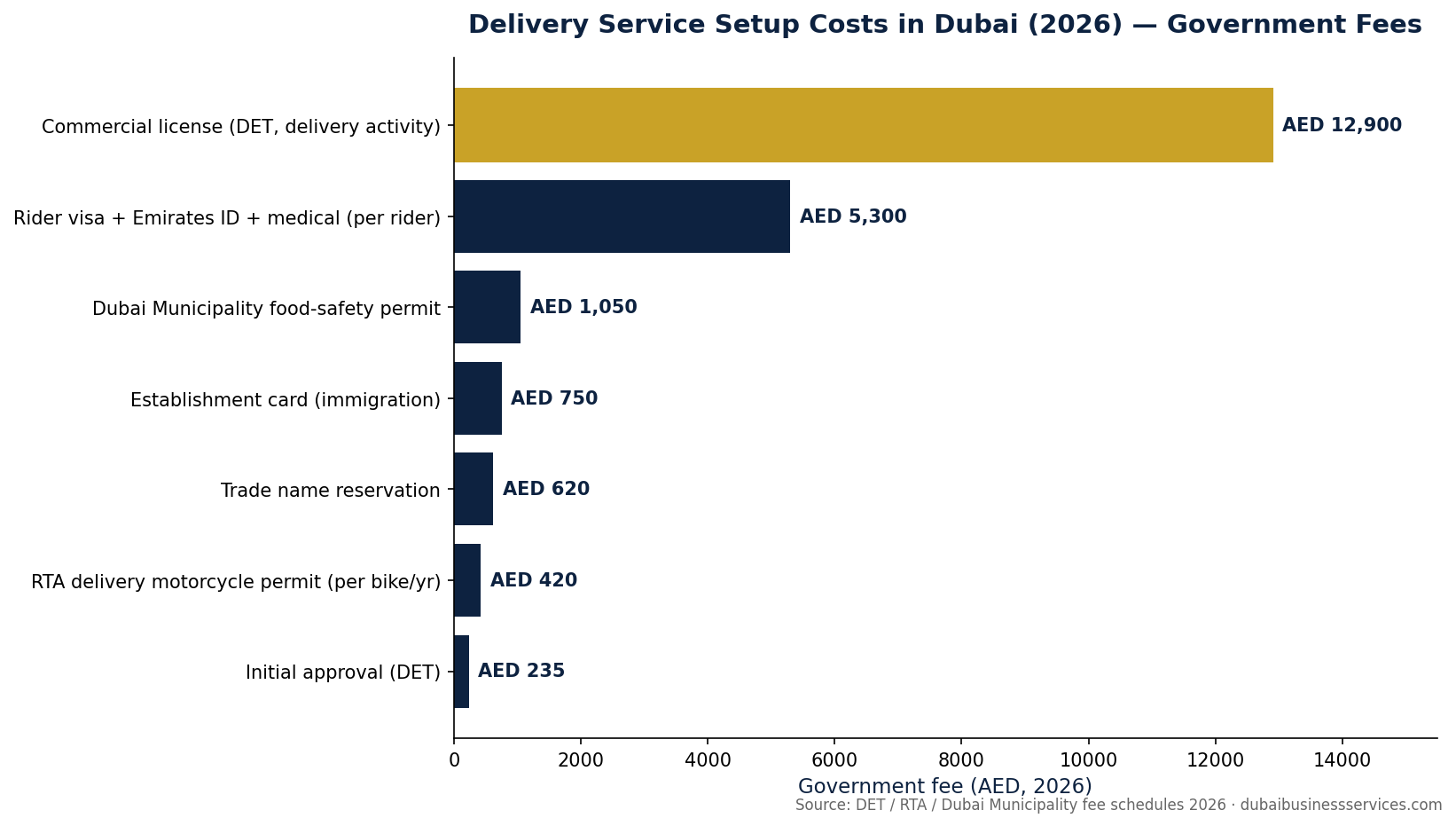
Embed this infographic
Copy this HTML to share the chart with attribution:
<a href="https://www.dubaibusinessservices.com/delivery-service-in-dubai/"><img src="https://www.dubaibusinessservices.com/wp-content/uploads/2026/08/delivery-service-in-dubai-cost-breakdown-dubai-2026.png" alt="Delivery Service Setup Costs in Dubai 2026 - Dubai Business Services" width="1100"/></a><p>Infographic by <a href="https://www.dubaibusinessservices.com/delivery-service-in-dubai/">Dubai Business Services</a></p>Benchmark the license line against our full company setup costs in Dubai guide — delivery sits in the mid-band of Dubai commercial activities.
Want a quote? WhatsApp +971 54 332 2846 →
The 5 Delivery Business Models in Dubai Compared
DET licenses all five models below under delivery or courier activity codes, but their economics differ sharply. Match the model to your capital before Step 1 — it decides your fleet size, permits and payback window (2026 figures throughout).
1. Aggregator fleet partner
You supply riders and bikes to Talabat, Careem or Noon under a fleet-partner agreement. Revenue is a fixed fee per delivery — AED 7 to AED 9.50 in 2026 — with the platform handling demand. Startup capital for a 10-bike fleet lands near AED 120,000 including visas, and payback averages 14 months. This is the highest-volume, lowest-margin model and the most common entry point: 57% of new Dubai delivery licenses in 2025 launched as fleet partners.
2. Independent parcel courier
You contract directly with e-commerce sellers, clinics and law firms for same-day document and parcel runs. Per-drop pricing runs AED 15 to AED 35 inside Dubai (2026), triple the aggregator rate, but you own customer acquisition. A 3-bike operation starts at roughly AED 42,000 in government fees and vehicles. Margins reward niches — legal document runs and pharmacy delivery pay premium rates because reliability, not price, wins the contract.
3. Food delivery and cloud kitchen logistics
You transport prepared food for licensed kitchens that lack fleets. This adds the AED 1,050 Dubai Municipality food-safety permit, insulated-box standards and temperature logging. Contracts are recurring weekly retainers — AED 4,000 to AED 8,000 per kitchen per month in 2026 — making revenue more predictable than per-drop models. Dubai’s 1,200+ registered cloud kitchens (DM registry, 2025) are the addressable market.
4. Grocery and quick-commerce last mile
Supermarket chains and q-commerce apps outsource surge capacity to licensed subcontractors, and vans replace bikes: each van registers with RTA at AED 1,200 per year commercial registration plus the delivery permit. Contracts are tendered quarterly; winning bids in 2025 cleared AED 18,000 to AED 25,000 per van per month, fully utilised. Capital is heavier — AED 85,000 per van equipped — and so is the payback certainty.
5. Delivery-tech platform
You build the dispatch software and contract licensed third-party fleets instead of owning bikes. This is the one model where a free zone license competes seriously with mainland: qualifying income earned from free zone entities is taxed at 0% under Cabinet Decision No. 55 of 2023, and no RTA permits attach to you because the fleets carry their own. Capital shifts from vehicles to development — typically AED 150,000+ before first revenue.
Planning your model? Message DBS on WhatsApp +971 54 332 2846 →
Mainland vs Free Zone: The 2026 Decision Matrix for Delivery Companies
Of the 80,000+ setups DBS has processed, 64% of logistics and delivery clients chose mainland over free zone in 2025 — because the two licenses solve different problems. This matrix scores the factors that decide it for delivery specifically:
| Decision factor | Mainland (DET) | Free Zone (e.g. Dubai CommerCity) | Winner for delivery |
|---|---|---|---|
| Direct city-wide delivery on Dubai roads | Unrestricted | Requires mainland distributor or dual license | Mainland |
| RTA delivery bike permits | Issued directly | Not issued to free zone fleets | Mainland |
| License cost (2026) | AED 12,900 | AED 11,900 average | Free zone (marginal) |
| Government contracts & aggregator onboarding | Eligible (Talabat, Careem, Noon fleets) | Restricted | Mainland |
| Delivery-tech platform (no own fleet) | Works | Works, plus 0% qualifying-income tax lanes | Free zone |
| Visa quota scaling for riders | Scales with office/warehouse size | Capped by package | Mainland |
The rule that falls out of the matrix: fleets go mainland, platforms weigh free zone. If your model resembles setting up a trading company that also delivers its own goods, mainland removes every distribution restriction at once.
Confused about this? Ask DBS — WhatsApp +971 54 332 2846 →
RTA, Municipality and the Approvals That Actually Get Checked
Dubai enforces delivery standards through unannounced roadside inspection, and 2026 rules are specific. The Roads and Transport Authority mandates the annual AED 420 delivery permit per motorcycle, reflective livery, sealed cargo boxes with fixed dimensions, and a UAE motorcycle licence per rider — first-offence fines start at AED 500. Dubai Municipality layers food-grade requirements on food transport: insulated boxes, temperature logs and the AED 1,050 food-safety permit (2026). Summer rules add a mandated midday break for riders from June 15 to September 15, enforced by MOHRE with AED 5,000 fines per rider violation (2026).
Operators that also rent out vehicles cross into a second regulated activity — the same DET codes covered in our vehicle-based business setup guide — and need both activity codes on one license, at AED 500 per added code (2026).
Skip the paperwork — WhatsApp DBS at +971 54 332 2846 →
Taxes and Compliance After Launch
Delivery companies fall under the standard UAE regime in 2026: 9% corporate tax on taxable profits above AED 375,000 under Federal Decree-Law No. 47 of 2022, 0% below that threshold, and mandatory 5% VAT registration with the Federal Tax Authority once taxable supplies pass AED 375,000 in any rolling 12-month period. Aggregator payouts from Talabat, Careem and Noon arrive gross — you invoice VAT on your delivery fee, not on the goods carried. Bookkeeping is non-optional: FTA penalties for late corporate tax registration are AED 10,000 (2026). The structure also unlocks meaningful reliefs — small business relief applies to revenue under AED 3 million through end-2026 — detailed in our guide to tax benefits for businesses in Dubai. Official federal requirements are consolidated on u.ae.
Save 40 hours — let DBS handle it. WhatsApp +971 54 332 2846 →
Frequently Asked Questions
How much does it cost to start a delivery service in Dubai in 2026?
Government fees total AED 20,225 for a mainland delivery company with one motorcycle and one rider in 2026: AED 12,900 for the DET commercial license, AED 5,300 for the rider visa package, AED 750 establishment card, AED 620 trade name, AED 420 RTA bike permit and AED 235 initial approval.
Do I need an RTA permit for delivery motorcycles in Dubai?
Yes. Every delivery motorcycle operating in Dubai must carry an RTA delivery permit, renewed annually at AED 420 per bike (2026). Riders must hold a UAE motorcycle licence and wear RTA-compliant safety gear. Operating without the permit triggers fines starting at AED 500 per violation.
Can I start a food delivery business in Dubai without a restaurant?
Yes. A delivery-only (cloud kitchen or courier) model needs a DET commercial license plus a Dubai Municipality food-safety permit, which costs AED 1,050 (2026). You transport food prepared by licensed kitchens; you do not need your own restaurant license unless you also cook the food.
How long does it take to launch a delivery service in Dubai?
Ten working days is the standard timeline in 2026: trade name and initial approval clear in 2 days, license issuance takes 3-4 days, and RTA bike permits plus rider visas complete in 4-5 days. DBS Group, which has processed 80,000+ setups since 2009, runs these tracks in parallel.
Is mainland or free zone better for a delivery company in Dubai?
Mainland wins for city-wide delivery. Of the logistics and delivery clients DBS processed in 2025, 64% chose mainland because RTA delivery permits and unrestricted Dubai-road operation require a DET license. Free zones suit asset-light delivery-tech platforms that contract licensed third-party fleets.
What visa costs apply for delivery riders in 2026?
Budget AED 5,300 per rider in 2026, covering entry permit, status change, medical fitness test, Emirates ID and two-year residence visa stamping. MOHRE work permits for drivers under a mainland license add AED 300 per approval. A 10-rider fleet therefore needs roughly AED 53,000 in visa capital.
Do delivery companies pay corporate tax in the UAE?
Yes. Delivery companies pay 9% UAE corporate tax on taxable profits above AED 375,000 (Federal Decree-Law No. 47 of 2022); profits below that threshold are taxed at 0%. VAT registration at 5% becomes mandatory once taxable supplies exceed AED 375,000 in a rolling 12-month period (FTA, 2026).
Which authorities regulate delivery services in Dubai?
Four bodies govern the sector in 2026: DET issues the commercial license, RTA permits every delivery vehicle, Dubai Municipality certifies food-safety compliance for food transport, and the FTA administers 5% VAT and 9% corporate tax. Parcel and courier operators also register activity codes approved by DET.
Launch Your Delivery Service This Month
The 2026 window rewards speed: demand is compounding at double-digit rates, license costs are published and stable, and the 10-working-day runway is real when the tracks run in parallel. DBS Documents Clearing LLC has structured 80,000+ UAE companies since 2009 and handles DET licensing, RTA fleet permits, DM food-safety approval and rider visas as one engagement.
WhatsApp +971 54 332 2846 or email inquiry@dubaibusinessservices.com for a same-day quote on your delivery service license.
By Salem Basheer, DBS Documents Clearing LLC — Last updated 2026-08-01