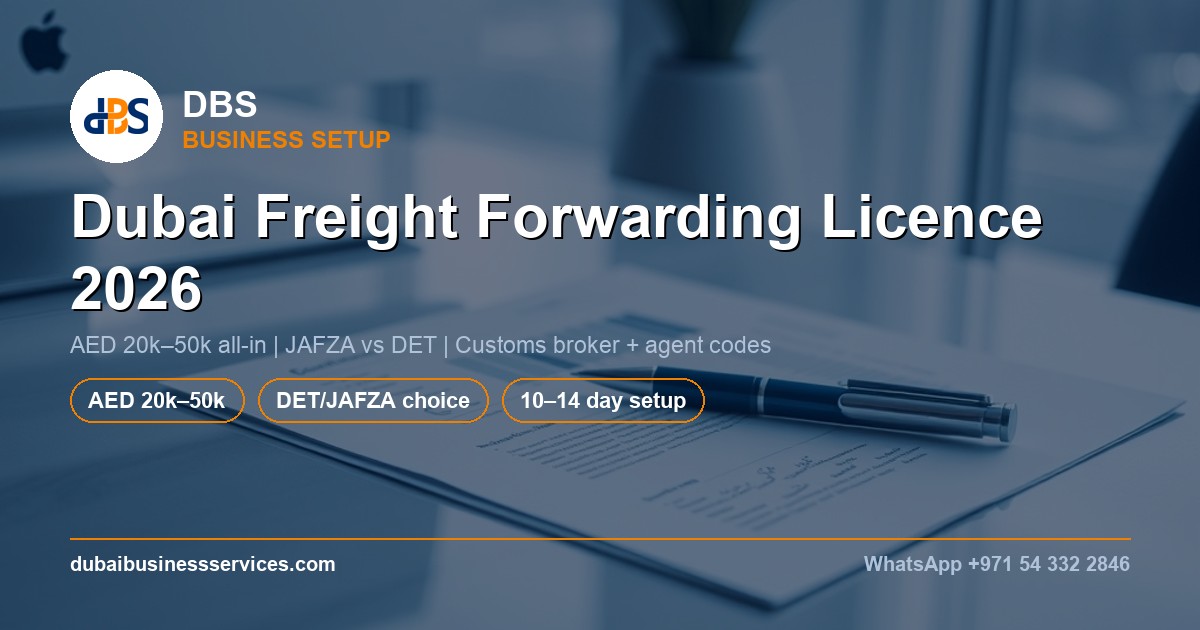
A Dubai freight forwarding licence costs AED 20,000–50,000 all-in, depending on location (mainland via Dubai Economic Department or JAFZA) and scope (forwarding agent, customs broker, or both). You’ll need registered office and warehouse space, plus activity codes 5229 (freight forwarding) and 6311 (customs broker) from MOHRE and DET.
What Is a Freight Forwarding Licence in Dubai?
A freight forwarding licence authorises you to arrange shipments, negotiate rates, and manage documentation for clients moving goods internationally. In Dubai, this falls under Dubai business setup regulations set by the Department of Economy and Tourism (DET) on the mainland and Jebel Ali Free Zone Authority (JAFZA) in the free zone. The licence covers your role as a forwarding agent (activity code 5229) and optionally as a customs broker (code 6311). You may also hold an NVOCC (Non-Vessel-Operating Common Carrier) licence if you consolidate Less Than Container Load (LCL) shipments under your own bill of lading.
Unsure which location suits your freight operation? WhatsApp +971 54 332 2846 for a location cost–benefit breakdown.
Mainland (DET) vs JAFZA Freight Forwarding Setup
| Factor | DET Mainland | JAFZA Free Zone |
|---|---|---|
| Licence cost (all-in) | AED 20,000–35,000 | AED 28,000–50,000 |
| Office space requirement | Min. 100 sqm | Dedicated booth or office |
| Warehouse space | Optional but recommended | Optional (JAFZA has storage) |
| Customs broker approval | Via DET & Customs | Via JAFZA & Customs |
| Access to free zone ports | Limited (Jebel Ali gates) | Unrestricted Jebel Ali access |
| Client base flexibility | National + international | 100% export/import focus |
Mainland suits general freight forwarding serving local and export clients. JAFZA advantages: zero import duty on goods in transit, faster customs clearance for zone-registered clients, and direct Jebel Ali terminal access. However, JAFZA requires you to operate exclusively in import/export (no domestic distribution) and lease dedicated space at JAFZA rates (typically AED 3,000–8,000/month for a booth).
DBS has guided 80,000+ entrepreneurs since 2009. Get your free 20-minute setup call: email inquiry@dubaibusinessservices.com.
Freight Forwarding Licence Cost Breakdown 2026
All-in range: AED 20,000–50,000 (2026 estimates)
- DET mainland licence (forwarding agent + customs broker): AED 20,000–35,000
- JAFZA booth licence (forwarding agent + customs broker): AED 28,000–50,000 (includes 12-month booth rental and sponsored licence)
- Ministry of Human Resources & Emiratisation (MOHRE) attestation: AED 500–1,000
- Office fit-out and initial signage: AED 3,000–8,000
- Insurance (professional indemnity & cargo liability): AED 2,000–5,000/year
- FIATA/IATA accreditation (optional): AED 1,500–3,000 (recommended for air freight agents)
Costs exclude office/warehouse rental, which varies: mainland AED 2,000–6,000/month for 150–250 sqm; JAFZA AED 3,000–8,000/month. Most entrepreneurs budget an additional AED 5,000–15,000 for initial compliance, software setup, and customs broker application fees.
Customs Broker vs Forwarding Agent: Activity Codes & Scope
Dubai regulations distinguish two core roles:
- Forwarding Agent (Code 5229): Arranges shipments, negotiates rates, manages documentation, handles customs clearance as an agent. Acts on behalf of shippers. Mandatory for any freight forwarding licence.
- Customs Broker (Code 6311): Clears goods through UAE Customs independently. Only brokers and forwarding agents with this code can lodge customs declarations directly. Most forwarding companies add this code to serve clients end-to-end.
Your licence from DET or JAFZA will specify both activity codes. However, to legally process customs declarations, you must also obtain a separate Customs Broker Approval from the General Department of Residency & Foreign Affairs (GDRFA) and UAE Customs. This approval (no additional licence fee, but submission and vetting AED 1,000–2,000) confirms your authority to lodge entries and clearances. NVOCC operators (who issue their own bills of lading) follow the same pathway but are registered separately in shipping registries.
Navigating customs broker approval? Dubai business setup consultants from DBS can expedite your application. WhatsApp +971 54 332 2846.
FIATA & IATA Accreditation for Freight Forwarders
Although not legally mandatory in the UAE, FIATA (International Federation of Freight Forwarders Associations) and IATA (International Air Transport Association) accreditation significantly strengthen your credentials:
- FIATA FC Certificate: Demonstrates compliance with global freight forwarding standards. Costs AED 1,500–3,000; valid 3 years. Many international clients and insurance providers prefer FIATA-accredited partners.
- IATA CASS/Agent Accreditation: Required if you sell airline tickets or consolidate air cargo. AED 2,000–4,000 plus annual fees (AED 1,000–2,000). Unlocks direct airline relationships and commissions.
DBS partners help clients pursue accreditation after licence grant. Apply to the respective bodies (FIATA via Emirates Logistics Council; IATA via regional training centres in Dubai) once your DET or JAFZA licence is live and your customs broker approval confirmed.
Office & Warehouse Space Requirements
Mainland (DET): Minimum 100 sqm registered office, separately leased. Many forwarders add a 200–500 sqm warehouse for document filing, VGM (Verified Gross Mass) handling, and cargo staging. Not compulsory, but essential if you handle breakbulk or LCL consolidation.
JAFZA: Dedicated booth (typically 50–80 sqm all-in) or private office. Booth rental includes basic utilities and security. Warehouse access available through JAFZA’s shared storage (AED 50–100 per pallet/month) or external zone warehouses.
DET and JAFZA both mandate a signed tenancy contract (Ejari registration, AED 50–300 admin fee) as proof of office location. This contract is verified during licence application. Warehouse space does not require a separate licence but must be documented in your company profile for insurance and customs audit purposes.
How to Obtain Your Freight Forwarding Licence: Step-by-Step
Mainland (DET) pathway:
- Secure office tenancy (Ejari registered). Obtain MOA (Memorandum of Association) and Articles from a local freelance consultant or law firm (AED 500–1,500).
- Submit business setup application to DET with office plan, shareholding details, and nominated director CV. Processing: 5–7 days. Cost: AED 2,000–3,000.
- DET issues licence approval letter. Proceed to MOHRE for labour card and staff visas (AED 1,500–3,000).
- Apply for Customs Broker Approval via GDRFA (submit licence, directors’ CVs, insurance details). Approval timeline: 7–10 days. Cost: AED 1,000–2,000.
- Open corporate bank account and obtain cargo liability insurance (AED 2,000–5,000/year).
- Total timeline: 10–14 days. Total cost: AED 20,000–35,000.
JAFZA pathway:
- Apply for JAFZA licence via the JAFZA online portal or a zone-accredited agent. Provide incorporation documents and director details. JAFZA processes internally: 7–10 days.
- JAFZA issues licence (includes customs broker activity code). Cost: AED 28,000–50,000 (includes first-year booth rent & sponsorship).
- Register with GDRFA for Customs Broker Approval using JAFZA licence (AED 1,000–2,000, 7–10 days).
- Secure insurance and open bank account.
- Total timeline: 10–14 days. Total cost: AED 28,000–50,000 (including booth rental).
DBS manages both pathways end-to-end. WhatsApp +971 54 332 2846 to start your application today.
Frequently asked questions
How much does a freight forwarding licence cost in Dubai?
A freight forwarding licence in Dubai costs AED 20,000–50,000 all-in, depending on location and scope. Mainland (DET) ranges AED 20,000–35,000; JAFZA ranges AED 28,000–50,000 (including booth rental and first-year sponsorship). Additional costs: office/warehouse rent (AED 2,000–6,000/month), insurance (AED 2,000–5,000/year), and optional FIATA accreditation (AED 1,500–3,000).
Should I set up freight forwarding in JAFZA or mainland Dubai?
Choose mainland (DET) if your clients are domestic or mixed (UAE + international). DET costs less upfront (AED 20k–35k) and allows flexible service scope. Choose JAFZA if your business is 100% import/export focused. JAFZA (AED 28k–50k) offers zero import duty on transit goods, faster customs clearance, and direct Jebel Ali terminal access. Both take 10–14 days; JAFZA requires long-term booth commitment (AED 3k–8k/month).
Do freight forwarders need a customs code in Dubai?
Yes. Every freight forwarding licence includes activity code 5229 (forwarding agent). To legally lodge customs declarations, you must also obtain activity code 6311 (customs broker) and a separate Customs Broker Approval from GDRFA. This approval (non-fee or AED 1k–2k) confirms your authority to process customs entries. Without it, you cannot clear goods independently and must partner with a licensed broker.
What is the difference between freight forwarding and logistics licences in Dubai?
A freight forwarding licence (code 5229 + 6311) authorises arranging shipments, negotiating rates, and handling customs clearance. A logistics licence (codes 5221, 5222, or 5229) is broader and may include warehousing, inventory management, and last-mile delivery. Freight forwarders focus on documentary and customs work; logistics companies manage physical storage and distribution. Both are activity codes under MOHRE and DET.
What warehouse and office space do I need for a freight forwarding licence?
Mainland: minimum 100 sqm registered office (separate lease). Add a 200–500 sqm warehouse if handling breakbulk, LCL consolidation, or VGM documentation. JAFZA: dedicated booth (50–80 sqm) or private office, with optional access to shared zone warehouses (AED 50–100/pallet/month). All space must be documented in a signed Ejari tenancy contract. Warehouse space is not licensed separately but audited for compliance.
Do I need FIATA or IATA accreditation for a Dubai freight forwarding licence?
Not legally mandatory, but highly recommended. FIATA FC (AED 1,500–3,000; valid 3 years) demonstrates global standards compliance and appeals to international clients and insurers. IATA CASS (AED 2,000–4,000 plus AED 1,000–2,000/year) is required only if you consolidate air cargo or sell airline tickets. Both are applied for after your DET or JAFZA licence and customs broker approval are live.
What is an NVOCC licence in Dubai and do I need one?
An NVOCC (Non-Vessel-Operating Common Carrier) licence allows you to issue your own bill of lading for consolidated LCL shipments, even though you do not operate the vessel. It is optional; you can forward cargo as an agent without NVOCC status. If you consolidate regularly and want shipper status, apply for NVOCC registration (AED 2,000–4,000) via international shipping registries recognised by DET or JAFZA. Requires proof of consolidation volume and liability insurance.
Get expert help in 20 minutes
Need clarity on your Dubai setup? Talk to DBS Documents Clearing LLC — 80,000+ entrepreneurs served since 2009. WhatsApp +971 54 332 2846 or email inquiry@dubaibusinessservices.com for a free 20-minute scoping call.