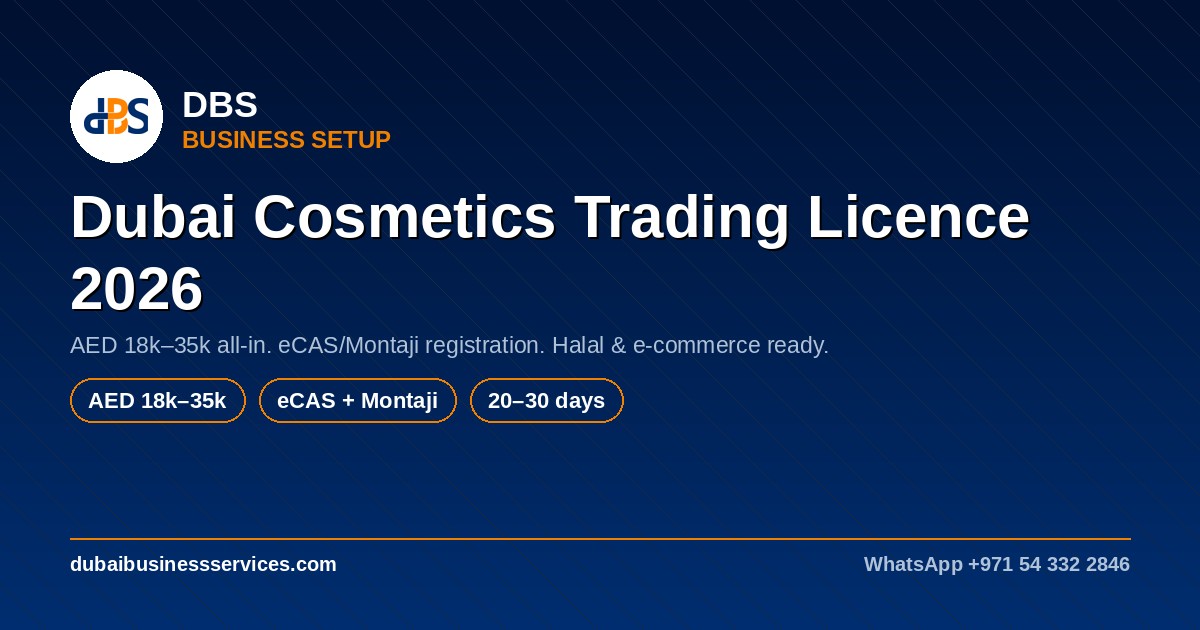
A Dubai cosmetics trading licence costs AED 18,000–35,000 all-in for 2026. You must register products via Dubai Municipality’s eCAS or Montaji system and comply with UAE ingredient labelling and Halal certification rules. Contact Dubai Business Services for a free scoping call: WhatsApp +971 54 332 2846.
What Is a Dubai Cosmetics Trading Licence?
A cosmetics trading licence permits you to import, distribute, and sell beauty and personal-care products in the UAE. Whether you operate a retail shop, wholesale distributor, or e-commerce platform, you need this licence issued by Dubai Municipality. Dubai business setup for cosmetics differs from general trading because product safety, labelling, and Halal certification are mandatory. The Department of Economy and Tourism (DET), formerly DCCI, oversees licence issuance; Dubai Municipality enforces product registration and compliance.
Get a free 20-minute setup review: WhatsApp +971 54 332 2846.
2026 Cosmetics Licence Cost Breakdown: AED 18,000–35,000
The all-in cost to establish a cosmetics trading business in Dubai spans AED 18,000–35,000, depending on your business structure and scope:
| Cost Component | AED Range | Notes |
|---|---|---|
| Trade Licence (mainland) | 1,800–3,500 | Annual; scope of activity influences fee |
| Business Registration (DET) | 500–1,200 | One-time registration |
| Dubai Municipality Product Registration (eCAS/Montaji) | 2,000–5,000 | Per product category; Halal certification included |
| Tenancy Contract & Office Setup | 5,000–12,000 | Annual rent or ejari registration |
| Health & Safety Inspections | 800–2,000 | Municipality compliance checks |
| E-Commerce Addon (optional) | 1,500–3,000 | Online selling channel approval |
| Consultancy & Document Services | 3,000–8,000 | DBS or equivalent setup support |
Costs vary by product category (skincare, haircare, makeup) and import volume.
Dubai Municipality Product Registration: eCAS & Montaji
Before you can sell a single item, every cosmetic product must be registered and approved by Dubai Municipality. There are two digital pathways:
eCAS (Electronic Compliance & Approval System): Used for standard cosmetic imports. You submit product formulations, ingredient lists, safety data sheets (SDS), and Halal certificates. Dubai Municipality chemists review submissions within 10–15 working days. Fee: typically AED 1,500–3,000 per product SKU.
Montaji (Dubai Municipality’s Product Database): A centralized platform for pre-approved cosmetic manufacturers and formulas. If your supplier is listed, registration is faster and cheaper (AED 800–1,500 per SKU). Dubai business setup consultants can verify your supplier’s Montaji status before you commit.
Struggling with eCAS submissions? DBS handles all documentation. Email inquiry@dubaibusinessservices.com.
Halal Certification & Ingredient Labelling Rules
The UAE Food and Drug Authority (FMCG wing) mandates that all cosmetics sold in the emirate comply with GCC standards for ingredient disclosure and safety. Key requirements for 2026:
- Halal Certificate: Products must carry a valid Halal certification from an approved body (e.g., ESIC, SMIIC-accredited labs). This applies to skincare, haircare, and makeup; even if alcohol-free, certification proves compliance with Islamic standards.
- Arabic Labelling: Product labels must include ingredient lists, usage instructions, and warnings in Arabic and English. Ingredient names must comply with INCI (International Nomenclature of Cosmetic Ingredients) standards.
- Country of Origin & Batch Number: All packages must display manufacturer country, batch code, and shelf-life (expiry date in DD/MM/YYYY format).
- Allergen Disclosure: Any known allergens (nuts, shellfish, gluten) must be clearly flagged on packaging.
Non-compliant labelling can trigger product seizure and fines up to AED 10,000. Let DBS verify your labels before import.
E-Commerce Add-On for Online Cosmetic Sales
Selling cosmetics online in Dubai requires an e-commerce endorsement to your trade licence. The add-on costs AED 1,500–3,000 annually and allows you to list products on your website, app, or third-party marketplaces (Noon, Amazon UAE, Souq.com).
Requirements:
- Valid website or mobile app with clear product descriptions and pricing.
- Online Terms & Conditions that comply with UAE Consumer Protection Law.
- A designated customer-service email and phone number.
- Proof of secure payment gateway and data-privacy compliance (GDPR-ready, if selling to EU customers).
- Same product registration (eCAS/Montaji) applies; you cannot sell unregistered cosmetics online.
Dubai Municipality monitors e-commerce platforms quarterly for counterfeit products and unlicensed sellers. Operating without the endorsement can result in licence suspension and fines of AED 5,000–20,000.
Ready to go online? DBS can register your e-commerce channel within 7 days.
Free-Zone Cosmetics Licensing: Alternative Route
If you prefer lower overhead and faster approvals, consider a free-zone licence in the Dubai Multi-Commodities Centre (DMCC), Jebel Ali Free Zone, or Dubai Airport Free Zone. Free-zone cosmetics licences cost AED 12,000–25,000 annually and offer 100% foreign ownership, no Emirati sponsor required, and streamlined Dubai Municipality product registration.
Trade-off: You must have a physical address in the free zone and export/re-export at least 70% of inventory outside the UAE, or establish a distribution agent within mainland Dubai to service local retail and e-commerce channels. Many large beauty distributors use this hybrid model for tax efficiency and regulatory flexibility.
Next Steps: How to Apply in 2026
Step 1: Gather your product portfolio, Halal certificates, and SDS for all SKUs. Step 2: Choose mainland Dubai or free-zone setup based on your sales strategy. Step 3: Apply for a trade licence via DET’s eServices portal or engage a licensed consultant. Step 4: Submit products for Dubai Municipality eCAS/Montaji approval simultaneously; do not import without approval. Step 5: Complete health inspections and collect your licence certificate. Step 6: If selling online, request e-commerce endorsement. Total timeline: 20–30 working days for standard approval; 10–15 days for expedited fast-track via DMCC or free zones.
Dubai Business Services has cleared 80,000+ entrepreneurs through this process since 2009. WhatsApp +971 54 332 2846 or email inquiry@dubaibusinessservices.com for a free 20-minute scoping call—no obligation, no upsell.
Frequently asked questions
How much does a cosmetics trading licence cost in Dubai in 2026?
A complete cosmetics trading licence setup costs AED 18,000–35,000 all-in, including trade licence (AED 1,800–3,500), Dubai Municipality product registration (AED 2,000–5,000), office tenancy/ejari (AED 5,000–12,000), and consultancy services. E-commerce add-ons cost AED 1,500–3,000 extra. Free-zone alternatives range from AED 12,000–25,000 annually.
How do I register a cosmetic product with Dubai Municipality?
Submit your product formulation, ingredient list, SDS, and Halal certificate via Dubai Municipality’s eCAS (Electronic Compliance & Approval System) or Montaji platform. Review takes 10–15 working days; fee is AED 1,500–3,000 per SKU via eCAS, or AED 800–1,500 if your supplier is pre-approved on Montaji. No product may be sold without approval.
Do I need Montaji or eCAS approval for cosmetics?
Yes, both are Dubai Municipality’s mandatory routes. Montaji is faster and cheaper if your manufacturer or formula is pre-registered in Dubai Municipality’s database. eCAS is the standard path for new products. You cannot legally import or sell cosmetics without approval from one of these systems; the choice depends on your supplier’s Montaji status.
Can I sell cosmetics online under a Dubai trading licence?
Yes, but you need an e-commerce endorsement to your trade licence (AED 1,500–3,000 annually). All products sold online must still be registered via eCAS/Montaji. Dubai Municipality monitors e-commerce platforms quarterly; unlicensed online sales incur fines of AED 5,000–20,000 and licence suspension.
What labelling rules apply to imported cosmetics in the UAE?
Products must display ingredient lists (INCI-compliant), Arabic and English labels, country of origin, batch number, shelf-life (DD/MM/YYYY), allergen warnings, and a valid Halal certificate. Non-compliant labels trigger product seizure and fines up to AED 10,000. All labelling must comply with GCC and UAE Food and Drug Authority standards.
What is the difference between mainland and free-zone cosmetics licensing?
Mainland licences (AED 18,000–35,000) allow retail, wholesale, and direct e-commerce sales in the UAE with no export requirement. Free-zone licences (AED 12,000–25,000) offer 100% foreign ownership and faster approvals but require 70% of stock to be exported or an agent for local distribution. Choose based on your target market and tax strategy.
How long does it take to get a cosmetics licence in Dubai?
Standard approval takes 20–30 working days: 3–5 days for trade licence, 10–15 days for eCAS/Montaji product registration, 2–3 days for health inspections. Fast-track via free zones or DMCC can reduce this to 10–15 days. DBS expedites the process by pre-checking all documents and liaising with DET and Dubai Municipality simultaneously.
Get expert help in 20 minutes
Need clarity on your Dubai setup? Talk to DBS Documents Clearing LLC — 80,000+ entrepreneurs served since 2009. WhatsApp +971 54 332 2846 or email inquiry@dubaibusinessservices.com for a free 20-minute scoping call.