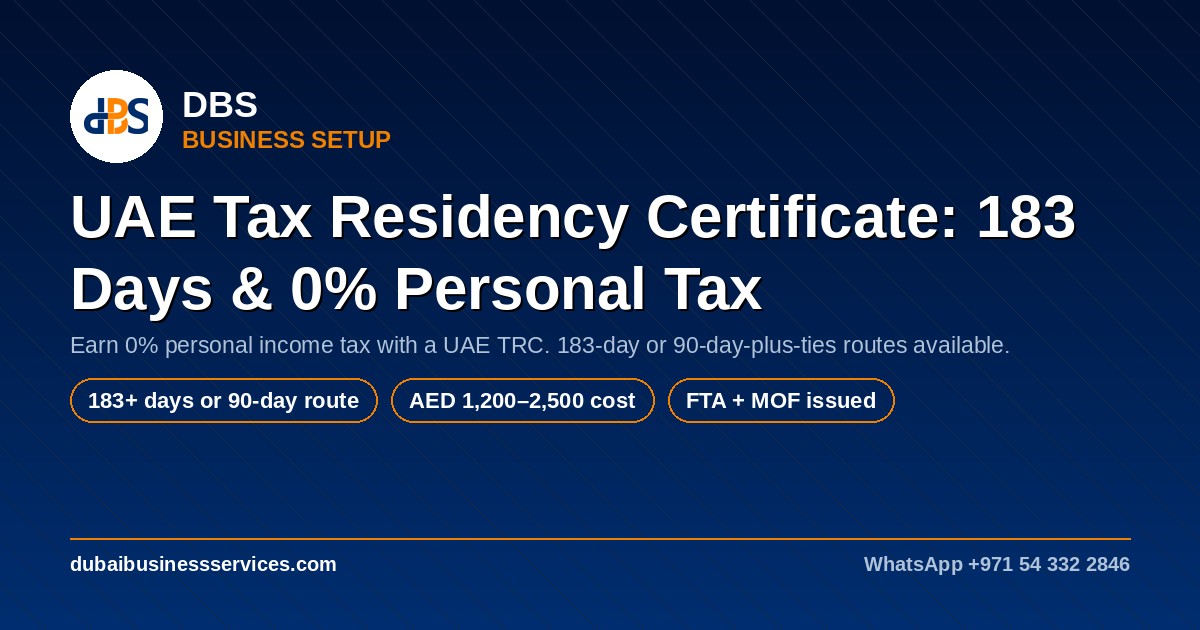
A UAE Tax Residency Certificate (TRC) is an official document proving you are tax-resident in the UAE for personal income purposes. Meet 183+ days in the UAE annually, or 90+ days plus permanent home/business ties, to qualify for 0% personal income tax—provided your home country recognises the break in residency. Issued by the Ministry of Finance or FTA (Federal Tax Authority).
What is a UAE Tax Residency Certificate and Why Does It Matter?
A UAE Tax Residency Certificate (TRC) is a formal letter from the UAE Ministry of Finance or Federal Tax Authority confirming that you are tax-resident in the UAE. It establishes your centre of economic interest in the UAE for OECD treaty purposes. UAE personal income tax is 0% for all residents—no salary tax, no capital gains tax, no dividends tax. However, your home country must also recognise that you have severed tax residency there; a UAE visa alone does not end your home-country tax liability unless you meet that country’s own residency tests (typically also involving physical presence or permanent home disposal). A TRC is therefore essential when applying for business setup in Dubai, obtaining a residence visa, or proving tax status to HMRC, IRS, or your home tax authority. DBS supplies certified TRC applications with full OECD tie documentation—WhatsApp +971 54 332 2846.
The 183-Day Rule: Your Primary Route to Tax Residency
The most straightforward path to UAE tax residency is 183 days in the UAE within a calendar year. Days are counted from entry stamp to exit stamp; partial days count as full days. You do not need to be physically present every single day—only meet the 183-day cumulative threshold. Many expats and business founders use this route: reside in Dubai, spend 183+ days annually in the emirate, and file a TRC application with the FTA at the end of the tax year (1 January–31 December). The FTA will cross-reference your entry/exit records from GDRFA (General Directorate of Residency and Foreigners Affairs) and issue the certificate, typically within 10–15 working days. Your home country’s tax authority (HMRC, IRS, tax agency) will then accept the TRC as proof that you are no longer resident there, ending your liability for personal income tax in that jurisdiction.
The 90-Day-Plus-Ties Route: Alternative for Business Owners
If 183 consecutive days is impractical—for instance, if you travel to manage multiple businesses—you may qualify under the 90-day-plus-permanent-ties criterion. You must spend a minimum of 90 days in the UAE and satisfy at least two of the following:
- Permanent home: Ownership, lease, or uninterrupted availability of housing in the UAE (≥12 months).
- Centre of vital interests: Family, business operations, close personal/economic ties, or registered office in the UAE.
- Habitual abode: Regular pattern of residence, social integration, or community involvement in the UAE.
This route is common for entrepreneurs with Dubai free zone company formation across Jebel Ali, DMCC, Dubai Silicon Oasis, or the DIFC, who spend significant time overseas but maintain a registered office and residence visa in Dubai. Document permanence: produce a tenancy contract, property deed, or memorandum of understanding with your landlord, alongside company registration papers and visa evidence.
How to Obtain Your UAE Tax Residency Certificate
Follow this step-by-step process:
- Prepare documents: Passport copy, UAE residence visa, entry/exit stamps, tenancy contract or property deed (if using 90-day route), company trade licence or investor visa letter.
- Submit via FTA portal or in person: Visit www.tax.gov.ae, create an FTA account, or visit the Federal Tax Authority office in Dubai (Al Manara, Al Fahidi Street). No appointment required; processing is typically same-day for complete applications.
- Pay application fee: AED 1,200–2,500 depending on complexity and whether you require certified English or Arabic translations (obtain at certified translator in Dubai, typically AED 200–500 per document).
- Receive TRC: The FTA issues the certificate in hardcopy and digital format. Validity is one year from issue date.
- Notify your home tax authority: Submit the TRC to HMRC (UK), IRS (USA), CRA (Canada), ATO (Australia), or your national tax office as proof of non-residence. Include a cover letter explaining the break in tax residency and a copy of your UAE residence visa.
DBS handles TRC applications, document preparation, and liaison with the FTA—email inquiry@dubaibusinessservices.com for a free checklist.
Will a UAE Visa Alone End Your Home-Country Tax Residency?
No. A UAE residence visa is necessary but not sufficient. Your home country applies its own residency test, which usually mirrors the OECD Model: 183+ days of physical presence, or permanent home and centre of vital interests. For example, if you hold a UK residence visa and work in Dubai but return to the UK every month, the UK tax authority (HMRC) may still consider you UK-resident because you maintain a permanent home there. Conversely, if you sell your home in the UK, sever all business ties, and meet the UAE 183-day test, HMRC will accept the TRC and classify you as non-resident. The TRC is your evidence of compliance with the UAE half; your home country’s own threshold decides the other half. Many people incorrectly assume Dubai is ‘100% tax-free’—it is not since corporate tax launched in 2023. However, personal income genuinely is 0% for UAE residents, and corporate income is 0% on profit up to AED 375,000 per year (9% above, or 9% from the first dirham if your company is in a free zone and receives non-qualifying income).
Itemised Setup Cost Table (AED + Indicative Home-Country Equivalents)
| Item | AED Range | USD (approx. 1 AED = 0.27 USD) | GBP (approx. 1 AED = 0.21 GBP) |
|---|---|---|---|
| TRC Application & FTA Processing | AED 1,200–2,500 | USD 325–675 | GBP 250–525 |
| Document Certification & Translation | AED 200–800 | USD 54–216 | GBP 42–168 |
| Residence Visa Sponsorship (First Year) | AED 500–2,000 | USD 135–540 | GBP 105–420 |
| Medical Fitness Test & Emirates ID | AED 250–700 | USD 68–189 | GBP 52–147 |
| Business Licence (if required) | AED 500–5,000 | USD 135–1,350 | GBP 105–1,050 |
| Flexi-Desk & Business Address (12 months) | AED 1,500–4,000 | USD 405–1,080 | GBP 315–840 |
| Total (All-In Estimate) | AED 4,650–15,000 | USD 1,255–4,050 | GBP 969–3,150 |
Rates are indicative at January 2026 and move daily. Convert at www.xe.com or your bank’s rate. DBS supplies a fully itemised quote in your currency—book a free consultation.
Key Myths & Facts about UAE Tax Residency
Myth: “Dubai is 100% tax-free.”
Fact: Personal income tax is 0%; corporate tax is 0% on taxable profit up to AED 375,000 (9% above). Free-zone companies receive 0% only on Qualifying Income under the QFZP; non-qualifying income is taxed at 9% from the first dirham. Small-business relief grants 0% if revenue ≤ AED 3M (ending 31 Dec 2026). VAT is 5% (registration at AED 375,000 turnover).
Myth: “A UAE visa ends my home-country tax residency automatically.”
Fact: Your home country applies its own test. A UAE visa is necessary; a TRC is evidence that you meet the UAE half. You must also satisfy your home country’s residency criteria (e.g., sell your permanent home, sever business ties) to end that country’s claim on your income.
Myth: “I need to rent an expensive villa in Dubai to get a TRC.”
Fact: For the 183-day route, a residence visa is sufficient; home ownership is not mandatory. For the 90-day-plus-ties route, a permanent home (rented or owned) is one of several qualifying ties. A studio or one-bedroom flat in a managed community costs AED 1,500–3,000/month and satisfies the ‘permanent home’ criterion.
Frequently asked questions
How many days must I spend in the UAE to be tax-resident?
The primary rule is 183+ days in a calendar year (1 Jan–31 Dec). Days are counted from entry to exit stamps; partial days count as full. Alternatively, the 90-day-plus-ties route allows 90+ days if you hold a permanent home, run a business, or have strong family/economic ties in the UAE. Both routes require a TRC from the FTA to be formally recognised.
What is the 90-day route and who should use it?
The 90-day route is OECD-compliant alternative for entrepreneurs and frequent travellers. Spend 90+ days in the UAE and satisfy ≥2 ties: permanent home (tenancy/ownership), centre of vital interests (business, family, registered office), or habitual abode (community integration). Ideal for free-zone business owners or investors managing portfolios across multiple emirates. Document all ties with tenancy contracts and company registration papers.
How do I get a Tax Residency Certificate and how long does it take?
Visit www.tax.gov.ae, create an FTA account, and upload passport, visa, entry/exit records, and tenancy/business documents. Pay AED 1,200–2,500; certified translations add AED 200–800. Processing is typically 10–15 working days. Collect your certificate in hardcopy or digital format from the FTA office (Al Manara, Dubai) or receive it by post. Validity is one year.
Will a UAE visa alone end my home-country tax residence?
No. A UAE visa is necessary but insufficient. Your home country (UK, USA, Canada, Australia) applies its own residency test, typically requiring 183+ days, a permanent home, or centre of vital interests there. You must also sever ties: sell property, close business accounts, notify your tax authority. A TRC proves you meet the UAE half; your home country’s test determines the other half. Always consult your home tax authority.
Do I need to rent or own a home in Dubai to get a Tax Residency Certificate?
For the 183-day route, no—a residence visa is sufficient. For the 90-day route, a permanent home (rented or owned) is one of ≥2 qualifying ties. A flat or studio costs AED 1,500–3,000/month in managed communities (JBR, DIFC, Dubai Marina, Al Barsha). A tenancy contract or deed satisfies the FTA requirement. Home ownership is not mandatory.
What is the difference between corporate tax and personal income tax in the UAE?
Personal income tax is 0% for all residents—no salary, bonus, or capital gains tax. Corporate tax is 0% on taxable profit up to AED 375,000 annually (9% above). Free-zone companies get 0% only on Qualifying Income (e.g., core business revenue); non-qualifying income is 9% from the first dirham. Small-business relief grants 0% if turnover ≤ AED 3M (expiring 31 Dec 2026). VAT is 5% (from AED 375,000 turnover).
What documents do I need for a Tax Residency Certificate application?
Core: passport copy, UAE residence visa, entry/exit record (from GDRFA), national ID card copy. For 90-day route: tenancy contract or property deed (≥12 months), company trade licence or business registration, family ties documentation (spouse visa, children’s school enrolment). For 183-day route: visa alone is typically sufficient. Hire a certified translator (AED 200–500 per document) if your documents are not in Arabic or English. DBS prepares full application packs.
Get expert help in 20 minutes
Talk to DBS on WhatsApp +971 54 332 2846 or email inquiry@dubaibusinessservices.com for a free, fully itemised cost breakdown in your currency.