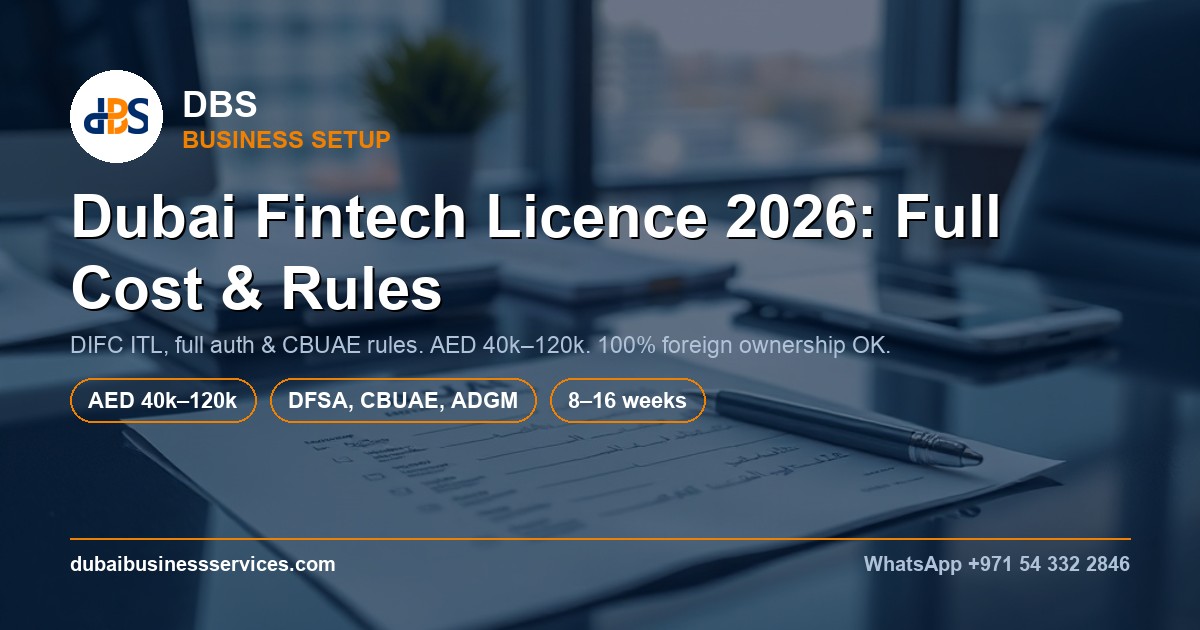
Dubai fintech licence costs AED 40,000–120,000 all-in under DIFC, ADGM or CBUAE frameworks in 2026. Regulated by the Dubai Financial Services Authority (DFSA), Abu Dhabi Global Market (ADGM) Authority, or the Central Bank of the UAE (CBUAE), requirements vary by entity type and payment services scope. DBS has cleared 80,000+ setups since 2009.
Dubai Fintech Licence: 2026 Regulatory Landscape
Launching a Dubai business setup in fintech requires navigating three distinct regulatory ecosystems. The Dubai International Financial Centre (DIFC) operates under the DFSA; the Abu Dhabi Global Market (ADGM) follows its own Authority; and the Central Bank of the UAE (CBUAE) governs retail payment services and digital wallets across the emirate. Each framework has different capital thresholds, compliance structures, and ownership rules. DBS advisory clarifies which path suits your business model.
DIFC Innovation Testing Licence vs. Full Fintech Authorisation
The DIFC offers a two-stage pathway. The Innovation Testing Licence (ITL) is designed for early-stage fintech startups and allows you to test products with real customers in a sandbox environment for up to two years at lower cost (typically AED 40,000–60,000 all-in). Upon graduation, firms apply for full authorisation as a Payment Institution or Digital Bank, which carries higher compliance and capital requirements (AED 80,000–120,000+ depending on service scope). This ladder approach reduces initial risk and cost.
Unsure if ITL or full licence fits your timeline? WhatsApp +971 54 332 2846 for a free 20-minute scoping call.
DIFC vs. ADGM: Regulatory Sandbox Comparison
Both hubs offer innovation frameworks, but differ in scope and structure:
| Factor | DIFC (Dubai) | ADGM (Abu Dhabi) |
|---|---|---|
| Regulator | DFSA | ADGM Authority |
| ITL Duration | Up to 2 years | Up to 18 months (renewable) |
| Typical All-In Cost | AED 40,000–65,000 (ITL) | AED 35,000–55,000 (ITL) |
| Compliance Officer Mandatory | Yes (full time or contracted) | Yes (full time or contracted) |
| Minimum Capital (ITL) | AED 100,000–500,000 (varies) | AED 100,000–300,000 (varies) |
| 100% Foreign Ownership | Permitted | Permitted |
Both permit full foreign ownership, reducing the need for local sponsors. ADGM typically offers marginally faster approvals (6–8 weeks vs. 8–12 weeks in DIFC). Choose DIFC if you target regional payments and investment; choose ADGM for a cost-optimised sandbox with strong compliance infrastructure.
CBUAE Retail Payment Services & Digital Wallet Regulation
If your fintech offers retail payment services, digital wallets, or buy-now-pay-later (BNPL) products, you will likely require authorisation from the Central Bank of the UAE (CBUAE). CBUAE oversees payment service providers and e-money institutions operating across all seven emirates. Capital requirements range from AED 2,000,000 for a full Payment Service Provider licence to AED 500,000 for certain specialised roles. Compliance officer and robust anti-money-laundering (AML) controls are non-negotiable. Many firms operate as DIFC-licensed entities with a separate CBUAE retail-payments endorsement to serve both international and domestic customers.
Get CBUAE alignment checked upfront—it shapes your entire cost and timeline. Email inquiry@dubaibusinessservices.com for a regulatory audit.
Capital, Compliance Officers & Ownership: 2026 Requirements
Dubai’s Dubai business setup consultants confirm these baseline rules:
- Minimum Capital (DIFC ITL): AED 100,000–500,000 depending on product scope; full authorisation typically AED 500,000–1,000,000+.
- Compliance Officer: Mandatory for all regulated fintech entities. Must be full-time or contracted; credentials verified by DET (Department of Economy and Tourism). Annual salary/fee typically AED 80,000–150,000.
- Ownership: DIFC and ADGM permit 100% foreign ownership; no local sponsor required. CBUAE retail-payments licences may require a local UAE national director or shareholder in some cases—confirm with CBUAE in advance.
- Governance: Board of Directors (minimum 1–2 members), regular audit, and annual financial reporting mandated by DFSA or ADGM Authority.
All-In Cost Breakdown: AED 40,000–120,000 in 2026
DBS data shows typical fintech setup costs in Dubai:
- DIFC Innovation Testing Licence (Tier 1 start-up): AED 40,000–60,000 all-in (licence fee, legal filing, compliance setup).
- DIFC Full Fintech Authorisation (Payment Institution): AED 80,000–120,000 all-in (higher regulatory scrutiny, expanded governance).
- ADGM ITL (faster track): AED 35,000–55,000 all-in.
- CBUAE Retail Payment Services Endorsement (add-on): AED 50,000–100,000 additional (if required alongside DIFC).
These figures exclude ongoing costs (compliance-officer salary, annual licence renewal AED 5,000–20,000, audit fees AED 10,000–30,000 per year). DBS offers radical cost transparency and can itemise your exact pathway.
Ready for a custom quote? WhatsApp +971 54 332 2846 now.
Next Steps: Secure Your Dubai Fintech Licence in 2026
Define your product (payments, lending, investing, trading), identify your primary market (UAE retail, GCC corporate, global), and confirm whether CBUAE oversight applies. DBS Documents Clearing LLC guides 80,000+ entrepreneurs through this choice—20-minute call is free. Contact us at WhatsApp +971 54 332 2846 or email inquiry@dubaibusinessservices.com to lock in your framework and timeline.
Frequently asked questions
How much does a fintech licence cost in Dubai in 2026?
All-in costs range from AED 40,000 (DIFC Innovation Testing Licence) to AED 120,000 (full DIFC or ADGM authorisation plus CBUAE retail-payment endorsement, if required). The spread reflects licence type, regulatory scope, and compliance complexity. DBS provides itemised quotes with zero hidden fees.
What is the difference between DIFC and ADGM for fintech?
DIFC (regulated by DFSA) offers a longer innovation-testing window (2 years) and attracts regional fintech talent; ADGM (regulated by its Authority) typically costs 10–15% less and approves faster (6–8 weeks). Both permit 100% foreign ownership. Choose DIFC for market reach; ADGM for speed and cost efficiency.
Do I need CBUAE authorisation for a payments fintech?
Yes, if you offer retail payment services, digital wallets, or BNPL to UAE consumers. CBUAE oversees all payment service providers across the UAE. You can operate as a DIFC entity with a separate CBUAE retail-payments endorsement. Capital minimums start at AED 500,000. Confirm your product scope with DBS.
What is the DIFC Innovation Testing Licence?
A sandbox licence allowing fintech startups to test regulated products with real customers for up to two years at lower cost (AED 40,000–60,000 all-in). Post-graduation, firms apply for full authorisation. It reduces initial capital and compliance burden, ideal for MVP validation.
Can a fintech startup get 100% ownership in Dubai?
Yes. Both DIFC and ADGM permit 100% foreign ownership—no local UAE national sponsor or shareholder is required. CBUAE retail-payment licences may have local-director rules in some cases; confirm upfront. DBS verifies ownership structure for your specific licence type.
What is a Compliance Officer, and is it mandatory?
A Compliance Officer ensures your fintech adheres to AML, sanctions, and regulatory rules. Mandatory for all DIFC, ADGM, and CBUAE-regulated entities. Can be full-time (AED 80,000–150,000/year) or contracted. DFSA and CBUAE verify credentials. DBS can source pre-vetted contractors.
How long does a Dubai fintech licence approval take in 2026?
DIFC ITL: 8–12 weeks; ADGM ITL: 6–8 weeks; full DIFC authorisation: 12–16 weeks. CBUAE retail-payment endorsement adds 4–8 weeks. Timeline depends on document completeness and regulator workload. DBS tracks submissions and expedites via established regulator channels.
Get expert help in 20 minutes
Need clarity on your Dubai setup? Talk to DBS Documents Clearing LLC — 80,000+ entrepreneurs served since 2009. WhatsApp +971 54 332 2846 or email inquiry@dubaibusinessservices.com for a free 20-minute scoping call.