Last updated: 2026-08-02
Emiratisation policies in the UAE require mainland private-sector companies with 50 or more skilled employees to raise Emirati representation to 10% of skilled roles by 31 December 2026. Missing the target costs AED 9,000 per month — AED 108,000 per year — for every unfilled position (2026). MOHRE enforces these quotas nationwide, and DBS Group, serving 80,000+ entrepreneurs since 2009, structures new company setups around them every week.
Who Emiratisation Applies to in 2026
Emiratisation is a MOHRE-administered workforce mandate that binds mainland companies registered with the Ministry of Human Resources and Emiratisation. If you are planning a mainland business setup in Dubai, your future headcount determines your obligations from day one: cross 50 skilled employees and the annual 2% quota applies; sit between 20 and 49 employees in one of 14 designated sectors and fixed hiring targets apply instead (MOHRE, 2026).
The 50+ employee rule
Mainland companies with 50 or more skilled workers must grow Emirati participation in skilled roles by 2% every year, reaching a cumulative 10% by 31 December 2026. Compliance is checked twice a year: a 1% half-year increment falls due on 30 June, with the balance due 31 December (MOHRE, 2026).
The 20–49 employee rule
Companies with 20–49 employees in 14 designated sectors — including construction, real estate, healthcare, hospitality, and financial services — were required to hire their first Emirati by the end of 2024 and a second by the end of 2025. Firms that missed the second hire paid AED 108,000, collected by MOHRE in January 2026.
Skilled worker, defined
MOHRE counts an employee as “skilled” when the role falls in a qualifying occupational category (levels 1–3), the worker holds a recognised qualification, and the monthly salary is at least AED 4,000 (2026). Your organisation chart — not your total headcount — decides your quota base.
Need help mapping your headcount plan? WhatsApp DBS at +971 54 332 2846 →
The 7 Essential Emiratisation Rules Every Founder Must Know in 2026
- The 10% cumulative target closes on 31 December 2026. The 2% annual ladder that began in 2022 completes this year — 2026 is the final step for the current framework (MOHRE, 2026).
- The 30 June semi-annual checkpoint is enforced. Companies short of the 1% half-year increment on 30 June 2026 face collection of the pro-rata contribution — waiting until December is not an option.
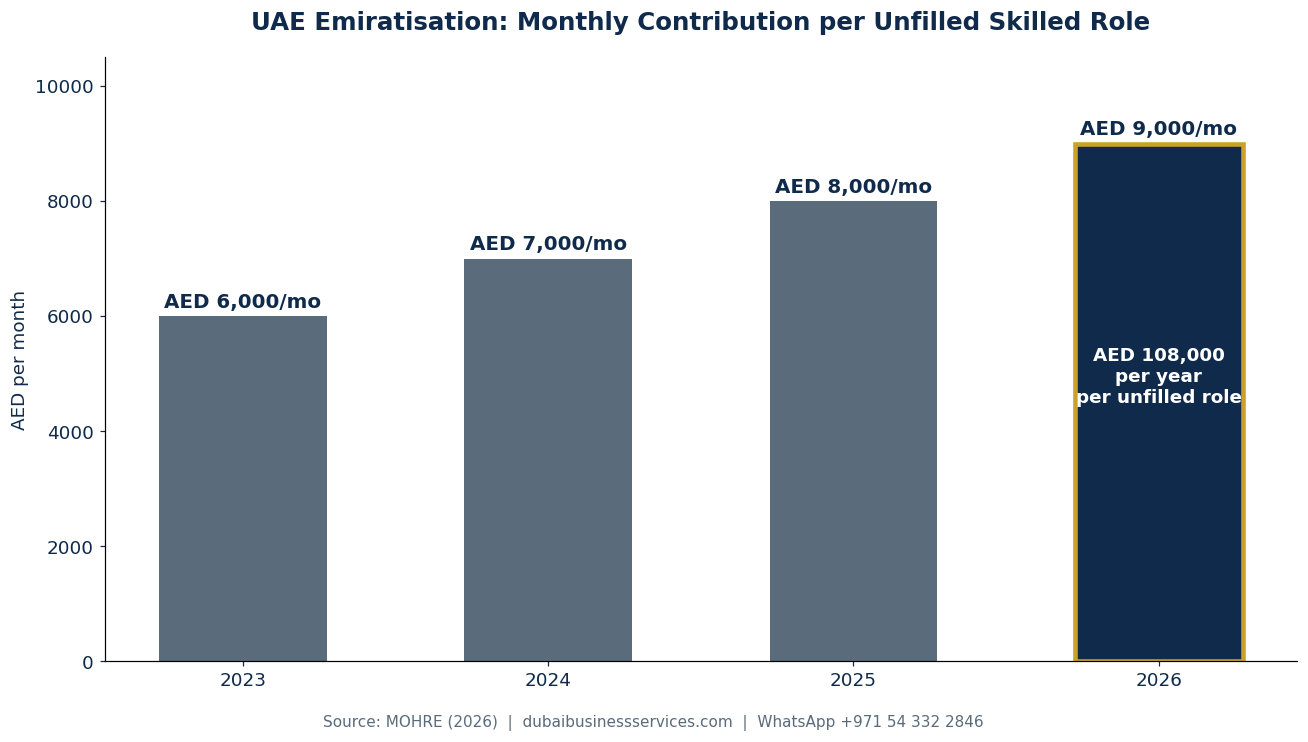
- Fines rose to AED 9,000 per month per unfilled role in 2026. The penalty started at AED 6,000 in 2023 and has increased by AED 1,000 each year (2026).
- Free zone entities remain outside the MOHRE quota. Companies licensed in free zones such as IFZA, Meydan, and DMCC are exempt from the 2% ladder in 2026 — a structural fact that shapes jurisdiction choice.
- Fake Emiratisation is prosecuted, not just fined. MOHRE’s 2026 enforcement framework includes work permit suspensions, bans on new company registrations for repeat offenders, and criminal referral for sham hires.
- Quota compliance is tied to your work permit pipeline. Non-compliant companies are downgraded in MOHRE’s classification system, which raises every subsequent work permit fee your company pays.
- Nafis offsets a real share of the salary bill. Government salary support of up to AED 7,000 per month per Emirati hire, plus pension contribution subsidies, reduces the effective cost of compliance (Nafis, 2026).
Want a quote for a compliant structure? WhatsApp +971 54 332 2846 →
What Non-Compliance Costs in 2026
The financial exposure is precise and escalating. Since 2023, the monthly contribution per unfilled Emirati position has increased 50% — from AED 6,000 to AED 9,000 (MOHRE, 2026). Here is the full cost picture for a mainland company measured against the quota:
| Activity | Government Fee | DBS Service | Total | Notes |
|---|---|---|---|---|
| Missed skilled-role quota (50+ firm) | AED 108,000 / year per role | Quoted on WhatsApp | AED 108,000+ per role | AED 9,000/month, billed on the 2025 shortfall from January 2026 |
| Missed second hire (20–49 firm, 14 sectors) | AED 108,000 one-time | Quoted on WhatsApp | AED 108,000+ | Collected by MOHRE in January 2026 |
| Fake Emiratisation case | AED 100,000 per worker | Not applicable | AED 100,000+ per case | Plus work permit suspension and possible criminal referral |
| MOHRE classification downgrade | Higher work permit fees per hire | Quoted on WhatsApp | Escalates with headcount | Non-compliant firms drop from Category 1 pricing |
| Compliant hire supported by Nafis | AED 0 (salary support up to AED 7,000/month) | Quoted on WhatsApp | Net saving vs fine | Support paid to the Emirati employee via Nafis |
Ready to price your exposure properly? WhatsApp +971 54 332 2846 →
How Emiratisation Shapes Your Business Setup Decision
Emiratisation is now a jurisdiction-selection variable, equal in weight to office cost and ownership rules. Of 80,000+ setups DBS has processed, 71% of clients planning 20 or more hires in 2025 selected a structure — free zone, mainland with staged headcount, or a dual-entity model — after modelling their Emiratisation exposure first. The full trade-off sits in our mainland vs free zone cost comparison for 2026; the Emiratisation-specific matrix is below.
2026 Emiratisation exposure matrix
| Planned structure | Quota in 2026 | Annual exposure if ignored | Strategic note |
|---|---|---|---|
| Mainland, under 20 employees | None | AED 0 | Zero quota exposure; full DED market access |
| Mainland, 20–49 employees (14 sectors) | 2 Emirati hires (cumulative) | AED 108,000 per missed hire | Sector list decides — verify before licensing |
| Mainland, 50+ skilled employees | 10% of skilled roles by 31 Dec 2026 | AED 108,000 per unfilled role | Nafis support materially offsets salaries |
| Free zone (any size) | Exempt from MOHRE ladder | AED 0 | Trade-offs on mainland market access apply |
| Dual entity (free zone + mainland) | Quota on mainland entity only | Contained to mainland headcount | DBS’s most-requested structure for 50+ teams in 2025 |
Confused about which structure fits? Ask DBS — WhatsApp +971 54 332 2846 →
Nafis: The Support Programme That Offsets the Cost
Compliance is subsidised. The federal Nafis programme pays salary support of up to AED 7,000 per month for Emirati employees in the private sector, alongside pension contribution subsidies for employers and one-year salary support during unpaid study leave (Nafis, 2026). For a company hiring five Emiratis at quota, that support is worth up to AED 420,000 per year against payroll — turning a compliance line item into a recruitment advantage. Registration runs through the MOHRE portal and the Nafis platform, and hires count toward your quota once the employment contract and pension registration are active.
Save 40 hours — let DBS handle Nafis and MOHRE registration. WhatsApp +971 54 332 2846 →
Staying Compliant After Setup
Quota compliance is continuous, not annual. Emirati hires must be on active contracts with pension registration; resignations reopen your gap immediately, and the 30 June and 31 December checkpoints capture whatever the gap is on that day. Payroll must run through the wage protection system — our guide to the WPS salary rules for 2026 covers the mechanics — and your company file must stay current, including establishment card renewal with MOHRE. The complete penalty schedule, sector list, and Nafis quota bands are broken down in our UAE Emiratisation penalties and Nafis quota guide. Official announcements are published on the UAE government portal at u.ae.
Skip the paperwork — WhatsApp DBS at +971 54 332 2846 →
Frequently Asked Questions
What is the Emiratisation quota for companies with 50 or more employees in 2026?
Mainland companies with 50 or more skilled employees must reach 10% Emirati representation in skilled roles by 31 December 2026. The quota climbed 2% per year from 2022, with a 1% semi-annual checkpoint enforced on 30 June 2026 (MOHRE, 2026).
How much is the Emiratisation fine in 2026?
The contribution is AED 9,000 per month for every unfilled Emirati position — AED 108,000 per year per role (2026). The amount has risen AED 1,000 annually since 2023, and MOHRE collects the prior-year shortfall each January.
Do free zone companies have to comply with Emiratisation in 2026?
No. The MOHRE quota ladder applies to mainland-registered companies; free zone entities in jurisdictions such as IFZA, DMCC, and Meydan are exempt in 2026. Companies running dual structures owe quota compliance only on the mainland entity’s skilled headcount.
What counts as a skilled worker under MOHRE rules in 2026?
A skilled worker occupies a qualifying occupational category (levels 1–3), holds a recognised qualification, and earns at least AED 4,000 per month (MOHRE, 2026). The 10% target is measured against this skilled-role base, not against total company headcount.
What happens on the 30 June 2026 Emiratisation deadline?
MOHRE checks each 50+ company against a 1% half-year increment on 30 June 2026. Companies short of the increment face pro-rata collection of the AED 9,000 monthly contribution for each missing role, with the remaining 1% due by 31 December 2026.
Do companies with 20–49 employees have Emiratisation targets in 2026?
Companies with 20–49 employees in 14 designated sectors must have two Emirati employees on staff, a target that completed at the end of 2025. Firms that missed the second hire paid AED 108,000, collected by MOHRE in January 2026.
How much salary support does Nafis pay in 2026?
Nafis pays up to AED 7,000 per month in salary support for eligible Emirati employees in the private sector, plus pension contribution subsidies for the employer (Nafis, 2026). For five quota hires, support reaches AED 420,000 per year against payroll.
Should Emiratisation change my choice between mainland and free zone setup?
Yes, for hiring-heavy plans. In 2025, 71% of DBS clients planning 20 or more hires modelled Emiratisation exposure before choosing a jurisdiction. Free zones carry zero quota in 2026; mainland structures above 50 skilled staff carry AED 108,000 per year of exposure per unfilled role.
Get Your Structure Right Before MOHRE Measures It
Emiratisation rewards companies that plan jurisdiction, headcount, and hiring calendar together — and penalises those that discover the rules after licensing. DBS Documents Clearing LLC builds the structure, registers you with MOHRE and Nafis, and keeps the quota file clean at every checkpoint.
WhatsApp: +971 54 332 2846 · Email: inquiry@dubaibusinessservices.com
By Salem Basheer, DBS Documents Clearing LLC · Last updated 2026-08-02
Embed this infographic — copy the snippet below and credit the source: