Last updated: 2026-06-22
Setting up in the JAFZA free zone means incorporating inside Jebel Ali Free Zone, the DP World–operated trading and logistics hub beside the region’s busiest port. A standard JAFZA trading licence starts at roughly AED 5,500, while a realistic first-year budget with office and visas runs AED 40,000 to AED 150,000 in 2026. DBS Documents Clearing LLC, guiding entrepreneurs through UAE setup since 2009, secures most JAFZA licences within 7 to 10 working days.
What Is JAFZA (Jebel Ali Free Zone)?
Jebel Ali Free Zone, universally shortened to JAFZA, is the United Arab Emirates’ oldest and largest free zone. For the wider context, our JAFZA free zone primer compares Dubai’s main zones, while this article goes deep on Jebel Ali itself. Launched in 1985 and operated by global ports group DP World, it sits directly beside Jebel Ali Port — the largest man-made harbour in the world and the busiest container terminal in the Middle East — and a short drive from Al Maktoum International Airport. That land-sea-air corridor is the entire reason JAFZA exists: it was built for companies that move physical goods at scale.
The zone hosts over 9,500 active companies from more than 130 countries, and JAFZA-based firms are estimated to handle a substantial share of Dubai’s non-oil trade flows. For an entrepreneur, the practical headline is simple: JAFZA offers 100% foreign ownership, 0% personal income tax, zero import and export duties inside the zone, and full repatriation of capital and profits.
Why JAFZA Stands Apart From Other Dubai Free Zones
Most of Dubai’s 40-plus free zones compete on price and speed for desk-based service businesses. JAFZA competes on infrastructure. It is the only Dubai free zone with direct, bonded access to a tier-one seaport, dedicated rail-ready logistics corridors, and industrial plots large enough for heavy manufacturing. For a comparison of the lighter, cheaper alternatives, see our guides to the Meydan free zone cost and DMCC free zone setup. JAFZA is the choice when your business is built around shipping containers, warehousing, and re-export — not just a laptop.
Who Should Choose JAFZA
JAFZA is the right fit for general traders and re-exporters, freight and logistics operators, industrial manufacturers, automotive and machinery distributors, food and commodity importers, and large e-commerce fulfilment businesses. If your model is a consultancy, agency, or single-founder tech startup, a lower-cost zone like the one in our IFZA free zone licence cost guide will usually serve you better and cheaper.
Confused about whether JAFZA fits your model? Ask DBS — WhatsApp +971 54 332 2846 →
JAFZA License Types and Costs in 2026
JAFZA issues licences by activity group rather than charging one flat fee, so your cost depends on what you actually do. The authority structures most trading permissions into “Type 1” (a single activity group, up to seven activities) and “Type 2” (two activity groups, up to twelve activities), then prices specialist permits — general trading, industrial, and logistics — separately.
The five core JAFZA licence categories are:
- Trading Licence — import, export, distribution, and storage of specified products.
- General Trading Licence — the widest permission, allowing trade across multiple unrelated product lines.
- Service Licence — consultancy, logistics support, and professional services.
- Industrial Licence — manufacturing, processing, assembly, and packaging.
- National Industrial / Logistics Licence — for GCC-qualifying manufacturers and large freight operators.
JAFZA Licence Tariff Matrix (2026)
The table below pairs each JAFZA government licence fee with how DBS structures the rest of the setup. Government fees are official and indicative for 2026; DBS service is tailored to your activity and quoted on request.
| Licence / Activity | JAFZA Govt Fee (2026) | DBS Service | Indicative First-Year Total | Notes |
|---|---|---|---|---|
| Trading Licence (Type 1) | From AED 5,500 | Done-for-you — WhatsApp for quote | From AED 40,000 | Up to 7 activities, one group; flexi-desk + 1 visa |
| Trading Licence (Type 2) | From AED 9,000 | Done-for-you — WhatsApp for quote | From AED 48,000 | Up to 12 activities, two groups |
| Service Licence | From AED 5,500 | Done-for-you — WhatsApp for quote | From AED 40,000 | Consultancy & professional services |
| Industrial Licence | From AED 5,500 | Done-for-you — WhatsApp for quote | From AED 90,000 | Requires leased unit / plot; higher visa quota |
| General Trading Licence | From AED 15,000 | Done-for-you — WhatsApp for quote | From AED 60,000 | Unlimited product lines; popular for re-export |
| Logistics Licence | From AED 15,000 | Done-for-you — WhatsApp for quote | From AED 95,000 | Warehouse / open-yard space typically required |
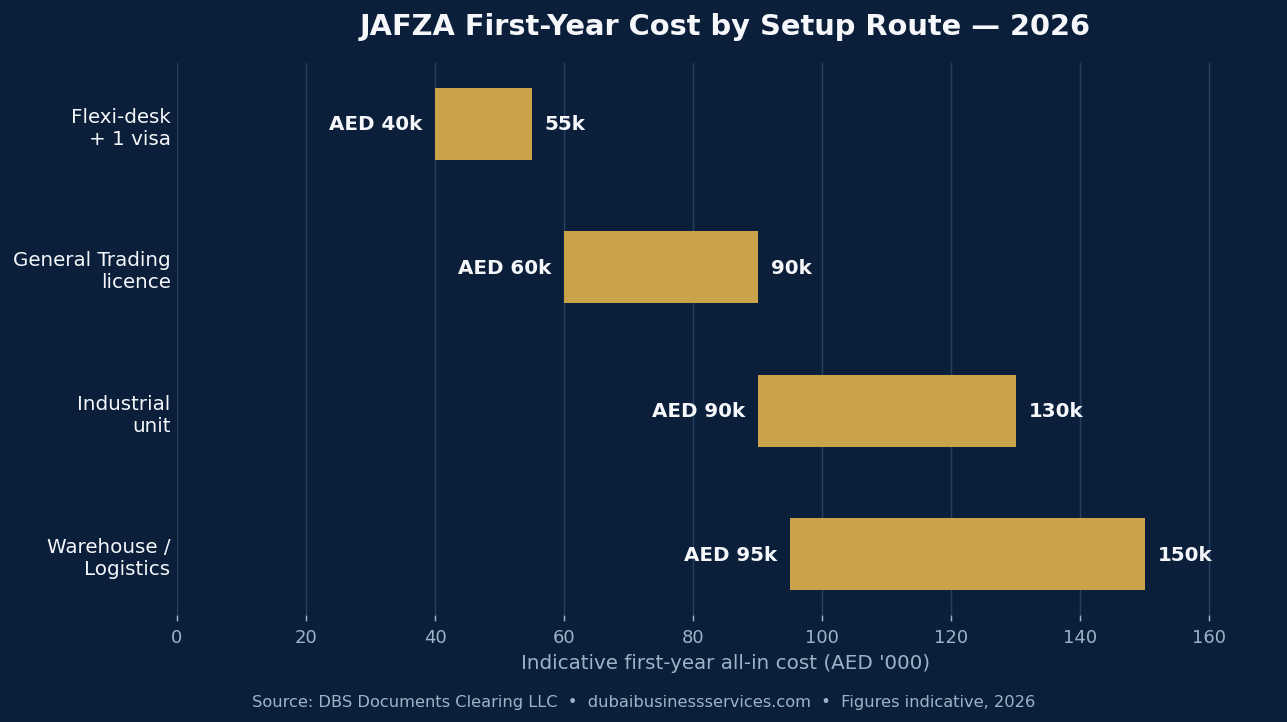
Because JAFZA ties most packages to a physical facility, the licence fee is rarely the biggest line item. Office or warehouse rent, establishment card, and visa costs together account for the majority of a first-year budget — which is why two companies with the same licence can pay AED 40,000 or AED 150,000 depending on facility size.
Hidden Costs to Budget For in JAFZA
Beyond the headline licence fee, three line items routinely surprise first-time JAFZA applicants. The establishment (immigration) card, renewed annually, is a separate charge from the trade licence. Visa processing — entry permit, medical examination, Emirates ID, and passport stamping — adds a per-person cost that multiplies with every employee you sponsor. And the facility deposit, often equal to several months of rent, is required up front on offices and warehouses. Factoring these in early prevents the most common budgeting mistake we see at DBS: founders who price only the licence, then meet a year-one bill two to three times larger than expected. A disciplined JAFZA budget treats the trade licence as roughly 10–15% of total first-year cost in 2026, with facility rent and residence visas making up the balance. Build the model around the facility, not the licence, and the numbers stop surprising you.
Want a precise JAFZA quote for your activity? WhatsApp +971 54 332 2846 →
The 7 Steps to Set Up in JAFZA Free Zone
JAFZA company formation follows a defined sequence. With paperwork in order, the licence itself is typically issued in 7–10 business days; a full setup including residence visas usually completes in 6–8 weeks.
- Define your activity and licence type. Your chosen activities determine the licence category, the facility you must lease, and your visa quota. Getting this right on day one avoids costly amendments later.
- Choose your legal structure. Decide between an FZE (single shareholder), an FZCO (two or more shareholders), a branch of an existing company, or a JAFZA offshore entity. This dictates share capital and documentation.
- Reserve your trade name. Submit up to three name options to JAFZA for approval, observing UAE naming rules. Our guide to free zone naming conventions explains the rules in detail.
- Submit the application and initial approval. File shareholder passports, the application form, a business plan where required, and your facility selection. JAFZA issues an initial approval and the lease offer.
- Sign the lease and pay fees. Execute your flexi-desk, office, or warehouse lease and settle the licence and registration fees. The facility size is locked in here, fixing your visa allocation.
- Receive licence and establishment card. JAFZA issues the trade licence and the establishment (immigration) card, which authorises the company to sponsor residence visas.
- Process residence visas and bank account. Apply for shareholder and employee visas (entry permit, medical, Emirates ID, stamping), then open a corporate account. See our guide to opening a business bank account in Dubai.
Ready to start your JAFZA application? WhatsApp +971 54 332 2846 →
JAFZA Company Structures: FZE vs FZCO vs Branch vs Offshore
JAFZA supports four distinct entity types, and choosing correctly affects your shareholding flexibility, capital requirement, and whether you get a UAE residence visa at all. Roughly speaking, the FZE and FZCO are onshore free zone entities that grant residency, while the JAFZA offshore company is a non-resident vehicle used mainly for holding and international structuring.
| Structure | Shareholders | Residence Visa Eligible | Best For | Typical Use |
|---|---|---|---|---|
| FZE (Free Zone Establishment) | 1 (individual or corporate) | Yes | Solo owners | Single-owner trading or service firm |
| FZCO (Free Zone Company) | 2–50 | Yes | Partnerships & JVs | Multi-shareholder trading or industrial business |
| Branch of a Company | Parent-owned | Yes | Existing firms | UAE or foreign company expanding into JAFZA |
| JAFZA Offshore | 1+ | No | Holding & assets | Asset holding, IP, international structuring |
For most first-time founders the decision is binary: an FZE if you are the sole owner, an FZCO if you have partners. The offshore route is a specialist tool — powerful for holding Dubai real estate or consolidating international subsidiaries, but it does not come with a residence visa.
Skip the guesswork on structure — WhatsApp DBS at +971 54 332 2846 →
Visas, Office and Warehouse Options at JAFZA
JAFZA’s defining feature — its physical infrastructure — also drives its visa system. Your residence visa quota is tied directly to the facility you lease, not to a flat package number. A flexi-desk typically supports 1–3 visas, a private office scales the quota with floor area, and a warehouse or industrial unit can sponsor dozens of employees.
Facility Tiers
- Flexi-desk / smart office: the entry point for traders and service firms; lowest cost, 1–3 visa quota.
- Private offices: fitted units across JAFZA’s business parks, with visa quotas scaling by square metre.
- Warehouses: pre-built logistics units for distribution and fulfilment, with substantial visa allocations.
- Industrial plots: land parcels from 5,000 square metres, leased on long-term terms of 15–20 years, with high-voltage power and telecoms delivered to the boundary.
This is the structural difference that matters: in a desk-only zone your headcount is capped at a handful of people. In JAFZA, leasing a warehouse can lift your sponsorship capacity into the dozens — which is exactly why logistics and manufacturing employers concentrate here. If headcount and renewal economics matter to you, our breakdown of Dubai free zone renewal costs in year two is essential reading before you commit.
Need help matching a facility to your visa needs? WhatsApp +971 54 332 2846 →
Corporate Tax and QFZP Status for JAFZA Companies in 2026
Free zone status is not an automatic tax exemption — a point many founders misunderstand. Under Federal Decree-Law No. 47 of 2022, a JAFZA company can access the 0% corporate tax rate only by qualifying as a Qualifying Free Zone Person (QFZP). To hold QFZP status, the company must earn “qualifying income,” maintain adequate economic substance in the zone, comply with transfer-pricing rules, and not have elected to be taxed at the standard rate.
Where those conditions are met, qualifying income is taxed at 0%. Income that falls outside the qualifying definition — most notably revenue earned from mainland UAE customers — is taxed at the standard 9% corporate tax rate above the AED 375,000 profit threshold. Every JAFZA company must still register for corporate tax with the Federal Tax Authority, and VAT registration at 5% becomes mandatory once taxable turnover exceeds AED 375,000.
In practice, every JAFZA company must register for corporate tax with the FTA even when its effective rate is 0% — a 100% registration requirement across the zone — and getting the substance and income classification right is what protects the exemption. Our general trading licence guide covers how trading income is typically classified for QFZP purposes.
Save dozens of hours on tax structuring — let DBS handle it. WhatsApp +971 54 332 2846 →
The DBS Advantage for JAFZA Setup
JAFZA is a heavier, more document-intensive jurisdiction than the desk-based free zones, and the cost of a wrong activity code, an undersized facility, or a missed QFZP condition is measured in tens of thousands of dirhams. DBS Documents Clearing LLC has guided business owners through UAE formation since 2009, and our JAFZA service is built around three things the zone specifically rewards: precise activity-to-licence mapping so you never overpay or under-scope, government liaison and PRO relationships that keep approvals and visa stamping moving, and facility advisory so your office or warehouse lease matches both your visa quota and your year-two renewal budget. Of the JAFZA enquiries DBS handles, the majority are trading and logistics operators choosing the zone for port access rather than price — and we structure each one for the qualifying-income rules from day one, not as an afterthought.
JAFZA Setup Cost Snapshot
The infographic below summarises indicative first-year all-in costs across the main JAFZA routes for 2026.
Embed this infographic on your site
<a href="https://www.dubaibusinessservices.com/jafza-free-zone-setup-2026/"><img src="https://www.dubaibusinessservices.com/wp-content/uploads/2026/06/jafza-free-zone-cost-2026-infographic-dubai-2026.png" alt="JAFZA first-year cost by setup route 2026 | Dubai Business Services 2026" width="1287" height="722" /></a><br />Source: <a href="https://www.dubaibusinessservices.com/jafza-free-zone-setup-2026/">Dubai Business Services</a>Frequently Asked Questions About JAFZA Free Zone
How much does it cost to set up a company in JAFZA in 2026?
A JAFZA trading licence starts from AED 5,500, but a realistic first-year total — including a flexi-desk and one visa — begins near AED 40,000. Full office or warehouse setups with multiple visas commonly reach AED 150,000 or more in 2026, because cost is driven by facility size, not the licence fee alone.
How long does JAFZA company formation take?
The JAFZA trade licence is typically issued within 7–10 business days once documents and facility selection are complete. A full setup including residence visas — entry permit, medical, Emirates ID, and stamping — usually completes in 6–8 weeks, depending on visa numbers and the type of facility leased.
What is the difference between an FZE and an FZCO in JAFZA?
An FZE (Free Zone Establishment) has exactly one shareholder, whether an individual or a corporate body. An FZCO (Free Zone Company) has between two and fifty shareholders, making it the structure for partnerships and joint ventures. Both grant UAE residence visas; the choice depends on how many owners your business has.
Does a JAFZA company pay corporate tax?
A JAFZA company qualifies for 0% corporate tax on qualifying income if it meets Qualifying Free Zone Person conditions under Federal Decree-Law No. 47 of 2022. Non-qualifying income, such as revenue from mainland UAE clients, is taxed at 9% above AED 375,000 profit. All companies must still register for corporate tax with the FTA.
Can I get 100% foreign ownership in JAFZA?
Yes. As a free zone, JAFZA grants 100% foreign ownership with no UAE national sponsor required. Owners retain complete control of shares, profits, and decision-making, and benefit from full repatriation of capital and profits plus zero import or export duties on goods handled inside the zone.
How many visas can a JAFZA company get?
Visa quotas in JAFZA are tied to the facility leased rather than a flat allowance. A flexi-desk typically supports 1–3 visas, a private office scales the quota by floor area, and a warehouse or industrial unit can sponsor dozens of employees — which is why logistics and manufacturing firms favour the zone.
Is JAFZA better than other Dubai free zones?
JAFZA is the strongest choice for trading, logistics, and industrial businesses because of its direct access to Jebel Ali Port and Al Maktoum Airport. For desk-based consultancies, agencies, or solo startups, a lower-cost zone is usually more economical. The right answer depends entirely on whether your business moves physical goods.
What is a JAFZA offshore company used for?
A JAFZA offshore company is a non-resident entity used mainly for holding assets, owning Dubai real estate, protecting intellectual property, and structuring international subsidiaries. It does not grant a UAE residence visa and cannot trade within the UAE market, so it complements — rather than replaces — an onshore FZE or FZCO.
Start Your JAFZA Company With DBS
Jebel Ali Free Zone rewards businesses that get the structure right the first time — and penalises those that don’t. Whether you are launching a general trading operation, a logistics hub, or an industrial unit, DBS Documents Clearing LLC will map your activities, secure your licence and facility, process your visas, and structure your company for the qualifying-income rules from day one.
Talk to a DBS specialist today: WhatsApp +971 54 332 2846 or email inquiry@dubaibusinessservices.com. We handle the paperwork; you focus on the business.
By Salem Basheer, DBS Documents Clearing LLC
Last updated: 2026-06-22
Related guide: a 2026 all-in cost breakdown with an instant calculator — free zone vs mainland, real AED prices including Year-2 renewal, plus a free instant cost calculator.
Ready to proceed? DBS handles the full setup — see our JAFZA service, or get a free quote on WhatsApp +971 54 332 2846.