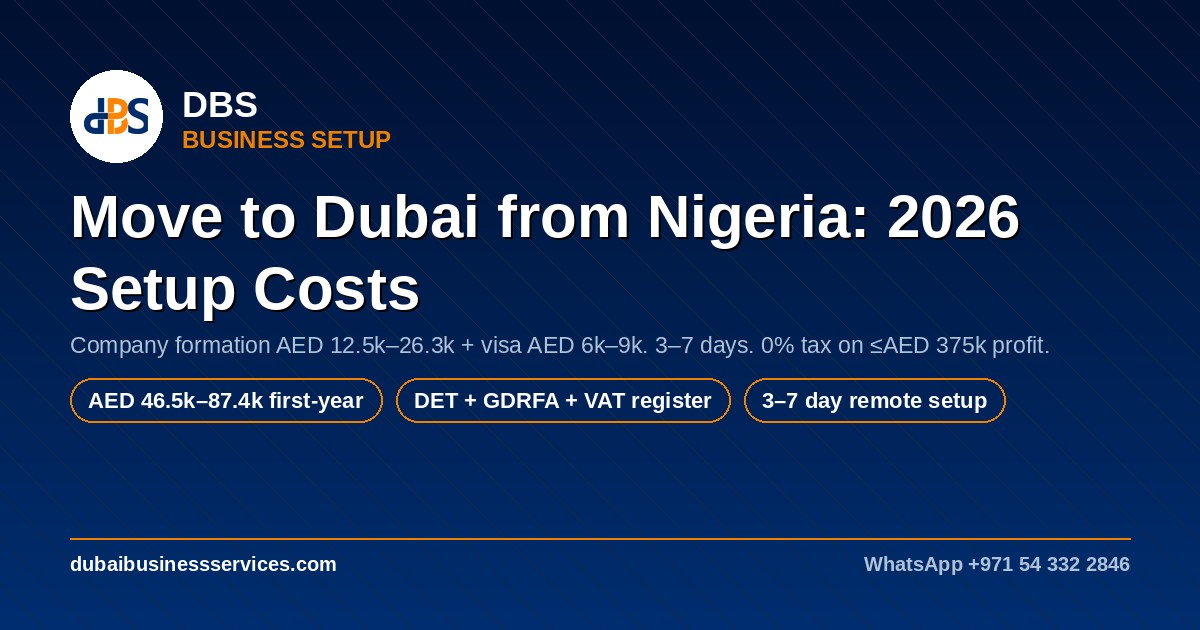
Setting up a company to relocate to Dubai from Nigeria costs AED 15,000–25,000 all-in in year one (licence, one investor visa, banking, insurance). Formation takes 3–7 working days, is 100% remote, and corporate tax is 0% on profits up to AED 375,000—though you must comply with UAE residency rules and confirm your Nigerian tax position with a local advisor.
Key takeaways
- Relocate to Dubai from Nigeria by forming a UAE company: AED 15,000–25,000 first-year all-in cost
- Formation is 100% remote; banking is the real friction—non-resident KYC stricter, needs clean UBO docs
- 0% corporate tax on profits ≤ AED 375,000; 9% above. Personal income tax is 0% in UAE
- Company formation alone does not grant residence—you need an investor visa (~AED 6,000–9,000) separately
- Nigeria Tax Act 2025 taxes residents on worldwide income from 1 Jan 2026; cease residency and consult a licensed tax advisor
- Realistic all-in monthly living (family): AED 8,000–15,000 depending on district; sponsoring family costs AED 4,000+/mo
What’s the Real Cost to Relocate to Dubai from Nigeria?
Moving to Dubai requires two separate outflows: (1) company formation and trade licensing, and (2) residency visa and ancillary costs. Many Nigerian entrepreneurs assume the first buys the second—it doesn’t. A business setup in Dubai alone does not grant you a residence visa. This guide breaks down the actual cash, the timeline, and the tax reality from both angles so you don’t face a surprise rejection at the bank or immigration.
How Much Does Company Formation Cost in Dubai?
Licence costs range sharply by location. A free-zone licence (Meydan, IFZA, Jebel Ali) runs AED 12,500–12,900, and typically includes one visa. Mainland Dubai–Abu Dhabi (via Department of Economy and Tourism (DET), now under the Federal Tax Authority umbrella for compliance) starts at AED 18,200 (no visa) to AED 26,355 (with one visa). Ajman and SHAMS (Sharjah) offer rock-bottom licences at AED 4,888–5,750 for trade only, but zero visas and tighter sector eligibility. All licences include general municipality fees, registration, DED/DET filing, and initial business plan approval; renewal typically costs AED 7,000–20,000 depending on location and activity.
Get a free, itemised breakdown tailored to your business activity: use the DBS cost calculator.
What About Residence Visa and Medical Screening?
A company licence grants a trade licence, not a residence visa. To live in Dubai, you need a separate visa. The most common route for owners is a 2-year investor/partner visa, costing AED 6,000–9,000 all-in (visa processing, Emirates ID, medical screening at approved UAE clinics per government portal, GDRFA (General Directorate of Residency and Foreigners Affairs) fees). Alternatively, the Golden Visa (10-year residency) requires either an AED 2 million property investment, AED 2 million deposit, or significant company equity; government fees alone range AED 4,695–10,140. As of February 2026, mortgaged and off-plan property qualify (the 50%-upfront rule was removed). The 5-year Green Visa suits skilled workers (salary ≥AED 15,000/month) or freelancers earning ≥AED 360,000 annually.
Consult DBS on the visa option that fits your plan: WhatsApp +971 54 332 2846 or email inquiry@dubaibusinessservices.com.
Itemised First-Year All-In Cost Table (AED & ₦)
| Item | AED Range | ₦ Approx. (at 1 AED ≈ ₦1,500–1,650) |
|---|---|---|
| Licence (Free Zone, Dubai) + Reg | AED 12,500–12,900 | ₦18.75m–21.3m |
| Investor Visa (2-yr) + Emirates ID + Medical | AED 6,000–9,000 | ₦9m–14.85m |
| Flexi-Desk / Virtual Office (1 month) | AED 500–1,500 | ₦750k–2.5m |
| Corporate Bank Account (opening + initial balance hold) | AED 25,000–50,000 (balance, not fee) | ₦37.5m–82.5m |
| Professional Indemnity / Public Liability Insurance (annual) | AED 1,500–3,500 | ₦2.25m–5.775m |
| FIRST-YEAR TOTAL (excluding bank balance) | AED 21,500–37,400 | ₦32.25m–61.56m |
| FIRST-YEAR REALISTIC ALL-IN (inc. bank balance hold) | AED 46,500–87,400 | ₦69.75m–144m |
Indicative at current rates—convert at today’s FX rate. Bank minimum balances (AED 25,000–50,000) are operational holds, not fees. Some fintechs (e.g. Wio, Mashreq NeoBiz) offer lower minimums (AED 0–10,000). If you opt for a cheaper Ajman licence (AED 4,888–5,750), savings of ₦7.3m–12.3m are possible, but zero visa inclusion and stricter sector rules apply.
3-to-7 Day Formation Timeline: What Happens When?
Day 1–2: You submit signed POA (Power of Attorney), home-country attestation (Nigerian notary stamp), passport copy, CV, source-of-funds letter, and trade-name application to DBS or your formation agent. All documents are e-signed and scanned. Day 3–4: DET/DED processes licence and publishes in Al Khaleej newspaper; Emirates ID application filed. Day 5–6: GDRFA (residence authority) approves visa; you receive initial trade-licence copy (soft copy via WhatsApp). Day 7+: Physical licence card and Emirates ID card arrive (1–2 weeks). Banking KYC interview usually happens in parallel or shortly after (see next section). No in-person visit is mandatory for formation—you can sign everything remotely, and an agent or POA holder can collect documents if needed.
Speed up your setup: book a free consultation with DBS to confirm your exact timeline at DBS free consultation.
Banking Is the Real Friction: What Banks Want from Nigerians
Forming a company is fast and remote. Opening a corporate bank account is where most Nigerian movers hit delays or rejections. Banks classify non-residents as higher-risk and demand: (1) a clean Ultimate Beneficial Owner (UBO) declaration with proof of beneficial ownership and no sanctions; (2) a source-of-funds letter explaining how you’ll capitalise the account; (3) a notarised home-country company registration or personal ID; (4) proof of business address (trade licence copy); (5) often a UAE-resident signatory or Power of Attorney holder. Some banks ask for a tax-residency certificate from Nigeria, which triggers your first tax question (see section below). Pro tip: bring proof that you’ve ceased Nigerian tax residency, or a letter from a Nigerian tax advisor confirming your position—this reassures the bank you’re not trying to hide income. Account approval typically takes 1–3 weeks if all docs are clean; non-residents often wait 2–8 weeks. Fintechs like Wio and Mashreq NeoBiz have shorter cycles (~5–10 days) but lower features. Expect to attend at least one video KYC call or visit a branch in person.
Get a banking-approval checklist from DBS: WhatsApp +971 54 332 2846 for a step-by-step doc list tailored to your bank choice.
What’s the Tax Story? Nigeria to UAE in 2026
This is critical. The Nigeria Tax Act 2025 (effective 1 January 2026) taxes residents on worldwide income. If you are a Nigerian tax resident on 1 January 2026 and move to Dubai mid-year, you owe tax on that year’s worldwide income pro-rata. You must cease Nigerian tax residency by filing a final return and notifying the Nigeria Revenue Service (NRS) or your state tax board. Residency is determined by physical presence (183+ days in a tax year) or other ties (family, business premises). By contrast, UAE corporate income tax is 0% on profits up to AED 375,000 (taxable income)—and 9% above. Free-zone companies enjoy 0% only on Qualifying Income under QFZP rules (non-qualifying income is taxed at 9% from AED 1). The Small Business Relief allows 0% if revenue ≤AED 3M for accounting periods ending on or before 31 December 2026. Personal income tax in the UAE is 0% across all income types—no income tax, no VAT on most services, no wealth tax. However, you must register for VAT at AED 375,000 revenue, and VAT at 5% applies to most goods and services.
Critical: hire a licensed tax advisor in Nigeria before you leave to file your final resident return and confirm cessation of residency. DBS advises only on UAE entity structure and UAE tax rules; we do not provide Nigerian tax advice. For 2026 CBN FX and remittance rules, consult a Nigerian forex/banking advisor—changes in naira controls may affect bringing money home.
Can You Sponsor Family, and How Much?
Yes. Family sponsorship is separate from your company visa. Sponsoring a spouse costs approximately AED 4,000–6,000 all-in; each child adds AED 2,000–3,500. Parents can be sponsored if you earn ≥AED 20,000/month and are a UAE resident; their visa runs AED 20,000–25,000+ depending on age and health. All family visas require proof of accommodation (tenancy contract) and medical screening. If you’re living on a free-zone licence alone (zero visa), you cannot sponsor family—you must hold a residence visa first. Many families sponsor a spouse on a free-zone visa (AED 12,500 + spouse AED 4,500 = AED 17,000) to unlock family residency. Monthly living for a family of four in Dubai–Abu Dhabi (school, rent, food, utilities, transport) realistically runs AED 8,000–15,000 depending on district and choices (Ajman/Sharjah: AED 5,000–9,000).
Can a Company Licence Alone Get You Residency?
No. A trade licence proves you are a business owner but does not grant a residence permit. You must apply for a residence visa separately. The exception: a free-zone licence typically includes one visa in the package (the owner’s visa). If you want to live in Dubai without a visa, you are legally not supposed to; you would be an overstayer and subject to deportation and re-entry ban. If you hold a free-zone licence with one visa and want to sponsor others, they also need separate visas. Many entrepreneurs find it cheaper to register a mainland company (AED 18,200 licence-only) and then apply for a separate investor visa (AED 6,000–9,000) rather than paying for a free-zone licence bundle.
Frequently asked questions
How much money do Nigerians need to move to Dubai?
First-year all-in (excluding living expenses): AED 46,500–87,400 (~₦70m–144m). This covers licence (AED 12,500–12,900), investor visa (AED 6,000–9,000), medical screening, bank minimum balance hold (AED 25,000–50,000), insurance, and virtual office. Add AED 8,000–15,000 monthly for family living costs. If starting with an Ajman licence, you can reduce licence costs by ₦7m–12m.
Does opening a company get me residency?
No. A trade licence alone does not grant a residence visa. You must apply separately—typically a 2-year investor visa (AED 6,000–9,000) or Golden Visa (AED 4,695–10,140 gov fees + property/deposit/equity). Free-zone licences usually bundle one visa; mainland licences do not. Without a visa, you are an overstayer and risk deportation and re-entry ban.
What are realistic monthly living costs for a family in Dubai?
Family of four (school, rent, food, utilities, transport): AED 8,000–15,000/month in Dubai–Abu Dhabi; Ajman/Sharjah: AED 5,000–9,000. Budget higher if private school or villa; lower for studio/shared and public school. Childcare adds AED 1,500–4,000/month per child.
Can I sponsor my family?
Yes—if you hold a residence visa and earn enough. Spouse sponsorship: AED 4,000–6,000. Children: AED 2,000–3,500 each. Parents (if earning ≥AED 20,000/mo): AED 20,000–25,000+. All need tenancy contract and medical screening. You cannot sponsor family on a company licence alone; you need a personal residence visa first.
Do Nigerians still owe tax back home after moving to Dubai?
Yes—until you cease Nigerian tax residency. Nigeria Tax Act 2025 (from 1 Jan 2026) taxes residents on worldwide income. File a final return and notify NRS/state tax board before or upon departure. UAE corporate tax is 0% on profits ≤AED 375,000; personal income tax is 0%. Consult a licensed Nigerian tax advisor—DBS advises only on UAE setup, not home-country tax.
Will my bank reject me because I’m Nigerian?
Unlikely if your documents are clean. Banks want: clean UBO declaration, source-of-funds letter, home-country ID/company registration (notarised), proof of residency, and sometimes a UAE-resident signatory or POA. Non-residents face stricter KYC and longer approval (1–8 weeks). Bring proof of ceased Nigerian tax residency to reassure the bank. Fintechs (Wio, Mashreq NeoBiz) are faster (~5–10 days) but offer fewer features.
What if I want to work remotely for a Nigerian company—do I need to register in UAE?
No. Remote work (employment) for a foreign employer does not require a UAE business licence. You only need a residence visa (investor, Golden, Green, or family sponsorship). However, if you invoice that employer or any other client as a freelancer/consultant, you must register for a freelance licence or company licence and declare UAE tax—not registering risks visa cancellation and deportation. UAE tax is 0% on freelance income ≤AED 360,000/yr (Green Visa threshold) but 9% above.
Get expert help in 20 minutes
Try the free DBS cost calculator at https://www.dubaibusinessservices.com/business-setup-cost-calculator/ for an instant estimate, then talk to DBS on WhatsApp +971 54 332 2846 or email inquiry@dubaibusinessservices.com for a free, fully itemised cost breakdown in your own currency — and a straight answer on banking and tax.