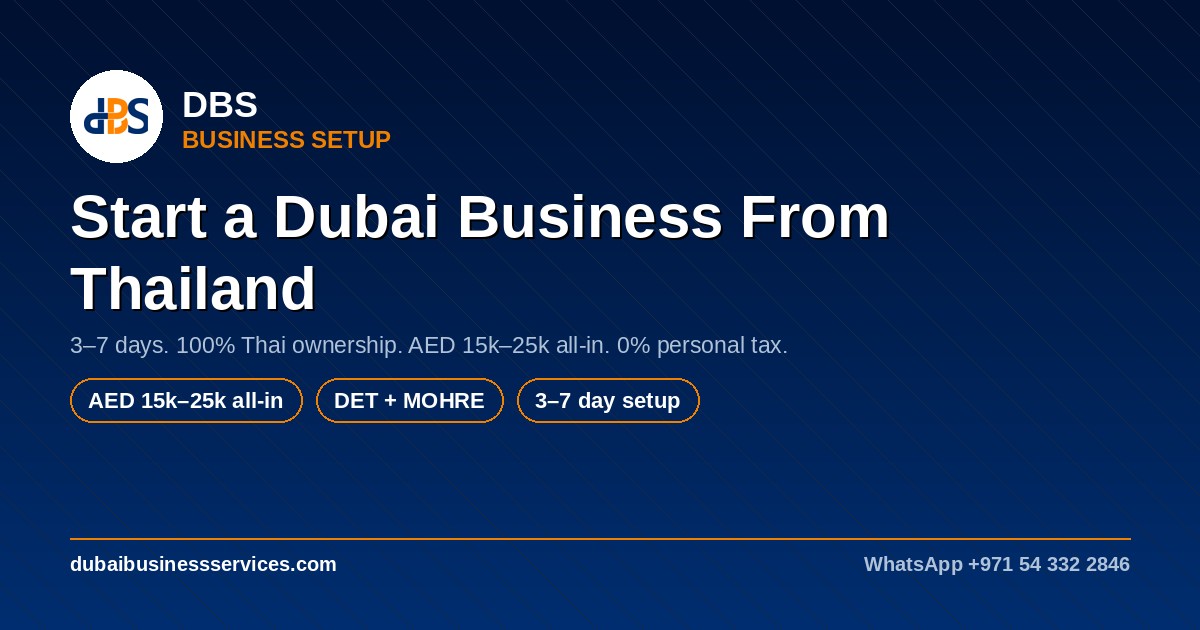
Yes, Thai entrepreneurs can establish a UAE business from Thailand entirely remotely. Formation costs range from AED 15,000–25,000 all-in (licence, registration, investor visa, Emirates ID). The entire process takes 3–7 working days under DET approval, with 100% foreign ownership permitted for most activities and 0% personal income tax in the UAE.
Key takeaways
- Start a business in Dubai from Thailand with 100% foreign ownership and zero residency requirement for the company itself.
- All-in first-year cost range: AED 15,000–25,000 (roughly THB 150,000–250,000 at current rates; convert for today’s rate).
- Formation completed fully remotely in 3–7 working days via e-signed POA and home-country attestation; no mandatory travel.
- Corporate tax: 0% on taxable profit up to AED 375,000; 9% above. Free-zone Qualifying Income taxed 0%; non-qualifying income at 9%. Small Business Relief: 0% if annual revenue ≤ AED 3M (until 31 Dec 2026). Personal income: 0%.
- Investor/partner visa (2-year) realistic all-in cost AED 6,000–9,000; Golden Visa (10-year) from AED 2M investment + AED 4,695–10,140 govt fees.
- Banking is the real friction: account approval takes 1–8 weeks; non-residents often need a UAE resident signatory or POA. Thai personal income tax applies only to funds remitted to Thailand.
Can you legally start a business in Dubai from Thailand?
Yes. Thai nationals and companies can establish a business setup in Dubai with 100% foreign ownership for most commercial activities. The company itself requires zero residency visa—you do not need to live in the UAE to own and operate it. Formation is entirely remote: you sign a Power of Attorney (POA), have it attested by the Thai authorities (Ministry of Foreign Affairs or notary), and submit it to the Department of Economy and Tourism (DET) or relevant free-zone authority. This takes 3–7 working days under normal conditions (2026).
Not sure where to start? DBS will guide you through the complete formation and cost structure—book a free consultation for a fully itemised breakdown.
How much does it really cost to open a Dubai company from Thailand?
Total first-year cost ranges from AED 15,000–25,000 all-in (approximately THB 150,000–250,000 at current rates; convert at today’s rate for accuracy). This includes business licence, company registration, one investor/partner visa, Emirates ID, flexi-desk, basic corporate insurance, and contingency. The largest variables are (1) free-zone vs. mainland, (2) visa inclusion, and (3) bank minimum balance.
| Item | AED Range | Approx. USD Range | Notes |
|---|---|---|---|
| Free-zone licence (Meydan/IFZA) | AED 12,500–12,900 | USD 3,400–3,500 | Includes basic trade name and office address |
| Free-zone licence (alternative: Ajman/SHAMS) | AED 4,888–5,750 | USD 1,330–1,570 | Cheapest UAE-wide option; no visa included |
| Mainland licence (no visa) | AED 18,200–19,500 | USD 4,955–5,310 | DET approval; no investor visa |
| Mainland licence + 1 investor visa | AED 26,355–28,000 | USD 7,180–7,625 | Includes visa fee, Emirates ID, biometrics |
| Investor/partner visa (standalone) | AED 6,000–9,000 | USD 1,635–2,450 | 2-year tenure; can be sponsored by company |
| Bank account setup (optional in-person KYC or POA) | AED 0–10,000 | USD 0–2,725 | Wio zero minimum; Mashreq NeoBiz ~AED 10k minimum |
| Flexi-desk / mailing address (annual) | AED 1,500–3,000 | USD 410–815 | Often bundled with free-zone; mainland may require |
| Corporate insurance (optional, annual) | AED 500–1,500 | USD 136–408 | Employer/professional liability |
Indicative at current rates—convert at today’s rate. Total lean setup (free-zone, no visa, no bank opening prep): AED 15,000–18,000. Total with one visa and bank minimum: AED 25,000–45,000. Renewal costs are AED 7,000–20,000 annually (licence + visa top-up).
Get a fully itemised quote in Thai baht—use our free Dubai business setup cost calculator.
What’s the day-by-day timeline for company registration?
Day 1–2: You prepare and sign Power of Attorney (POA), personal identification, and passport copy. These are notarised/attested in Thailand (Ministry of Foreign Affairs or public notary).
Day 3: Attestation documents, completed application forms, and POA forwarded to DBS or your formation agent. DET/free-zone submission begins.
Day 4–5: DET/authority conducts background checks, issues trade licence preliminary approval, and processes trade name reservation.
Day 6–7: Licence finalized; your company registration number (CR) and licence certificate issued; company name appears on the UAE Government Portal. If visa is requested, Emirates ID application begins in parallel.
Day 8–14: Visa/Emirates ID biometrics collection (may be done remotely via sponsor or requires brief visit; depends on bank/sponsor). Bank KYC in progress (this is the longest step—1–8 weeks).
Note: This assumes no missing documents or additional scrutiny. Non-resident applicants should expect bank approval to take 4–8 weeks because KYC rules are stricter for offshore clients.
DBS manages every step—WhatsApp +971 54 332 2846 to track your application in real-time.
How do Thai founders open a UAE business bank account?
Banking is the real friction, not company formation. Most UAE banks require one of the following for a foreign-registered company owner:
- UAE resident signatory: A director or partner with an Emirates ID and UAE residence. This is the simplest path; the bank will accept the resident as the account authority.
- Power of Attorney (POA): A certified POA from Thailand, attested by the Thai Ministry of Foreign Affairs, naming a UAE resident or the bank as your legal agent. This allows remote account opening but requires strict KYC on you (source of funds, UBO declaration, tax residency certificate).
- Non-resident direct account: Some challenger banks (Wio, Mashreq NeoBiz, UAE Exchange, liv.) accept non-residents if you provide a police clearance, international bank reference, and tax residency proof—approval still takes 2–8 weeks.
Required banking checklist:
- Notarised/attested company licence (from DET/free-zone)
- Company CR registration certificate
- Memorandum & Articles of Association (or equivalent bylaws)
- Personal passport (colour copy, attested)
- Personal bank reference from your Thai bank (last 6 months statement or letter)
- Proof of personal residence (utility bill or tenancy in Thailand—recent)
- Beneficial Owner (UBO) declaration form (signed & notarised)
- Source of Funds letter (explaining how you’ll fund the company)
- Tax Residency Certificate from Thailand (issued by Revenue Department; confirms you are a Thai tax resident)
- Completed bank’s KYC form (application, fit-&-proper declaration, PEP/sanctions check)
Non-resident approval is slower because international AML/CFT rules apply. If the bank spots any inconsistency in your paperwork, it will request re-submission, extending the timeline to 8+ weeks. DBS advises having a UAE-resident co-director or agent authorized under POA to expedite approval.
Not sure which bank to approach? DBS provides banking introductions for formation clients—reach out to inquiry@dubaibusinessservices.com to discuss options.
What tax do you pay on a Dubai business as a Thai founder?
In the UAE (Dubai):
Your company is subject to UAE Corporate Income Tax under the Federal Tax Authority (FTA) rules (effective 1 June 2023):
• 0% tax on taxable profit up to AED 375,000 per financial year.
• 9% tax on taxable profit above AED 375,000.
• Small Business Relief (SBR): If your annual turnover does not exceed AED 3 million, you pay 0% tax for financial periods ending on or before 31 December 2026 (this relief expires after 2026 for new businesses; existing businesses may transition).
• Free-zone rules: Some free zones (Jebel Ali, IFZA, DMCC) qualify for the QFZP (Qualified Free Zone Person) exemption: 0% on Qualifying Income (broadly, revenue from outside the UAE or certain re-export activity) if the de-minimis threshold (lower of 5% of revenue or AED 5 million) is not breached. Non-qualifying income (e.g., domestic-facing services, rent) is taxed at 9% from AED 1 of profit. Breach of the threshold forfeits the 0% status for approximately 5 years.
• Personal income tax: 0%—the UAE does not tax salary, dividends, or distributions to individuals. This is genuine, not a myth.
• VAT: You must register for VAT (5%) once your turnover exceeds AED 375,000 in a 12-month rolling period.
In Thailand (home country):
Thai residents are taxed by the Thai Revenue Department on worldwide income remitted to Thailand. This is critical: if you leave your Dubai profits in a UAE bank account, you generally do not owe Thai income tax. However, the moment you remit (transfer) funds to Thailand, that remittance is added to your Thai taxable income and taxed at Thailand’s progressive personal income tax rates (0–35% depending on bracket).
For example, if you remit THB 1 million (approx. AED 100,000) of profit to Thailand in a calendar year, the Thai Revenue Department may classify it as foreign-source income and tax it. You must consult a licensed Thai tax advisor or accountant to understand your personal filing obligations—DBS does not provide tax advisory in your home country, only information about UAE tax rules.
For the full tax framework, see the Federal Tax Authority official guidance and contact the UAE Ministry of Finance.
Unclear on your personal tax position? Engage a licensed Thai accountant before transferring funds home.
Do I need a residency visa to own and run a Dubai company?
No. The company itself does not require a residency visa. You can own 100% of a mainland or free-zone company while living in Thailand. However, if you wish to work in the UAE, travel frequently to the UAE, or take a salary as an employee of your own company, you will need a visa. The two most popular options for business owners are:
- Investor/Partner Visa (2-year): Issued to non-resident shareholders or partners; realistic all-in cost AED 6,000–9,000. Allows multiple UAE visits and can be renewed every 2 years.
- Golden Visa (10-year): Available if you invest AED 2 million in a UAE property, bank deposit, or company equity. Government fees range from AED 4,695–10,140 depending on category and visa type. As of February 2026, mortgaged and off-plan property qualify under the new residential property investment track (the 50%-upfront rule was removed in late 2025).
- Green Visa (5-year): For skilled professionals: a monthly salary of AED 15,000+, freelance annual income of AED 360,000+, or an investment stake of AED 1 million in a UAE entity.
If you do not plan to reside in the UAE or enter frequently, you can skip the investor visa entirely and renew your company licence annually without a visa sponsorship. The company can operate remotely; you will simply need a UAE bank account and a business address (flexi-desk or virtual office).
What if I want to bring my family to Dubai?
Once you have a residency visa (investor, Golden, or employment-based), you can sponsor family members. Indicative sponsorship costs (annual):
• Spouse/children (dependent): AED 4,000–6,000 per dependent (visa + Emirates ID + processing).
• Parents (if aged 60+): AED 20,000–25,000 per parent; stricter income/accommodation requirements apply.
Family sponsorship is processed by MOHRE (Ministry of Human Resources and Emiratisation) alongside the main visa holder’s renewal. Consult DBS or the UAE government portal for current category and income thresholds.
Frequently asked questions
How much does it cost in baht to open a Dubai company from Thailand?
First-year all-in cost ranges from AED 15,000–25,000, approximately THB 150,000–250,000 at current rates (convert at today’s rate). This includes business licence, company registration, one optional investor visa, Emirates ID, and flexi-desk. Free-zone licence-only is cheaper (AED 12,500–12,900); mainland with one visa is higher (AED 26,355–28,000). Bank account opening and corporate insurance add AED 0–1,500 each.
Can Thai founders own 100% of a Dubai company?
Yes. Thai nationals and companies can own 100% of mainland or free-zone companies in Dubai for most business activities (trading, services, consulting, manufacturing). There is no UAE residency requirement for the company itself, and no foreign-ownership cap applies to most sectors. Some restricted activities (e.g., oil & gas, aviation) may require a local partner; DBS will advise during setup if your activity is restricted.
Do I need to travel to Dubai to register my company?
No. The entire registration process is remote. You prepare and sign a Power of Attorney (POA), have it attested by the Thai Ministry of Foreign Affairs, and submit it via your formation agent. Formation takes 3–7 working days. However, if you require a residency visa or want to open a UAE bank account as a non-resident, the bank may request biometric collection or in-person KYC—this is handled separately from company registration.
How do Thai founders open a UAE business bank account from abroad?
Most UAE banks require a UAE-resident signatory (co-director with Emirates ID) or a certified Power of Attorney. Submit your company licence, CR certificate, personal passport, Thai bank reference, tax residency certificate from Thailand, UBO declaration, and source-of-funds letter. Non-resident approval takes 1–8 weeks due to stricter AML/CFT rules. Alternative: challenger banks (Wio, Mashreq NeoBiz) may accept non-residents with clean KYC documentation; still expect 2–8 weeks for approval.
Do I pay tax back home on my Dubai company income?
Thai residents are taxed by the Thai Revenue Department only on income remitted to Thailand. If you leave profits in a UAE bank account, Thai tax does not apply. Once you transfer funds to Thailand, that remittance is added to your Thai taxable income and taxed at Thailand’s progressive personal income tax rates (0–35% by bracket). You must consult a licensed Thai tax advisor before remitting funds home. DBS provides information on UAE tax only; we do not advise on Thai personal tax.
What is the UAE corporate tax on a Dubai company?
UAE Corporate Income Tax (via FTA) is 0% on taxable profit up to AED 375,000 per financial year, and 9% above. If your turnover does not exceed AED 3 million annually, you qualify for Small Business Relief (0% tax until 31 Dec 2026). Free-zone companies benefit from 0% on Qualifying Income (export-driven or non-domestic revenue) if they meet the de-minimis threshold (lower of 5% revenue or AED 5M); non-qualifying income is taxed at 9%. Personal income tax is 0% in the UAE.
What residency visa do I need if I want to run my Dubai company from the UAE?
If you want to reside in or frequently visit the UAE, apply for an Investor/Partner Visa (2-year, AED 6,000–9,000 all-in). It allows multiple entry/exit and renewal every 2 years. Alternatively, pursue a Golden Visa (10-year) if you invest AED 2M in UAE property, deposit, or company (government fees AED 4,695–10,140). If you operate remotely from Thailand, no visa is required—only a business address (virtual office) and a UAE bank account.
Get expert help in 20 minutes
Talk to DBS on WhatsApp +971 54 332 2846 or email inquiry@dubaibusinessservices.com for a free, fully itemised cost breakdown in your own currency — and a straight answer on banking and tax.