A Dubai free zone establishment is a single-shareholder limited-liability company licensed by a free zone authority, granting one owner 100% ownership, a visa quota and a corporate bank account. Entry-level licences start at AED 5,750 in SHAMS and AED 12,900 at IFZA in 2026, with most Dubai zones costing AED 20,000–25,000 all-in for year one. Free zone entities remain taxable under Federal Decree-Law No. 47 of 2022, though a Qualifying Free Zone Person pays 0% on qualifying income.
Last updated: 2026-08-17
What a Dubai Free Zone Establishment Actually Is (and What It Is Not)
The term gets used loosely, and that costs founders money. A Dubai free zone establishment is a specific legal form: a limited-liability entity with exactly one shareholder, incorporated under the regulations of a designated free zone authority. Add a second shareholder and the entity is no longer an FZE — it becomes an FZCO or FZ-LLC, depending on which zone you are in.
FZE vs FZCO vs Branch — the practical difference
An FZE suits a solo founder or a single holding company. An FZCO (Free Zone Company) accommodates two or more shareholders, whether individuals or corporate entities. A branch, as described in the official UAE government guidance on free zone company formation, is not a separate legal person at all — it is an extension of an existing parent company, carries no share capital of its own, and inherits the parent’s liabilities. Roughly 6 in 10 first-time applicants DBS Group processes arrive asking for an “LLC” when the structure that actually matches their shareholding is an FZE.
What the licence does and does not permit
A free zone licence authorises trade within the free zone, outside the UAE, and with other free zone entities. It does not authorise direct invoicing of the UAE mainland market for most activities. Selling to mainland customers requires either a mainland distributor, a dual licence arrangement where the zone offers one, or a separate DET licence. That single limitation is the most common reason founders migrate structures in year two — a decision worth modelling before you sign, using the mainland versus free zone cost and tax comparison.
Confused about which structure fits? Ask DBS — WhatsApp +971 54 332 2846 →
The 9 Steps to Register a Dubai Free Zone Establishment in 2026
Every Dubai free zone runs a variation of the same nine-stage sequence. Zones differ on portal design and inspection depth, not on the underlying logic.
- Fix the activity list first. Your activity codes determine your licence type, your visa quota, whether external approvals apply, and your renewal cost. Changing them post-issuance triggers an amendment fee of roughly AED 1,000–2,500 in most zones.
- Select the zone against the activity, not the price. A commodities trader belongs in DMCC. A logistics operator belongs in JAFZA or DAFZ. A consultant or agency is well served by IFZA, Meydan or SHAMS at a fraction of the cost.
- Reserve the trade name. Name reservation is typically valid for 30 to 90 days. Zones reject names containing religious references, government terms, or the names of countries and their governing bodies.
- Submit initial approval. Passport copies, a passport-size photograph, the shareholder’s CV or profile, and a completed application form. Most zones return initial approval within 24 to 72 hours.
- Clear external approvals where the activity demands it. Financial services route through the Central Bank of the UAE or the relevant regulator, healthcare through DHA or MOHAP, education through KHDA, and food-related activity through Dubai Municipality.
- Select and contract the facility. A flexi-desk is the minimum for most zones and is bundled into entry-level packages. Physical office space is mandatory once your visa quota exceeds the flexi-desk allocation, usually beyond three to six visas.
- Sign the incorporation documents. Memorandum and Articles of Association, the board resolution if the shareholder is a corporate entity, and the specimen signature form. Some zones still require in-person or notarised signature; several now accept fully digital execution.
- Pay and collect the licence. Payment triggers issuance of the trade licence, certificate of incorporation, share certificate and lease agreement. Turnaround from payment to licence is 3 to 10 working days across most Dubai zones.
- Open the establishment card, then the bank account. The establishment card (roughly AED 2,000) unlocks the visa quota. Corporate bank account opening runs 2 to 8 weeks depending on the bank’s compliance appetite for your nationality mix and activity profile.
Need help with this step? WhatsApp DBS at +971 54 332 2846 →
Dubai Free Zone Establishment Cost 2026: The Full AED Picture
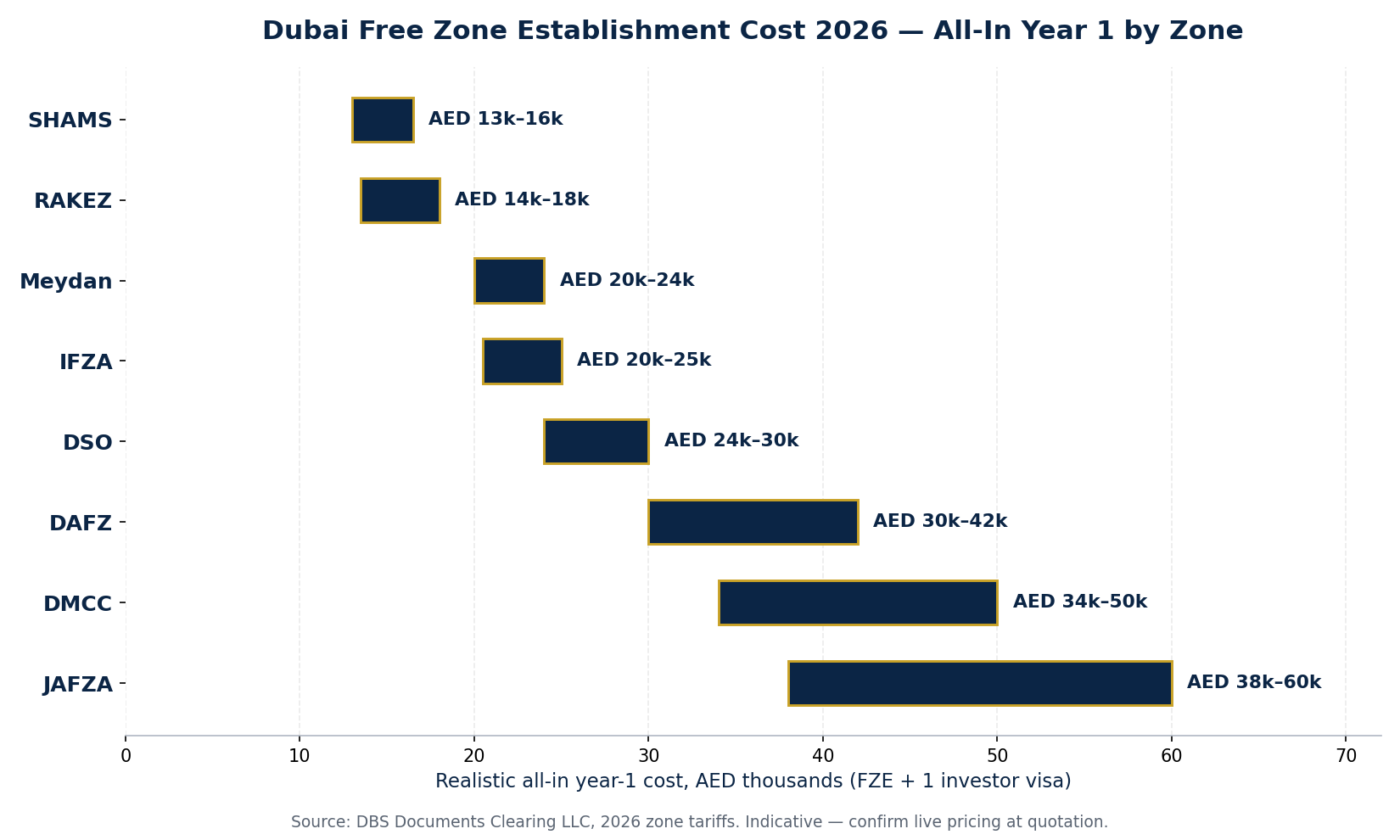
Published headline prices describe a zero-visa flexi-desk package. The number that matters is the all-in year-one cost including the establishment card, one investor visa, medical testing and Emirates ID. The table below reconstructs that figure zone by zone for a single-shareholder FZE with one visa in 2026.
| Zone / Activity Profile | Government & Authority Fee | DBS Service | Realistic Year-1 Total | Notes |
|---|---|---|---|---|
| SHAMS — media, consultancy, e-commerce | From AED 5,750 (0 visa) | Quoted on scope | AED 13,000–16,500 with 1 visa | Cheapest credible entry point; Sharjah-registered, Dubai-serviceable |
| RAKEZ — trading, light industrial | From AED 6,000 bundled | Quoted on scope | AED 13,500–18,000 with 1 visa | Strong warehousing economics; RAK jurisdiction |
| Meydan — consultancy, holding, services | ≈ AED 12,500 (0 visa) | Quoted on scope | AED 20,000–24,000 with 1 visa | Dubai address, fast digital portal |
| IFZA — general trading, consultancy | AED 12,900 (0 visa) | Quoted on scope | AED 20,500–25,000 with 1 visa | Each extra visa adds AED 2,000–3,000 |
| DSO — technology, R&D | From ≈ AED 15,000 | Quoted on scope | AED 24,000–30,000 with 1 visa | Tech-cluster credibility; stricter activity fit |
| DAFZ — aviation, logistics, re-export | From ≈ AED 20,000 | Quoted on scope | AED 30,000–42,000 with 1 visa | Airport-adjacent; premium facility rates |
| DMCC — commodities, crypto, precious metals | From ≈ AED 20,000 | Quoted on scope | AED 34,000–50,000 with 1 visa | Highest regulatory standing; heaviest compliance load |
| JAFZA — industrial, large-scale trading | From ≈ AED 25,000 | Quoted on scope | AED 38,000–60,000 with 1 visa | Port access; warehouse commitment typical |
Embed this infographic on your site:
<a href="https://www.dubaibusinessservices.com/need-help-setting-up-a-freezone-establishment/"><img src="https://www.dubaibusinessservices.com/wp-content/uploads/2026/08/dubai-free-zone-establishment-cost-2026-infographic.png" alt="Dubai free zone establishment cost 2026" width="800" /></a><p>Source: <a href="https://www.dubaibusinessservices.com/need-help-setting-up-a-freezone-establishment/">DBS Documents Clearing LLC</a></p>The four costs that are absent from every published package
- Establishment card: roughly AED 2,000, mandatory before any visa is issued.
- Medical test and Emirates ID: roughly AED 3,000 per person for a standard investor visa.
- Corporate tax registration and compliance: roughly AED 3,000 in the first year for registration and the opening filing cycle.
- Year-2 renewal: typically 35–60% higher than a promotional year-one price, because the introductory discount does not repeat. This is the single largest budgeting error DBS sees, and the mechanics are laid out in the year-2 free zone renewal cost analysis.
Want a quote? WhatsApp +971 54 332 2846 →
Which Free Zone Fits Your Activity in 2026
Price sorting produces the wrong answer surprisingly often. The right filter is activity fit, then banking reputation, then cost.
Cost-led zones: SHAMS, RAKEZ, IFZA, Meydan
These four cover the overwhelming majority of consultancy, marketing, e-commerce, IT services and general trading founders. IFZA and Meydan carry a Dubai registration, which matters for client perception and for some banks’ onboarding preferences. SHAMS and RAKEZ price 40–55% below the Dubai pair while delivering the same 100% ownership and the same visa mechanics. A full ranking sits in the guide to the best free zones in Dubai for foreign investors.
Reputation-led zones: DMCC, JAFZA, DAFZ, DSO
If you are raising capital, dealing with international counterparties, moving physical goods through Jebel Ali, or operating in commodities and precious metals, the premium is defensible. DMCC in particular carries the strongest banking recognition of any UAE free zone, which converts directly into faster account opening. It also carries the heaviest compliance obligations: AML registration, goAML enrolment for relevant activities, and annual audited financial statements.
The banking filter nobody mentions at the sales stage
Free zone choice affects bank account approval far more than founders expect. Banks assess the zone’s regulatory reputation, the substance of your facility, your activity’s risk classification, and the shareholder’s nationality profile together. A crypto or general-trading activity in a low-cost zone with a flexi-desk is the hardest combination to bank in the UAE today. Structuring around that constraint before incorporation — not after a rejection — saves months.
Save 40 hours — let DBS handle it. WhatsApp +971 54 332 2846 →
Corporate Tax, VAT and Substance After the Licence Is Issued
The 2017 assumption that a free zone company is tax-free is dead. Free zone entities fall squarely within the scope of UAE corporate tax and must register with the Federal Tax Authority regardless of profit level.
The 9% rule and the 0% carve-out
Under Federal Decree-Law No. 47 of 2022, taxable income above AED 375,000 is charged at 9%; income at or below that threshold is charged at 0%. A free zone entity that meets the Qualifying Free Zone Person conditions set out in Cabinet Decision No. 100 of 2023 pays 0% on qualifying income and 9% on everything else. The conditions are cumulative: adequate substance in the zone, qualifying income only, no election to be taxed at standard rates, arm’s-length transfer pricing, and audited financial statements.
What “adequate substance” means in practice
Substance is assessed on core income-generating activities performed in the free zone, measured against adequate assets, adequate qualified employees, and adequate operating expenditure. A flexi-desk with no staff and no local expenditure is a weak substance position for a company claiming 0% on material revenue. Outsourcing to a related party inside the zone is permitted where the entity retains adequate supervision.
VAT and the other filings
VAT registration is mandatory once taxable supplies exceed AED 375,000 in a 12-month period, with voluntary registration available at AED 187,500. The standard rate is 5%. Separately, every entity must maintain an accurate Ultimate Beneficial Owner register, file Economic Substance notifications where a relevant activity applies, and enrol in goAML if the activity is designated under the UAE AML framework. The Federal Tax Authority publishes the current filing calendar, and the wider setup budget is broken down in the full Dubai company setup cost guide.
Ready to start? WhatsApp +971 54 332 2846 →
Visas, Banking and the Five Traps That Cost Founders Months
Visa quota mechanics
Visa quota is a function of your facility, not your ambition. A flexi-desk typically supports 1 to 3 visas. Each additional visa beyond the package allocation adds AED 2,000–3,000 in zone fees at IFZA-tier pricing, plus roughly AED 3,000 in medical and Emirates ID costs per person. Investor visas are commonly issued for two or three years depending on the zone and the facility type.
The five traps
- Buying the cheapest licence for a mainland-facing business. If 80% of your customers are UAE mainland companies, a free zone licence creates an invoicing problem you will pay to solve twice.
- Under-scoping activity codes. Adding an activity later costs an amendment fee and, in some zones, a licence-category upgrade.
- Budgeting year one only. A 35–60% renewal increase against a promotional first-year price destroys a thin cash plan.
- Treating corporate tax registration as optional. Registration is mandatory for free zone entities irrespective of the 0% qualifying income position, and late registration carries administrative penalties.
- Applying to the bank before the file is ready. A declined application is recorded and materially weakens the next attempt. Sequence matters more than speed.
The DBS position
DBS Group has processed setups for 80,000+ entrepreneurs since 2009. What that volume buys a client is not a discount — it is the pre-submission judgement call: which zone will actually bank your activity, which activity code survives audit, and which structure you will not be unwinding in eighteen months. The licence is the easy part.
Skip the paperwork — WhatsApp DBS at +971 54 332 2846 →
Frequently Asked Questions
How much does it cost to set up a free zone establishment in Dubai in 2026?
Entry-level zero-visa licences start at AED 5,750 in SHAMS and AED 12,900 at IFZA. A realistic all-in year-one figure for a single-shareholder FZE with one investor visa in a Dubai zone is AED 20,000 to AED 25,000, rising to AED 34,000+ at DMCC or JAFZA.
What is the difference between an FZE and an FZCO in Dubai?
An FZE has exactly one shareholder; an FZCO has two or more. Both are limited-liability free zone entities with identical 100% foreign ownership rights, visa mechanics and tax treatment. The distinction is shareholder count only, and converting between them post-incorporation requires a formal amendment with the zone authority.
Do free zone companies pay corporate tax in the UAE?
Yes. Free zone entities are within the scope of Federal Decree-Law No. 47 of 2022 and must register with the Federal Tax Authority. A Qualifying Free Zone Person pays 0% on qualifying income under Cabinet Decision No. 100 of 2023, and 9% on non-qualifying income above AED 375,000.
How long does it take to get a Dubai free zone licence?
Initial approval typically returns in 24 to 72 hours, and the licence issues 3 to 10 working days after payment. The establishment card follows within about a week, and the corporate bank account is the long pole at 2 to 8 weeks depending on the bank’s compliance review.
Can a free zone establishment trade with the Dubai mainland?
Not directly for most activities. Selling to mainland customers requires a mainland distributor, a dual-licence arrangement where the zone offers one, or a separate DET licence. Trade within the free zone, between free zones, and internationally is fully permitted under the free zone licence itself.
How many visas can a free zone establishment get?
A flexi-desk package typically supports 1 to 3 visas. Physical office space raises the quota in proportion to leased area. Each additional visa costs roughly AED 2,000 to AED 3,000 in zone fees plus about AED 3,000 in medical testing and Emirates ID processing per person.
Which is the cheapest free zone for a Dubai business in 2026?
SHAMS at AED 5,750 and RAKEZ at around AED 6,000 are the cheapest credible options, though both register outside Dubai. Within Dubai, Meydan at approximately AED 12,500 and IFZA at AED 12,900 are the lowest-cost licences carrying a Dubai registration.
Why does the free zone renewal cost more than the first year?
Year-one prices are promotional. Renewal restores the standard tariff and adds the establishment card renewal, facility renewal and visa renewals that were bundled or discounted at signup. Expect a 35–60% increase over a promotional first-year price when budgeting year two.
Do I need a physical office for a free zone establishment?
No. A flexi-desk satisfies the minimum facility requirement in every major Dubai zone and is bundled into entry-level packages. Physical office space becomes mandatory once your visa requirement exceeds the flexi-desk allocation, generally beyond three to six visas, and strengthens your corporate tax substance position.
Set Up Your Dubai Free Zone Establishment With DBS
Choosing the zone is a five-minute conversation once someone has seen your activity, your customer mix and your banking profile. Getting it wrong costs a year. Send DBS your activity and target market on WhatsApp at +971 54 332 2846 or email inquiry@dubaibusinessservices.com, and you will get a zone recommendation with a live all-in AED figure — not a headline price that changes at checkout.
Written by Salem Basheer, DBS Documents Clearing LLC — Dubai business setup since 2003. Last updated: 2026-08-17.