A free zone company in UAE is a legally independent entity licensed by one of the country’s 45-plus free zone authorities, granting 100% foreign ownership without a local partner. Setup costs start at AED 5,555 for an Ajman Free Zone package in 2026, and qualifying free zone entities pay 0% corporate tax on qualifying income under Cabinet Decision No. 100 of 2023. DBS Group has served 80,000+ entrepreneurs since 2009.
Last updated: 2026-08-27
What a Free Zone Company in UAE Actually Is in 2026
A free zone is a defined economic territory with its own registrar, its own companies law, and its own licensing schedule. When you register a free zone company in UAE, you are not registering with the Department of Economy and Tourism (DET, formerly DED). You are registering with a standalone authority — IFZA, Meydan, DMCC, JAFZA, RAKEZ, SHAMS, Ajman Free Zone or Dubai Silicon Oasis — that issues your trade licence, your establishment card and your visa quota as a single bundle.
The UAE operates more than 45 active free zones across all seven emirates as of 2026. Each one is tied to a sector mandate: DMCC to commodities and crypto, JAFZA to logistics and heavy trade, Dubai Healthcare City to clinical services, SHAMS to media and creative work. That mandate determines which activities appear on your licence — and it is the single most common reason an application gets rejected at first submission.
Free Zone Company vs Offshore Company — Not the Same Thing
This distinction costs entrepreneurs money every week. A free zone company is a resident UAE entity: it receives a physical or flexi-desk address, an establishment card, visa eligibility and a UAE corporate tax registration number. An offshore company (RAK ICC, JAFZA Offshore) is a non-resident holding vehicle: it cannot sponsor residence visas, cannot lease UAE office space for operations, and cannot obtain an Emirates ID for its shareholders.
If your goal is to live in the UAE, employ staff, or open a local operating bank account, the offshore structure fails on all three counts. Choose the free zone entity.
What Changed Between 2023 and 2026
Three regulatory shifts reshaped the free zone proposition. First, Federal Decree-Law No. 47 of 2022 introduced UAE corporate tax at 9% on taxable income above AED 375,000, effective for financial years starting on or after 1 June 2023. Second, Cabinet Decision No. 100 of 2023 defined the Qualifying Free Zone Person (QFZP) regime, preserving a 0% rate on qualifying income for compliant free zone entities. Third, Cabinet Decision No. 142 of 2024 brought a 15% Domestic Minimum Top-up Tax for multinational groups with consolidated global revenue of EUR 750 million or more, for financial years starting on or after 1 January 2025.
For a founder registering a single-entity trading or consultancy business in 2026, the practical effect is narrow: you remain eligible for 0% on qualifying income, but you must now register with the Federal Tax Authority, maintain audited financial statements, and satisfy adequate substance requirements in the free zone. The tax-free reputation survives; the paperwork behind it does not run itself.
Need help with this step? WhatsApp DBS at +971 54 332 2846 →
The 7 Proven Steps to Register a Free Zone Company in UAE
Every UAE free zone follows the same seven-stage sequence. Names differ; the sequence does not. A straightforward trading or consultancy licence completes in 5 to 10 working days (2026) when documents are clean at first submission.
Step 1 — Fix the Business Activity First
Select your activity from the target free zone’s approved activity list before anything else. Activity determines licence type (commercial, service, industrial, e-commerce), fee band, visa allocation and whether external approval is required. A general trading activity typically costs AED 8,000 to AED 15,000 more per year than a single-activity commercial licence (2026).
Step 2 — Reserve the Trade Name
Trade names must avoid religious references, national or government terms, and the names of recognised institutions. Using a personal name requires the full first and last name — initials are rejected. Reservation is confirmed within 24 to 48 hours (2026) and holds for 60 days at most authorities.
Step 3 — Submit Initial Approval
You file passport copies for every shareholder, a completed application form, and the proposed shareholding split. Free zones issue initial approval in 1 to 3 working days (2026). This document confirms the authority has no objection to the entity, but it is not a licence and grants no trading rights.
Step 4 — Sign the Incorporation Documents
The Memorandum of Association, Articles of Association and shareholder resolutions are signed either in person at the authority counter or remotely under a notarised Power of Attorney. Corporate shareholders must supply attested certificates of incorporation and board resolutions, legalised through the issuing country’s UAE embassy and the Ministry of Foreign Affairs.
Step 5 — Secure the Office or Flexi-Desk
Every free zone licence requires a registered address. A flexi-desk (shared workspace with a mailbox) starts at AED 5,000 per year in Ajman Free Zone and RAKEZ, and reaches AED 20,000 per year in DMCC (2026). Your visa quota scales with the space: a flexi-desk typically supports 1 to 3 visas, while a 200 sq ft private office supports 5 to 7.
Step 6 — Collect the Licence and Establishment Card
On payment of the full licence fee, the authority issues the trade licence, the certificate of incorporation, the share certificate and the establishment card. The establishment card is registered with the Federal Authority for Identity, Citizenship, Customs and Port Security (ICP) and is the document that unlocks your visa quota.
Step 7 — Complete Visas, Banking and FTA Registration
Investor and employment visas run through entry permit, status change, medical fitness test, Emirates ID biometrics and visa stamping — 7 to 15 working days per applicant (2026). Corporate bank account opening takes 3 to 8 weeks depending on the bank’s compliance appetite for your activity and nationality mix. Corporate tax registration with the FTA is mandatory regardless of expected profit.
Ready to start? WhatsApp +971 54 332 2846 →
Free Zone Company in UAE Cost Table 2026 (AED)
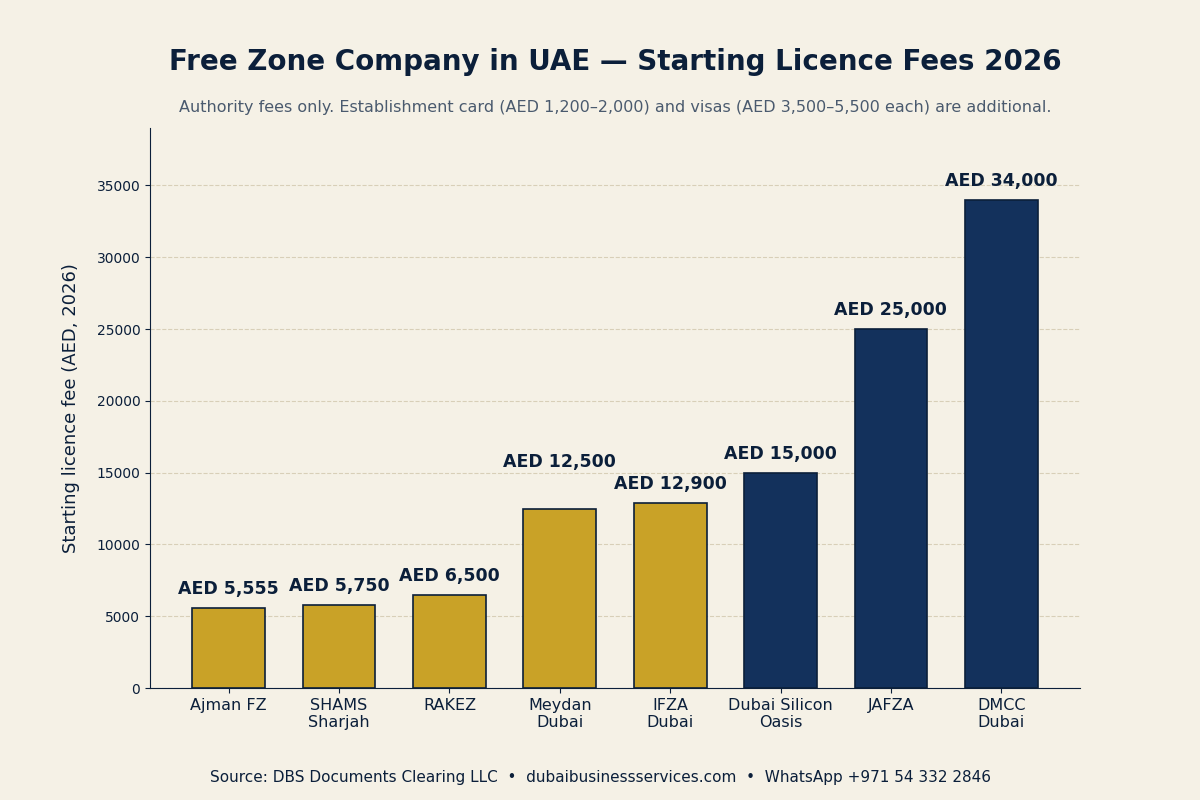
The figures below are 2026 free zone authority fees for a zero-visa or single-visa starter licence. Government and authority charges are published; DBS service fees are quoted per case because activity, visa count and shareholder nationality change the workload materially.
| Activity / Package | Government & Authority Fee (AED) | DBS Service | Total | Notes |
|---|---|---|---|---|
| Ajman Free Zone — service licence, 0 visa | 5,555 | WhatsApp for quote | From 5,555 | Lowest entry point in the UAE (2026) |
| SHAMS Sharjah — media/creative, 0 visa | 5,750 | WhatsApp for quote | From 5,750 | Fastest issuance; media activities only |
| RAKEZ — commercial licence, 1 visa | 6,500 | WhatsApp for quote | From 6,500 | Strong for light industrial and warehousing |
| IFZA Dubai — commercial, 0 visa | 12,900 | WhatsApp for quote | From 12,900 | Dubai address; broadest activity list |
| Meydan Free Zone — commercial, 0 visa | 12,500 | WhatsApp for quote | From 12,500 | Central Dubai; e-commerce friendly |
| Dubai Silicon Oasis — tech licence | 15,000 | WhatsApp for quote | From 15,000 | Tech and IT mandate |
| JAFZA — trading licence + warehouse | 25,000 | WhatsApp for quote | From 25,000 | Port access; customs-bonded storage |
| DMCC Dubai — commodities/crypto | 34,000 | WhatsApp for quote | From 34,000 | Premium tier; strongest banking acceptance |
| Investor visa (per person, 2 years) | 3,500 – 5,500 | WhatsApp for quote | Add per visa | Includes medical, Emirates ID, stamping |
| Establishment card (ICP) | 1,200 – 2,000 | Included | Add once | Required before any visa application |
Two cost traps recur. First, the advertised “from” price almost always excludes the establishment card and the visa allocation — a AED 5,555 licence becomes roughly AED 11,000 once one investor visa and the card are added (2026). Second, renewal is not discounted: budget the same authority fee every twelve months, plus a late-renewal penalty of AED 200 to AED 1,000 per month at most zones (2026).
For a side-by-side against the mainland route, compare these figures with our Dubai trade licence cost breakdown for 2026.
Want a quote? WhatsApp +971 54 332 2846 →
Corporate Tax: How the 0% Rate Actually Works
The headline is accurate and the fine print is where founders lose the benefit. A Qualifying Free Zone Person pays 0% corporate tax on qualifying income and 9% on everything else. Non-qualifying income is not ring-fenced — breach the threshold and the entire entity loses QFZP status for that tax period and the following four tax periods.
The De Minimis Rule
Non-qualifying revenue must stay below the lower of AED 5,000,000 or 5% of total revenue (Cabinet Decision No. 100 of 2023). A free zone company earning AED 20,000,000 in total revenue therefore has a de minimis ceiling of AED 1,000,000 — 5% of revenue, not the AED 5 million figure most founders quote back to us.
What Counts as Qualifying Income
- Transactions with other free zone persons, where that person is the beneficial recipient
- Manufacturing, processing and holding of goods or materials
- Fund, wealth and investment management under regulatory supervision
- Headquarter services and treasury or financing services to related parties
- Logistics, distribution from a designated zone, and reinsurance
Direct sales of services to UAE mainland customers are excluded. A Dubai free zone marketing consultancy invoicing mainland clients is generating non-qualifying income on every one of those invoices — and once that exceeds 5% of revenue, the 9% rate applies to the whole company.
Three Obligations That Are Not Optional
Every free zone entity must register for corporate tax with the Federal Tax Authority, file a return within nine months of financial year end, and maintain audited financial statements to claim QFZP status. Separately, VAT registration becomes mandatory once taxable supplies exceed AED 375,000 in any rolling twelve-month period, with voluntary registration available from AED 187,500 (2026). Our 0% vs 9% free zone trading breakdown works through the qualifying-income tests in detail.
Confused about this? Ask DBS — WhatsApp +971 54 332 2846 →
Documents Required for a Free Zone Company in UAE
Document rejection is responsible for the majority of timeline slippage we see. The list below is the 2026 baseline across IFZA, Meydan, RAKEZ, SHAMS and Ajman Free Zone.
Individual Shareholders
- Passport copy, valid for at least 6 months, colour scan of the photo page
- UAE entry stamp or current visa page, if already in the country
- Passport-size photograph on a white background, taken within 6 months
- Proof of residential address — utility bill or bank statement issued within 3 months
- Curriculum vitae, required by DMCC, DIFC and regulated-activity zones
- No Objection Certificate from a current UAE sponsor, where the applicant holds an employment visa
Corporate Shareholders
- Certificate of incorporation, attested and legalised
- Memorandum and Articles of Association, attested
- Board resolution authorising the UAE subsidiary and naming the signatory
- Certificate of good standing or incumbency, issued within 3 months
- Passport copies of all ultimate beneficial owners holding 25% or more
Attestation for foreign corporate documents runs through the issuing country’s notary, its foreign ministry, the UAE embassy in that country, and finally the UAE Ministry of Foreign Affairs. Budget 10 to 20 working days and AED 2,000 to AED 6,000 per document set (2026). DBS handles this leg through its PRO desk — see our PRO services in Dubai page.
Save 40 hours — let DBS handle it. WhatsApp +971 54 332 2846 →
Which Free Zone Fits Your Business Model
Most comparison tables rank free zones by price. That is the wrong axis. The right question is which authority’s mandate, banking reputation and visa economics match how you actually earn revenue. Of the 80,000+ business setups DBS has processed since 2009, 63% selected a free zone over the mainland route in 2025 — and the ones who later restructured almost always picked on price alone.
| Your Business Model | Best-Fit Free Zone | Why It Fits | Banking Difficulty |
|---|---|---|---|
| Solo consultant, no UAE clients | Ajman Free Zone / SHAMS | Lowest fee, qualifying income stays clean | Moderate |
| E-commerce, GCC delivery | Meydan / IFZA | Dubai address, e-commerce activity approved | Moderate |
| Physical goods import/export | JAFZA | Jebel Ali port, customs-bonded warehousing | Low |
| Commodities, gold, crypto | DMCC | Sector regulator, strongest bank acceptance | Low |
| Light manufacturing / assembly | RAKEZ | Industrial land at the lowest AED per sq ft | Moderate |
| Software, SaaS, IT services | Dubai Silicon Oasis | Tech mandate, developer visa pathways | Moderate |
| Media, film, design, publishing | SHAMS | Purpose-built media mandate, fast issuance | Higher |
| Holding company for group assets | DMCC / RAK ICC offshore | Substance rules met via headquarter services | Low |
The banking column matters more than the fee column. A licence from a low-cost northern-emirates zone is a legitimate UAE company, but tier-one UAE banks apply heavier scrutiny to those entities, and account opening can extend to 8 weeks or be declined outright. If a corporate account with a major bank is critical to your model, the higher licence fee at DMCC or JAFZA buys you a materially shorter path.
Free Zone or Mainland — The Deciding Test
Since Federal Decree-Law No. 26 of 2020, mainland companies also permit 100% foreign ownership for most activities, which removed the historic reason to default to a free zone. The decision now reduces to one question: who pays your invoices? If your customers are outside the UAE or inside other free zones, the free zone entity preserves 0% corporate tax on that income. If your customers are UAE mainland businesses and consumers, a mainland licence removes the de minimis ceiling entirely and lets you trade without a distributor.
Skip the paperwork — WhatsApp DBS at +971 54 332 2846 →
Free Zone Company in UAE: Cost Comparison at a Glance
Embed this infographic:
<a href="https://www.dubaibusinessservices.com/uae-free-zone-companies-benefits/"><img src="https://www.dubaibusinessservices.com/wp-content/uploads/2026/08/free-zone-company-in-uae-cost-comparison-infographic-dubai-2026.png" alt="Free zone company in UAE 2026 cost comparison | Dubai Business Services 2026" width="1200" /></a><br/>Source: <a href="https://www.dubaibusinessservices.com/uae-free-zone-companies-benefits/">Dubai Business Services</a>Frequently Asked Questions
How much does a free zone company in UAE cost in 2026?
Starting licence fees run from AED 5,555 at Ajman Free Zone to AED 34,000 at DMCC in 2026. Add AED 1,200–2,000 for the establishment card and AED 3,500–5,500 per investor visa. A realistic single-shareholder, one-visa budget is AED 11,000–18,000 for year one.
Can a free zone company do business in Dubai mainland?
Yes, through a mainland-licensed distributor, a commercial agent, or by opening a DET-licensed branch. Direct sales of services to mainland customers are permitted but generate non-qualifying income for corporate tax purposes, so they must stay under 5% of total revenue to preserve the 0% rate.
Do free zone companies pay 9% corporate tax in the UAE?
Only on non-qualifying income. A Qualifying Free Zone Person pays 0% on qualifying income under Cabinet Decision No. 100 of 2023, and 9% on the remainder above AED 375,000. Breaching the de minimis threshold forfeits QFZP status for that period and four subsequent tax periods.
How long does it take to register a free zone company in UAE?
A clean trading or consultancy licence is issued in 5 to 10 working days in 2026. Add 7 to 15 working days per investor visa for entry permit, medical fitness, Emirates ID biometrics and stamping. Corporate bank account opening runs a separate 3 to 8 weeks.
How many visas can a free zone company get?
Visa quota is tied to leased space, not to share capital. A flexi-desk supports 1 to 3 visas at most authorities in 2026, a 200 sq ft office supports 5 to 7, and larger allocations require proportionally more square footage. Some zones sell additional visa slots separately.
Which is the cheapest free zone in the UAE?
Ajman Free Zone at AED 5,555 and SHAMS Sharjah at AED 5,750 are the lowest entry points in 2026. Both are legitimate UAE licences, but tier-one banks apply heavier compliance review to entities from these zones, which can extend account opening beyond 8 weeks.
Do I need to be in the UAE to set up a free zone company?
No. Most free zones accept remote incorporation under a notarised and attested Power of Attorney, and several complete the entire process digitally. You must, however, enter the UAE in person for medical fitness testing and Emirates ID biometrics if you intend to take a residence visa.
Does a free zone company need audited financial statements?
Yes, if it intends to claim Qualifying Free Zone Person status. Audited financials are a stated condition under Ministerial Decision No. 265 of 2023, alongside FTA corporate tax registration and adequate substance in the free zone. Several authorities, including DMCC and JAFZA, require audits for licence renewal regardless.
Start Your Free Zone Company with DBS
DBS Documents Clearing LLC has registered companies across every major UAE free zone since 2009, for more than 80,000 entrepreneurs. We select the authority that matches your revenue model, file the application, clear the attestations through our PRO desk, and stay with you through banking and FTA registration.
WhatsApp +971 54 332 2846 for a same-day quote, or email inquiry@dubaibusinessservices.com. Run your own numbers first with our business setup cost calculator.
Official Sources
- Federal Tax Authority (FTA) — corporate tax and VAT registration
- UAE Ministry of Finance — Cabinet Decision No. 100 of 2023 and free zone tax guidance
- The Official Portal of the UAE Government — directory of UAE free zones
Written by Salem Basheer, DBS Documents Clearing LLC. Last updated: 2026-08-27.